
Chairman’s Removal Leaves Thai Telecom and Broadcasting Facing Paralysis and Power Struggles
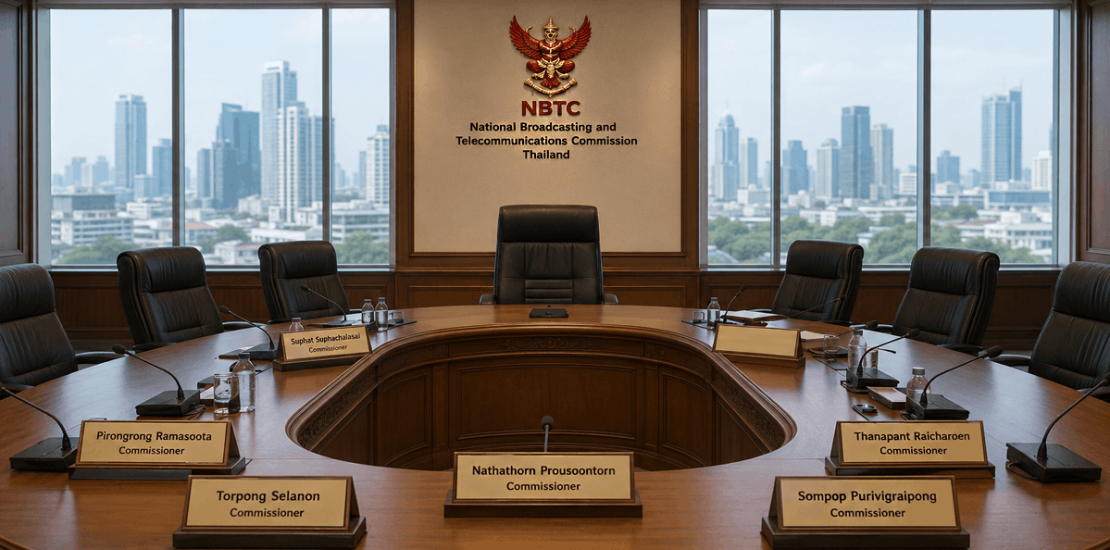
Thailand’s telecom regulator faces paralysis following the disqualification of NBTC Chairman Dr. Sarana
Thailand’s national broadcasting and telecommunications regulator (NBTC) faces regulatory paralysis following the unanimous 4-0 ruling by the Senate selection committee to disqualify NBTC’s Chairman Dr. Sarana Boonbaichaiyapruck. The decision follows formal complaints regarding his qualifications under Thai law, and Dr. Sarana is now expected to leave office.
The removal plunges the commission into a state of structural paralysis. To understand the severity of this shift, one must look at the board’s history, particularly during the controversial merger between True and DTAC.
During the October 2022 True-DTAC merger review, the board functioned with only five members because the selection process was slow and had not found the remaining two commissioners.
The initial vote resulted in a 2-2 tie between participating members.
Chairman Dr. Sarana and Commissioner Torpong Selanon voted in favor.
Professor Dr. Pirongrong Ramasoota and Associate Professor Dr. Suphat Suphachalasai voted against, while Air Marshal Thanapant Raicharoen abstained.
Dr. Sarana then invoked Article 41 of the NBTC Meeting Rules and Regulations to cast a deciding vote, pushing the outcome to a 3-2 majority approval to “acknowledge” the merger.
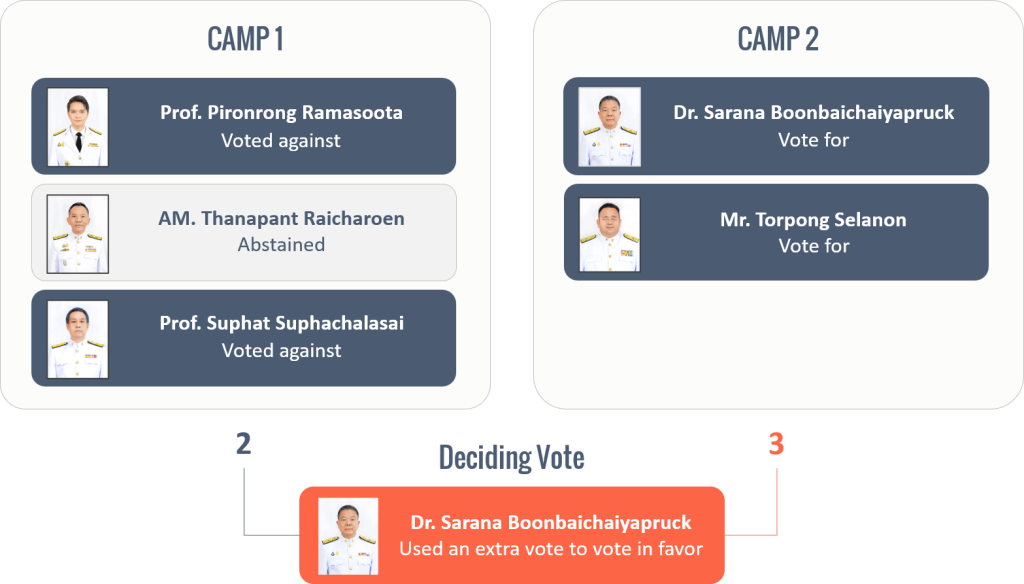
The board has famously been fractured into two opposing camps since, which often resulted in 2-3 or 3-3 deadlocks and the reliance on a chairman’s casting vote became a hallmark of the board’s deep factional splits, mirroring later debates over executive authority and administrative appointments.
While the tactical tie-break in meetings relied on internal bylaws like Article 41, broader executive overreach disputes often invoked Section 61 of the NBTC Act regarding administrative powers.
Article 41 of the NBTC Meeting Rules and Regulations (2012): This is the specific procedural rule the chairman actually cited during meetings. It states that if a vote results in a tie, the chairman of the meeting may cast an additional deciding vote. This was the exact mechanism used to break even-split deadlocks (such as 2-2 or 3-3 ties) during high-stakes decisions like the True-DTAC merger.
Section 61 of the NBTC Act: This is a statutory provision in the parent law (Frequency Allocation Act) that outlines the administrative powers regarding the appointment and removal of the secretary-general. While related to executive authority, the broader debate involved whether the chairman could stretch these administrative powers or internal meeting bylaws to unilaterally push through major decisions against a majority of the board.
With Dr. Sarana’s exit, this tie-breaking power is still a question.
The NBTC Board Split
The internal divide within the NBTC board has been a defining feature of its governance, clearly documented in most meeting minutes. The board has essentially operated in two distinct camps.
The first group has consistently included commissioners Pirongrong Ramasoota, Suphat Suphachalasai, and Thanapant Raicharoen.
The second camp has typically consisted of Dr. Sarana, Torpong Selanon, and Pol. Gen. Dr. Nathathorn Prousoontorn, who arrived after the True Dtac voting controversy.
The latest member to join was Assoc. Prof. Sompop Purivigraipong who became the seventh commissioner taking part in board meetings by March 2023.
However, the political and voting dynamics of the board have remained fluid rather than static. Commissioner Sompop Purivigraipong, who was initially aligned with the first group in many of his votes, has shifted his stance, voting on several matters alongside the second camp led by Dr. Sarana, Torpong Selanon, and Nathathorn Prousoontorn.
This shifting alignment reveals a board struggling to maintain a stable majority, with meeting minutes serving as a clear record of these persistent fractures and agenda items delays for years.
A Four-Year Fight Finally Reaches a Verdict
The ruling on the Chairman did not come out of nowhere. The qualification challenge against Dr. Sarana had been simmering for years, but it accelerated sharply in 2026.
In April, the National Anti-Corruption Commission wrote to the NBTC asking pointed questions about who had the authority to verify the chairman’s qualifications and what should happen if he were found disqualified – a signal that a long-dormant complaint was being taken seriously at the highest levels.
By May, the Senate’s original NBTC selection committee had reconvened and ruled, in a closed-door session, that it still retained the authority to judge the chairman’s qualifications even though its own term had technically lapsed.
That fight has now been resolved, at least at the committee level. The 4-0 finding is not final. Dr. Sarana’s departure still requires the PM to hand over the case for royal endorsement, but it is widely read in Bangkok as the effective end of his chairmanship.
Why Losing the Tie-Breaker Matters So Much
The mechanics of the NBTC’s decision making are the real story here, and they explain why this ruling is being described in terms of paralysis rather than simple leadership change.
Thai law envisions a seven-member commission. In practice, the board has spent much of its early history operating below that number, and the five and six-member configuration has a well-documented failure mode: Even splits.
Dr. Sarana’s use of a chairman’s tie-breaking vote to push resolutions through was one of the most contested aspects of that whole episode, criticized by rival commissioners and outside observers as an aggressive reading of his powers under the NBTC Act.
What happens to that tool now is genuinely unclear. The reporting available confirms Dr. Sarana asserted a tie-breaking vote under Section 61 of the NBTC Act in at least one specific dispute (the secretary-general selection process) and that other commissioners disputed whether he was entitled to use it that way in the first place.
It was contested even while he held it. What isn’t clear from public records is whether that power is a general, transferable feature of the chairmanship that a successor would simply inherit, or something narrower that dies with the circumstances of his tenure.
Thai regulatory bodies typically elect a new chair from among the remaining commissioners, so if Article 41 and Section 61 does grant the chair a standing tie-break authority, whoever takes over could plausibly claim the same power.
That ambiguity is arguably the more interesting problem. Rather than a clean structural gap, the board now faces an open question about the legitimacy of a mechanism that was already controversial, on top of a fresh vacancy, a six-member roster, and a documented history of 3-3 splits. Whether a new chair asserts, abandons, or has that power challenged outright is something to watch, not something this ruling settles on its own.
What's Stuck in the Pipeline
The NBTC’s paralysis lands at a genuinely inconvenient moment for Thailand’s telecom and broadcasting sectors. Several issues have already been described by industry analysts as stalled by the years-long infighting on the board, including:
Spectrum and satellite matters: Orbital slot allocation and spectrum management, both central to the NBTC’s mandate and both consequential for operators’ network investment plans, have been cited as areas where board dysfunction has produced delay, with critics arguing auction conditions have tended to favor incumbent operators.
A secretary-general post that’s been acting for over five years, itself a casualty of the same chairman-versus-board dispute described below.
MVNO market entry: Frozen through more than 55 agenda postponements before reaching a public hearing this month after a 4:3 vote, due to Sompop Purivigraipong joining the group of Dr. Sarana, Torpong Selanon, and Pol. Gen. Dr. Nathathorn Prousoontorn.
Digital economy coordination: Because the NBTC is legally required to align its resource-management decisions with broader government digital economy policy, prolonged board dysfunction risks friction with the Prime Minister-chaired National Board of Digital Economy and Society, which has the power to summon the regulator for direct policy instruction.
Ongoing litigation involving commissioners: The board has been described as entangled in a web of lawsuits involving multiple sitting members, adding legal noise on top of the qualification dispute itself.
For operators such as AIS and True Corporation, the risk isn’t confined to future decisions. The True/DTAC merger is not the closed chapter it might appear to be.
The Central Administrative Court dismissed the Thailand Consumers Council’s challenge to the NBTC’s approval, but the Council has pursued an appeal to the Supreme Administrative Court, arguing the merger left the market with an effective duopoly and that the NBTC failed to protect competition.
That case is still working its way through the courts, which means the NBTC’s own conduct – including how a fractured, chairman-less board handles its role in any related proceedings – could itself become part of the story rather than just a bystander to it.
On top of that, new regulatory approvals, license renewals, and spectrum-related decisions requiring board consensus become harder to secure without a functioning chair. Broadcasters face a parallel risk on content licensing and digital-terrestrial TV matters that also sit with the commission.
A Regulator Already Missing Its Top Administrator
The chairmanship is not the only leadership gap at the NBTC. The organization has gone without a permanent secretary-general (its top administrative post) since Takorn Tantasith’s term ended in September 2020. Trairat Viriyasirikul, then deputy secretary-general, has run the office in an acting capacity ever since, now well past five years.
Dr. Sarana was directly at the center of the failed attempts to fill that vacancy.
According to a detailed timeline published on X after the ruling by Rukchanok Srinork, a member of parliament and one of the complainants behind the original Chairman qualification challenge, the board actually began a standard selection process for the post back in May 2022, asking the NBTC Office to draft recruitment criteria for the board’s approval.
That process stalled for nearly a year until a special March 2023 board meeting, where Dr. Sarana informed the other commissioners that he considered the appointment and removal of the secretary-general to fall under his own authority as chairman, meaning he, not the board, would run the recruitment and simply bring a name back for an up-or-down vote.
Several commissioners objected on the spot, arguing the board had always run selections jointly from start to finish.
Dr. Sarana proceeded anyway, issuing his own recruitment notice later that month. Nine candidates, including Trairat, presented their credentials to the board but only as a formality, since Dr. Sarana alone scored them.
On January 17, 2024, he brought Trairat’s name to the board for approval. The board’s majority voted him down. Trairat then sued the other members, arguing the process that led to his rejection was improperly conducted, a lawsuit that effectively froze the board’s ability to restart a new selection while it was pending.
The court ultimately dismissed the case, but by then years had passed. Separate reporting has also described that January 2024 board vote as a 4-3 split, with commissioners Pirongrong Ramasoota, Air Marshal Thanapant Raicharoen, Suphat Suphachalasai, and Sompop Purivigraipong in the majority against Dr. Sarana’s pick – consistent with the recurring factional lineup described above.
Trairat remains acting secretary-general today, heading into his sixth year in the role despite the position’s term limit being five years – meaning the NBTC now heads into a leaderless chairmanship with its senior administrative post still informally held as well.
In Rukchanok’s own framing, posted publicly after the July 17 ruling, she argued the effort to clean up the NBTC should not stop with Dr. Sarana, and that Trairat’s prolonged acting status is next in line for scrutiny.
One further nuance from her account is worth flagging rather than glossing over. She describes the selection committee’s ruling as holding that Dr. Sarana is to be treated as though he never held the chairmanship at all, which she herself simplifies as equivalent to ordinary removal.
Whether that phrasing carries any retroactive legal effect on decisions made during his tenure (including the True–DTAC tie-break vote) is not something this article can resolve from a single social media account, but it is a distinction worth watching.
Years of Gridlock on MVNOs, Now Laid Bare
Nowhere has the board’s internal split been more visible or more consequential for the market than in its handling of Mobile Virtual Network Operator (MVNO) regulation.
According to industry trackers, a draft notification meant to open Thailand’s networks to MVNOs was postponed at board meetings more than 55 times over roughly two years after first appearing on the agenda in mid-2024, effectively freezing the entry of new, non-facilities-based mobile competitors into a market already dominated by AIS and True.
The board finally cleared the draft for public hearing in mid-2026, with the consultation running from June 21 to July 22 and a hearing session held on July 1.
But the way the NBTC announced that hearing became a story in itself.
Rather than issuing the customary neutral procedural notice, the commission’s public announcement disclosed the internal vote breakdown, naming which commissioners had supported moving forward and which had dissented – an unusually candid and unprecedented admission that the draft reflected a bare majority push-through rather than consensus.
Industry commentary at the time noted this fits a longer pattern. The same rough two-camp alignment that produced splits during the True/DTAC merger and the secretary-general fight has continued to shape regulatory work, including spectrum auction conditions that favored the two dominant incumbents.
Who Might Chair the NBTC Board Next - And Does It Even Matter?
There is a version of this story in which the July 17 ruling changes very little in practice. If a successor chair simply inherits and exercises the same tie-break authority Dr. Sarana claimed, a 3-3 split becomes 4-3 again.
The same voting pattern that defined the merger years, just with a different hand on the extra vote. On that reading, removing the chairman doesn’t fix the board’s structural problem, it just resets who benefits from it.
Which makes two questions more important than the removal itself: Who becomes the next chair, and where does Sompop Purivigraipong’s vote land?
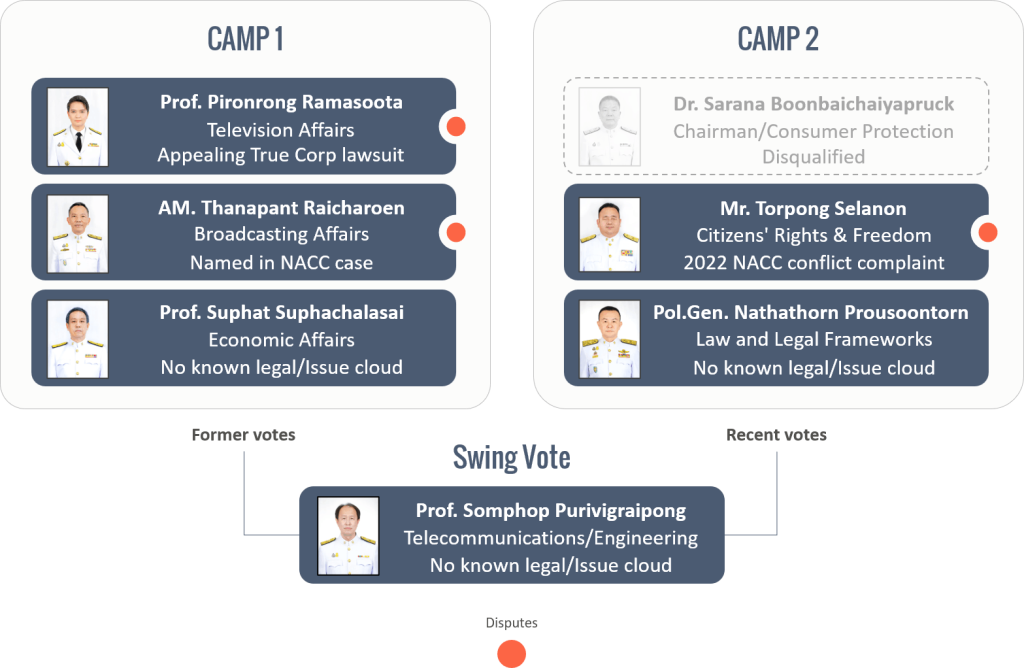
On the first question, some of the six remaining commissioners look like less obvious candidates than others, for reasons already on the public record:
Pirongrong Ramasoota is currently appealing a two-year prison sentence stemming from a lawsuit True Digital Group brought against her—a case still unresolved.
Thanapant Raicharoen was one of four commissioners named as a co-defendant in a lawsuit Trairat filed over his removal as acting secretary-general, tied to a separate controversy over 600 million baht in World Cup broadcast-rights funding, a court acquitted all four in April 2025, but the episode still ties him to that dispute.
He also carries an older, separate allegation. In May 2025, Thailand’s National Anti-Corruption Commission formally notified him and several others – including a former NBTC chairman, a former secretary-general, and Trairat, who was then deputy secretary-genera – of allegations in a procurement case involving roughly 158 million baht across two NBTC information-technology contracts. The conduct in question dates back to 2012, when Thanapant served on the NBTC chairman’s staff rather than as a commissioner.
It is worth being precise about where the case actually stands. A formal NACC notice of allegations means investigators found enough evidence to proceed, not that guilt has been established, the NACC’s own case file notes that everyone named remains legally presumed innocent while the matter is still at the stage of allowing the accused to respond, with no finding of wrongdoing yet made.
Still, the fact that both a sitting commissioner and the long-serving acting secretary-general appear in the same unresolved procurement case adds another layer to the pattern of unresolved legal questions trailing the board.
Torpong Selanon, who is blind and has built his NBTC career around disability rights, brings a different kind of expertise than the technical telecom or broadcasting background the role has often gone to – and he carries his own unresolved cloud.
During the True/DTAC merger fight, Move Forward Party lawmaker Sirikanya Tansakun filed a formal complaint with the National Anti-Corruption Commission alleging Torpong had a conflict of interest that should have barred him from voting on the deal at all.
She pointed to his position on a committee tied to the CP Group-led consortium behind the Bangkok high-speed rail project linking three airports, arguing that since CP Group is True Corporation’s parent, the connection was disqualifying.
That complaint was an allegation, not an adjudicated finding, and it hasn’t removed Torpong from the board or blocked his vote but it’s part of the same pattern of unresolved conflict questions hanging over multiple commissioners.
Pol Gen Nathathorn Prousoontorn holds the board’s law seat but comes from a police background rather than telecom or broadcasting.
Suphat Suphachalasai, who, notably, joined Pirongrong as one of only two commissioners to vote against the True-DTAC merger in 2022, and Sompop Purivigraipong.
Which brings the piece back to Sompop. His vote has reportedly moved between the two camps on recent matters, and where it settles now that Dr. Sarana is gone is arguably the single most consequential open question for the board’s direction – more consequential, in practical terms, than the removal ruling itself.
Does his realignment hold, effectively handing a working majority to the camp that includes Dr. Sarana’s old allies? Or does it revert, restoring the four-member bloc that includes Pirongrong, Thanapant, and Suphat?
Neither this article nor the public record can currently answer that. But it’s the question worth watching most closely.
Four Things to Keep an Eye Out For
Royal Endorsement: Dr. Sarana’s departure is not legally final until it clears this step.
Leadership and Authority: The remaining six commissioners must organize themselves and decide if a new chair claims the same tie-breaking authority.
The Seventh Member: Finding and approving a new commissioner historically involves years of delays.
Revisiting Past Board Resolutions: The removal of the chairman raises immediate questions about whether the board will revisit previous cases that were decided by split votes.
According to points raised by former NBTC commissioner Dr. Prawit Leesathapornwongsa, the legal stability of past decisions depends heavily on how they were originally won.
Decisions passed by a clear majority, meaning a margin of more than one vote, are expected to remain secure under standard administrative law principles.
In contrast, controversial decisions that were won by a single vote, or tied outcomes that relied entirely on the chairman’s disputed tie-breaking vote, are highly vulnerable to being reopened and reviewed.
The prime target for such a review is the True-DTAC merger, which remains the most heavily scrutinized decision in the commission’s history. However, actually revisiting these split-vote cases faces a massive hurdle.
Dr. Prawit notes that reopening past landmark resolutions requires a strict supermajority of at least two-thirds of the remaining commissioners. Because the active board has spent years deeply fractured into opposing camps, achieving this level of consensus requires an exceptional amount of political unity.
Whether the remaining members possess the willingness or the cooperation needed to meet this high threshold is highly uncertain. If they do find the unity to revisit these cases, it would trigger a massive shift in the regulator’s internal power structure and create widespread waves across the telecom sector.
For now, the headline fact is simple and consequential: Thailand’s telecom and broadcasting regulator has lost both its chairman and the mechanism it relied on to break deadlocks, at a moment when it already had a backlog of high-stakes decisions waiting on a board that struggles to agree …and they are also still looking for a second-in-command.
LATEST MVNO NEWS