
What Is a Carrier of Record (CoR)?

Quick Summary
A Carrier of Record (CoR) is a commercial term, not a formally recognized telecommunications industry classification, used by some software platforms to describe a managed connectivity arrangement. Under this model, the provider assumes the wholesale, regulatory, and operational functions a company needs to launch a mobile service. Unlike MVNO, MVNE, and MVNA, the term has no standard definition, no regulatory framework, and no recognized place in the established MVNO ecosystem.
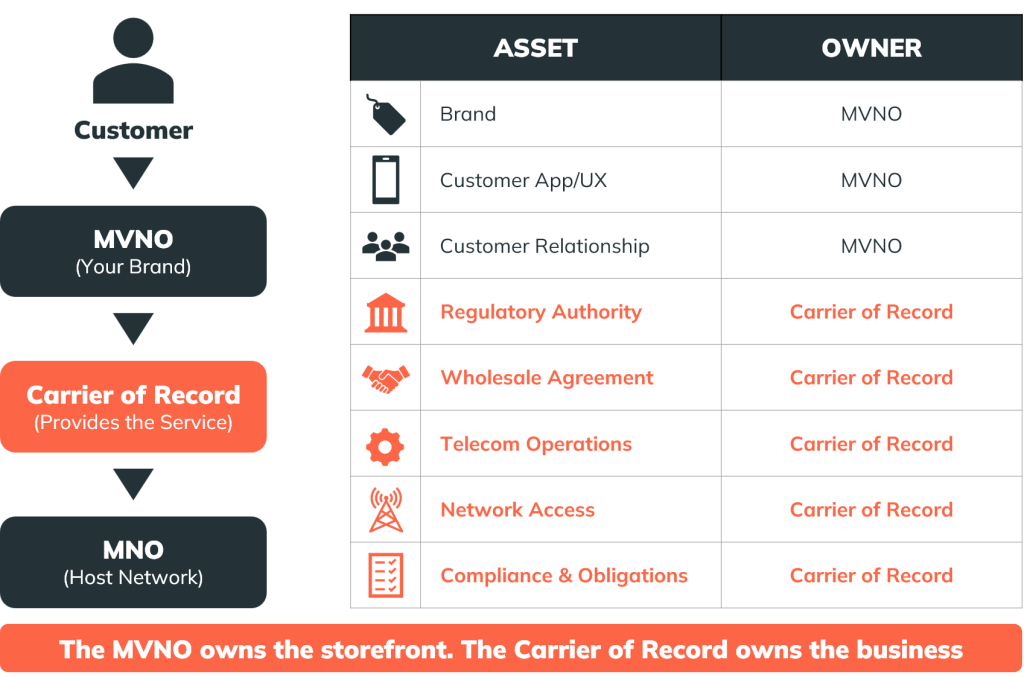
For the MVNO or brand, the appeal is speed. Carrier-of-Record platforms package wholesale access, provisioning, billing, compliance support, and operational services into a single commercial relationship, reducing the need to build telecom expertise in-house. The trade-off is that several functions and assets traditionally owned by the MVNO instead remain with the provider.
Key facts at a glance:
- Not an industry standard: Unlike MVNO, MVNE, and MVNA, “Carrier of Record” is a marketing term with no agreed definition, regulatory category, or recognized architecture.
- Repackages existing functions: the services sold under the CoR label are largely the wholesale access, enablement, and operational functions long delivered by MVNEs, managed service providers, and wholesale aggregators.
- Speed over ownership: CoR arrangements prioritize fast market entry; in exchange, the brand typically does not hold the regulatory authorization, wholesale agreements, or subscriber identity.
- Concentrated dependency: because one provider holds the regulatory, technical, and commercial functions, operational, financial, and regulatory risk is concentrated in a single relationship.
- Migration is hard: subscriber identity, numbering, and compliance frameworks are often tightly bound to the provider’s platform, making an exit far more complex than switching a software vendor.
For the full breakdown – what Carrier of Record providers typically deliver, how the model compares with MVNA/MVNE and Full MVNO, and the advantages and disadvantages MVNOs should weigh – read on below.
The term Carrier of Record (CoR) has gained traction in recent years among software platforms and API-driven companies that want to position a managed connectivity offering as more turnkey than a standard wholesale or enablement relationship. It typically describes an arrangement in which a platform provider assumes the wholesale, regulatory, and operational functions a company needs to launch a mobile service.
As the Quick Summary above notes, this is a commercial label rather than an established telecommunications classification – there is no governing body, licensing category, or technical standards body that defines what a Carrier of Record must provide.
The rest of this guide maps what providers typically bundle under the term, how it compares with the recognized MVNA, MVNE, and Full MVNO models, and what that gap in standardization means in practice for the brand signing the contract.
Why Did the Carrier-of-Record Model Emerge?
Telecommunications has traditionally been one of the world’s most regulated and operationally complex industries.
Launching a mobile service typically requires wholesale network agreements, subscriber management systems, provisioning platforms, customer support capabilities, billing systems, fraud controls, roaming arrangements, and compliance with numerous regulatory obligations.
The industry has historically addressed this complexity through established models such as MVNAs, MVNEs, managed service providers, and Full MVNOs, each with clearly understood roles, rules, and responsibilities within the mobile ecosystem. The capabilities associated with Carrier-of-Record providers are derived from the same functions delivered through MVNEs, managed service providers, wholesale aggregators, and hosted MVNO platforms – repackaged under a new label.
Carrier-of-Record Regulatory Context
The emergence of Carrier-of-Record providers has coincided with the liberalization of telecommunications markets and the reduction of traditional barriers to MVNO entry in many jurisdictions.
Telecommunications services are provided by operators working within clearly defined regulatory and industry frameworks. Mobile Network Operators (MNOs), MVNOs, MVNEs, and MVNAs evolved with well-understood roles, responsibilities, rules, and operational boundaries.
Across much of Europe, MVNOs no longer require the type of telecommunications licenses historically associated with operating communications services. Instead, market access is often achieved through commercial agreements with network operators and compliance with applicable regulatory obligations.
This environment has enabled providers to market telecommunications services outside the established MVNO, MVNE, and MVNA classifications, under marketing terms such as Carrier of Record. Carrier of Record therefore remains distinct from the recognized industry models that underpin the global MVNO ecosystem.
What Does a Carrier of Record Typically Provide?
Carrier-of-Record providers typically sell a combination of technology, regulatory, operational, and commercial services delivered through a managed platform arrangement. Services may include:
- Wholesale network access
- SIM and eSIM provisioning
- Subscriber onboarding and activation
- Billing and charging platforms
- Number management
- Roaming services
- Regulatory and compliance support
- API-based integration capabilities
- Reporting and analytics
Examples of Carrier-of-Record Providers
Examples of Carrier-of-Record providers include software platforms that enable banks, fintechs, travel companies, retailers, and digital brands to launch mobile services.
These providers typically combine wholesale network access, subscriber management, regulatory support, and operational services into a single commercial offering. In doing so, they assume responsibility for many of the telecommunications functions that would traditionally be performed by an MVNO or managed through an MVNE relationship.
Unlike traditional MVNEs, however, Carrier-of-Record providers often package these capabilities as an end-to-end managed service, with varying degrees of operational, regulatory, and commercial responsibility depending on the provider and market.
Because the term carries no fixed scope, the services included differ significantly from one provider to the next. MVNOs and customer-facing brands evaluating these platforms should carefully assess which responsibilities remain under their own control and which are delegated to the provider.
Is a Carrier of Record the Same as an MVNE?
Although there is often overlap between the services provided by Carrier-of-Record platforms and traditional Mobile Virtual Network Enablers (MVNE), the two concepts are not identical.
An MVNE is a recognized telecommunications industry model that provides the infrastructure, platforms, and operational services required to enable MVNOs. MVNEs operate upstream from the MVNO and do not own the retail customer relationship; instead, they provide the technical capabilities that allow MVNOs to launch and manage services.
Carrier-of-Record providers extend beyond the MVNE role by offering a managed commercial arrangement that absorbs functions that would normally be performed by the MVNO itself. The distinction is less about technology and more about commercial structure and operational responsibility which is one of the primary reasons the term remains controversial within the telecommunications industry and among regulatory authorities.
Carrier of Record vs MVNA/MVNE vs Full MVNO
Table: Feature comparison across Carrier of Record, MVNA/MVNE, and Full MVNO
Advantages of the Carrier-of-Record Model
- Faster time to market: Carrier-of-Record platforms can reduce the time required to launch a mobile service by providing access to existing MNO agreements, infrastructure, and operational processes.
- Reduced internal telecom operations: because the provider performs the telecommunications functions, the MVNO has less need to build internal telecom teams, operational processes, and specialized technical expertise.
- API-based integration: Carrier-of-Record providers offer software interfaces and integration tools that allow connectivity services to be incorporated into existing applications, customer journeys, and digital products.
- Focus on commercial activities: by outsourcing much of the operational responsibility, brands can focus more heavily on customer acquisition, marketing, distribution, product packaging, and customer experience.
- Simplified supplier management: the model can reduce the number of direct supplier relationships a company must manage by consolidating multiple telecommunications functions under a single commercial agreement.
Disadvantages of the Carrier-of-Record Model
Reduced Operational Independence
The primary trade-off of the Carrier-of-Record model is reduced operational independence. While the MVNO may own the app, marketing, and customer experience, the underlying telecommunications capabilities, license, and operations remain dependent on the platform provider. Unlike a traditional MVNO or Full MVNO strategy, the Carrier-of-Record model leaves critical elements of the mobile operation under the control of a third party, limiting the MVNO’s ability to independently manage, evolve, differentiate, or control its mobile service.
Dependency on a Single Provider
Carrier-of-Record platforms consolidate regulation, legal, wholesale access, subscriber management, compliance support, provisioning, billing, and operational functions into a single provider relationship. While this can accelerate deployment, it also concentrates operational, commercial, technical, and regulatory risk within one supplier. If the provider experiences technical issues, financial distress, regulatory intervention, a strategic change, a commercial dispute, an acquisition, or service discontinuation, the customer-facing brand may have limited alternatives available — in many cases with no direct relationship to the underlying network operator and no independent path to maintain service continuity.
Limited Control Over Network Policies
Many MVNOs enter the market to create differentiated products and customer experiences through network-based capabilities such as:
- Zero-rated applications
- Quality of Service (QoS) policies
- Traffic prioritization
- Subscriber-specific charging rules
- Enterprise connectivity features
- Security policies
- IoT-specific network configurations
In Carrier-of-Record models, access to these capabilities is often dependent on the provider’s architecture, roadmap, commercial priorities, and technical limitations. As a result, the MVNO may be constrained by decisions made by the platform provider rather than by its own commercial strategy.
Portability and Migration Challenges
Migrating away from a Carrier-of-Record provider may be significantly more complex than changing a software vendor. Subscriber identities, provisioning systems, operational processes, wholesale agreements, numbering resources, compliance frameworks, and customer lifecycle management may be tightly integrated with the provider’s platform. Transitioning to another provider can therefore require substantial operational effort, customer migration programs, technical redevelopment, and commercial renegotiation, and in some cases, the practical ability to migrate may be far more limited than initially assumed.
Lack of Ownership of Critical Telecom Assets
One of the most significant strategic limitations of many Carrier-of-Record arrangements is that the customer-facing brand may not own or directly control key telecommunications assets. Depending on the provider structure, this may include subscriber identity management, numbering resources, wholesale agreements, network policies, and operational processes – the elements that form the foundation of the mobile service. As the business grows, this can create a disconnect between ownership of the customer relationship and ownership of the telecommunications operation itself.
Unclear Industry Definition
Because the term carries no fixed scope, comparing two Carrier-of-Record proposals can mean comparing genuinely different bundles of responsibility, risk, and control there is no shared standard to benchmark against. This makes it harder for MVNOs and brands to compare solutions, assess risk, and determine the level of control they will ultimately possess, since the same label can describe materially different arrangements depending on the provider.
Regulatory and Compliance Dependency
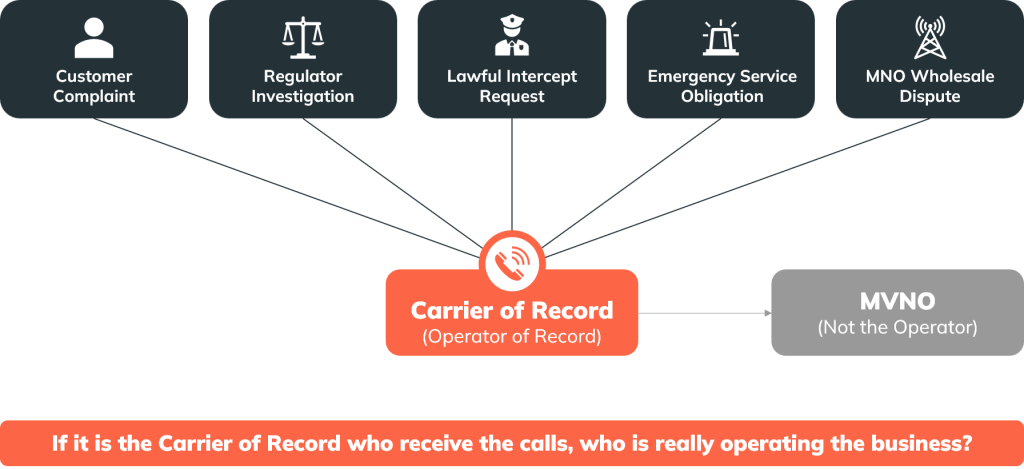
Although regulatory obligations may be managed by the provider, the customer-facing brand remains exposed to the consequences of regulatory issues affecting that provider. If regulatory authorizations, compliance processes, wholesale agreements, numbering resources, or network relationships are disrupted, the customer facing service may also be affected. Outsourcing responsibility does not eliminate exposure to regulatory or operational risk.
Strategic Lock-In
As a mobile business grows, the limitations of a highly managed platform model often become more apparent. MVNOs may find themselves constrained by the provider’s technical roadmap, commercial model, integration capabilities, operational structure, and willingness to support specialized requirements. What initially accelerated market entry may later become a barrier to achieving greater telecommunications independence.
Business Continuity Risk
A frequently overlooked risk is that the long-term viability of the mobile service becomes closely tied to the viability of the Carrier-of-Record provider itself. If the provider exits the market, changes strategy, is acquired, encounters financial difficulties, loses key wholesale agreements, or becomes subject to regulatory action, the MVNO may have limited options available. Because the underlying telecommunications operation is frequently controlled by the provider, rebuilding the service elsewhere may require significant migration effort and customer disruption.
Industry Perspective
Critics of the Carrier-of-Record approach argue that it prioritizes speed-to-market and commercial simplicity over long-term operational control and telecommunications independence.
A common criticism is that the model doesn’t solve a new telecommunications problem so much as rebrand functions the industry already delivers through other channels, packaged for companies that may not be fluent in the underlying distinctions between an MVNE, an MVNA, and a wholesale agreement.
For businesses evaluating the model, the practical test isn’t whether the brand looks independent — most CoR-powered apps look identical to a Full MVNO from the outside. It’s which specific functions sit in the brand’s contract versus the provider’s, and what happens to each one if that provider relationship ends.
For businesses where connectivity is a core strategic product rather than a value-added service, the level of dependency created by the model should be carefully evaluated. As with any MVNO strategy, companies should understand which parts of the business they own, which parts they control, and which parts remain dependent on external providers.
Strategic Considerations
MVNOs evaluating a Carrier-of-Record solution should carefully understand:
- Which parts of the operation they own
- Which capabilities they directly control
- Which functions remain dependent on the platform provider
- How subscriber identity is managed
- Who controls numbering resources
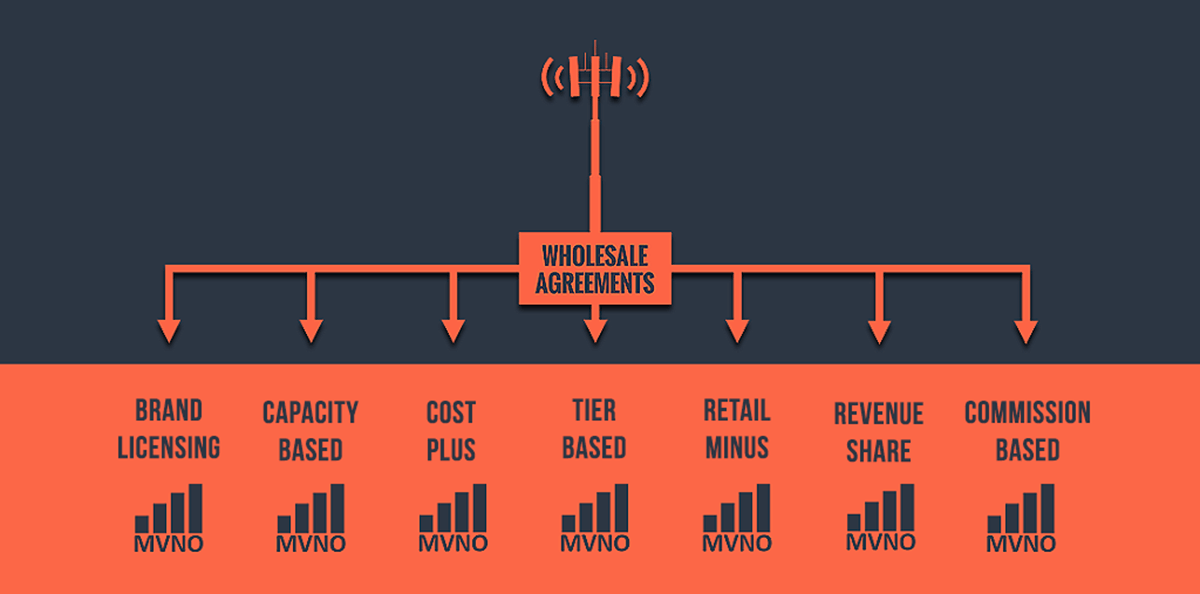
- Who owns the wholesale relationship
- Whether subscriber data can be ported elsewhere
- How easily services can be migrated if business requirements change
- What happens if the provider exits the market
These considerations become increasingly important as mobile services evolve from customer-acquisition tools into strategic products that form part of a broader digital ecosystem.
Carrier of Record – Frequently Asked Questions
Is Carrier of Record a recognized telecommunications industry model?
No. Unlike MVNO, MVNE, MVNA, and Full MVNO, Carrier of Record has no standard definition, no regulatory framework, and no recognized place in established industry classifications. It is a commercial term some providers use to describe a managed connectivity offering.
What is the difference between a Carrier of Record and an MVNE?
An MVNE is a recognized industry role: it provides the platforms and infrastructure that let an MVNO operate, while the MVNO keeps the customer relationship and operational responsibility. A Carrier of Record typically takes on more than that — including regulatory standing and the wholesale relationship itself — which is part of why the two terms sometimes get used interchangeably, even though what “CoR” actually includes varies by provider.
Does the brand own the customer relationship under a Carrier-of-Record model?
Often, yes — the brand may own the app, the marketing, and the customer experience. However, ownership of the customer relationship is not the same as ownership of the telecommunications operation. The regulatory authorization, wholesale agreements, and subscriber identity typically remain with the Carrier-of-Record provider.
What happens if a Carrier-of-Record provider exits the market or fails?
It depends on what’s written into the contract, but in most CoR arrangements the brand has limited fallback options, since the regulatory standing and wholesale relationships sit with the provider rather than the brand. See “Business Continuity Risk” above for what that exposure typically looks like.
Can an MVNO easily switch away from a Carrier-of-Record provider?
Generally, no — and this is one of the most underestimated risks of the model. See “Portability and Migration Challenges” above for what’s typically involved.
Why do fintechs and other brands choose the Carrier-of-Record model?
The model offers a fast route to market by packaging wholesale access, provisioning, billing, and regulatory support into a single commercial relationship, reducing the need to build internal telecom expertise. This speed comes with a trade-off: reduced operational independence and dependency on a single external provider for critical telecommunications functions.
See how the Carrier-of-Record model compares to the Mobile Virtual Network Enabler (MVNE), Mobile Virtual Network Aggregator (MVNA), or Full MVNO model in your MVNO Types & Operational Models guide.
Summary
Carrier of Record isn’t a formal telecommunications standard or recognized operating model – it’s a commercial label some providers use for a managed connectivity package built from capabilities the industry already delivers through MVNEs, wholesale aggregators, and managed service providers.
While the model can accelerate market entry and reduce the need to build internal telecommunications operations, it can also introduce significant dependency on third-party providers, reduced operational control, portability challenges, and long-term strategic lock-in.
The key distinction is that Carrier of Record prioritizes simplicity and speed-to-market, while traditional MVNO, MVNE, and Full MVNO models are generally designed to provide greater operational control, ownership, portability, and long-term telecommunications independence.





LET’S TALK MVNO
If you have any questions, please fill out the form and a member of our team will get in touch with you. We are always open for talks on how we can add value to your MVNO.