What is a Sub-brand MVNO? Strategy, History, and Lessons
Quick Summary
A Sub-brand MVNO (often referred to as a “flanker brand”) is a mobile service provider that is fully or partially owned and strategically controlled by a host Mobile Network Operator (MNO). While it operates under a separate commercial identity and pricing structure, its primary purpose is to help the parent operator defend its market share or target specific segments without diluting the premium positioning of the main brand.
Unlike independent MVNOs, which are third-party businesses, sub-brand MVNOs are integrated into the MNO’s wider group structure. They allow operators to compete in price-sensitive markets, test digital-first propositions, or reach demographics—such as younger consumers—that the main brand may struggle to attract.
Key facts at a glance:
- Owned or controlled by the parent MNO (internal “flanker” brand)
- Designed to protect the parent brand’s premium market position
- Provides agility to test new, low-cost, or digital-first business models
- Allows MNOs to capture niche segments without brand dilution
- Operational and management teams are often kept separate for autonomy
For the full breakdown — strategic rationale, defensive tactics, market positioning, and operational advantages — read on below.
Mobile Network Operators (MNOs) increasingly rely on sub-brand MVNOs to secure market share, address specific consumer segments, and defend against disruptive market entrants.
A sub-brand MVNO functions as a separately managed mobile brand that is fully or partially owned, controlled, or strategically supported by an existing MNO.
These operations are often created through acquisitions, joint ventures, licensing deals, or internal initiatives designed to emulate the agile and low-cost operating models that frequently disrupt established telecom pricing structures.
Unlike traditional independent MVNOs, and their operational models, sub-brand MVNOs are typically established to serve a strategic purpose for the parent operator, such as targeting price-sensitive customers, launching digital-first propositions, or competing in market segments that may not align with the premium positioning of the primary MNO brand.
What is a Sub-brand MVNO?
A sub-brand MVNO is a mobile virtual network operator operating under a separate commercial identity while maintaining a strategic relationship with a host Mobile Network Operator.
Press and marketing material often mixes MVNOs with sub-brands, leading to frequent confusion. To clarify, a sub-brand MVNO is a mobile virtual network operator that operates under its own distinct commercial identity. These entities typically feature:
Sub-brand MVNOs commonly feature:
- Separate branding and market positioning
- Independent pricing strategies
- Distinct customer experience models
- Leaner operational structures
- Wholesale agreement
- Digital-first or low-cost business models
- Independent or semi-independent management teams.
Sub-brand MVNOs operate as legally separate entities or joint ventures, maintaining a clear separation from the host MNO.
Sub-brands (Flanker brands):
When a brand belongs entirely to the host MNO – whether through a brand licensing deal, an acquisition where the MNO takes full operational control, or a brand launched internally by the MNO – it is not a MVNO. These are more accurately referred to as flanker brands, digital challenger brands, or prepaid sub-brands.
Critics sometimes describe them as “lipstick on a pig,” a common idiom for attempting to make something unattractive appear appealing through superficial improvements.
Regardless of the specific label, the strategic objective remains the same: allowing the MNO to compete across multiple market segments without diluting the positioning of its primary flagship brand.
Why MNOs Launch Sub-brand MVNOs
MNOs typically launch or acquire sub-brand MVNOs to:
- Protect premium pricing on the main brand
- Reach younger or price-sensitive customers
- Compete against low-cost challengers
- Test digital-first operating models
- Reduce customer acquisition costs
- Experiment with simplified pricing structures
- Lower operational complexity
- Increase utilization of existing network infrastructure
- Enter new customer segments without damaging the parent brand
In many markets, a mix of independent MVNO partners, sub-brand MVNOs, and flanker brands have become an essential defensive and growth strategy for established operators.
How the Sub-brand MVNO Concept Began
While independent companies like Virgin Mobile pioneered the broader MVNO concept in 1999, the MNO-owned sub-brand MVNO strategy emerged shortly afterward through a series of significant corporate partnerships and acquisitions.
The First Retail Sub-brand Venture (2003)
In May 2003, Tesco Mobile launched in the United Kingdom as a 50/50 joint venture between retailer Tesco and network operator O2. The partnership demonstrated how a major operator could leverage a powerful retail brand to create a dedicated value-focused mobile sub-brand targeting mainstream consumers.
The First Major MNO-owned MVNO Acquisition (2003–2004)
From 2000 to 2003, Telmore and fellow Danish MVNO CBB Mobil collectively captured approximately 43.7% of all new mobile subscribers in Denmark. The introduction of these low-cost MVNOs significantly increased market competition, driving mobile prices down by approximately 50% while simultaneously increasing overall traffic volumes.
In April 2003, Danish telecom operator TDC acquired a 20% stake in its MVNO partner Telmore. By January 2004, TDC had completed a full acquisition of Telmore and retained the company as an independently operated sub-brand. This move became one of the earliest and most influential examples of an MNO acquiring and preserving a disruptive MVNO model to defend market share.
The Telmore Case Study
Following the acquisition, TDC made the strategic decision to preserve Telmore as a separately managed entity with its own operational structure and brand identity. Mr. Allan Christiansen became head of Telmore, reporting directly to TDC Mobile International.
Reflecting on the decision to maintain separate entity setup and operational independence, Allan Christiansen later stated:
“Telmore had different processes, different service propositions and a very different company culture compared to TDC Mobile. We recognized that if we wanted Telmore to grow we needed to give the company freedom. This would not have happened if we simply followed the existing [TDC] mobile business. In fact, if we were part of TDC mobile business I would expect that we would be killed off within an operational quarter.”
The Telmore case became an early demonstration of how disruptive MVNO models often require operational independence to remain competitive against traditional telecom structures.
Telmore’s MVNO Business Model
Telmore introduced a radically simplified mobile business model (MVNO Business Model) compared to traditional operators when it entered the Danish market in 2000.
Table: MVNO business model choices made by the management team at Telmore.
The model proved highly efficient and scalable at a time when incumbent operators relied on expensive retail stores, complex pricing plans, and heavy operational structures.
TDC vs. Telmore: Two Different Operating Models
The contrast between TDC and Telmore highlighted two fundamentally different telecom operating philosophies. This contrast became one of the defining examples of disruptive telecom business model innovation during the early 2000s.
Traditional MNO structures emphasized:
- infrastructure ownership,
- broad product portfolios,
- retail distribution,
- complex pricing,
- and large operational organizations.
Figure 1: TDC’s business model at the time.

Telmore instead focused on:
- simplicity,
- low overhead,
- digital distribution,
- operational agility,
- and customer self-service.
Figure 2: Telmore’s MVNO business model at the time.

MNO main-brand (TDC) and MVNO sub-brand (Telmore) setup - after acquisition
Figure 3: Interaction between TDC and Telmore.
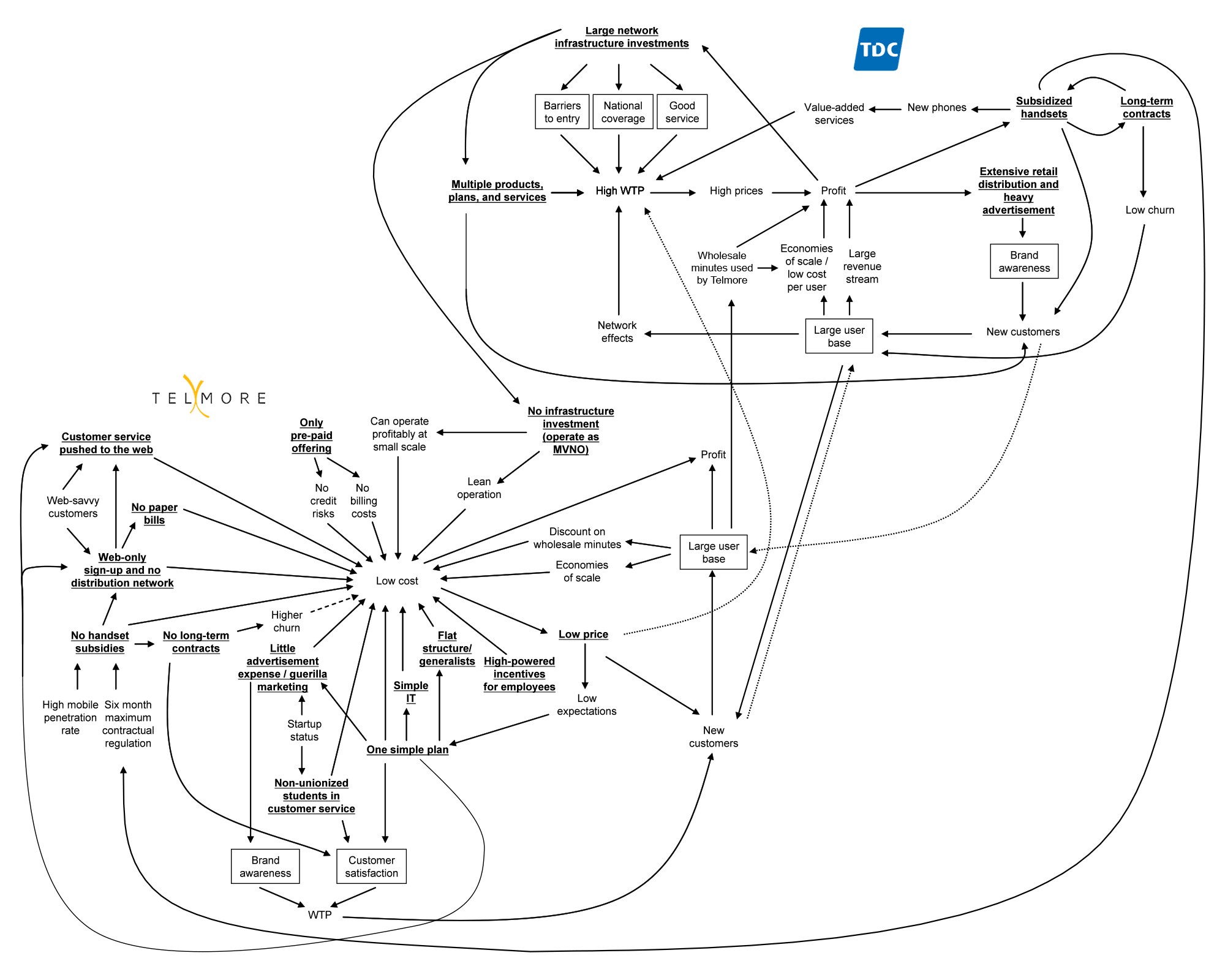
Illustrations adapted from: Harvard Business School – From Strategy to Business Models and to Tactics
(Ramon Casadesus-Masanell & Joan Enric Ricart)
Taking the Concept International: easyMobile
The success of Telmore in Denmark encouraged TDC to expand the concept internationally. By 2004, Telmore had acquired nearly 500,000 customers in a Danish market of approximately 4.7 million subscribers — representing roughly 11% market share in only a few years.
In August 2004, TDC entered into a licensing agreement with easyGroup to launch the “easyMobile” brand across multiple European markets using the Telmore MVNO operating model. TDC established Telmore International Holding (TIH) to manage the expansion, while easyGroup handled brand marketing activities.
On March 10, 2005, easyMobile UK launched as a partnership involving:
- TDC
- Telmore International Holding
- T-Mobile UK
- easyGroup
- and Telmore founder Frank Rasmussen
The operation initially reflected the same lean operating principles that had made Telmore successful in Denmark. easyGroup had no direct share in easyMobile but was being paid a license fee for the brand, while the host operator in the UK, T-Mobile enjoyed the wholesale revenue.
Figure 4: Shareholders and Stakeholders in easyMobile

easyMobile UK was up and running with just 25 people, operating the MVNO from a 2nd floor office, in Hertfordshire, north of London.
The Downfall of easyMobile
Following its launch in the UK, easyMobile announce its interest in launching easyMobile in the Netherlands and Germany. However, at an extraordinary board meeting in TDC on October 11, 2005, just a few weeks before the launch in the Netherlands and Germany, TDC decided to layoff Telmore founder Frank Rasmussen as CEO of easyMobile.
TDC wanted to take 100 percent control of easyMobile, to optimize the values of the company in connections with an ongoing sale of the entire TDC group back in Denmark. Instead of Frank Rasmussen, TDC decided to add local country-head – reporting to TDC instead. Following the changes, the operation of easyMobile slowed and failed to attract customers. Shortly after, easyMobile’s new operation in the Netherlands was shutdown and EasyGroup picked up the remains.
On Nov 13, 2006, EasyGroup announced publicly its displeasure with TDC and that it would no longer put its brand in association with TDC. Later on the same day, TDC announced the closure of its subsidiary easyMobile in the UK. At the same time, TDC announced it has decided to rename easyMobile in the German market to Callmobile.
A week prior, TDC’s own German mobile business unit Talkline had bought the 20% share in easyMobile Germany from TIH. At the closing of easyMobile UK there was only 80,000 customers, while the operation in Germany had approx. 130.000 customers.
What went wrong?
TDC made a series of bad decisions, it often ignored Frank Rasmussen, the founder of the original successful MVNO offering (Telmore) in Denmark, on how to run such operations. TDC was too slow to create a success on its own with easyMobile because the organization was too heavy in decision and business processes.
Shortly before and after the acquisition of TDC Group by a group of private equity firms, ventures outside of Denmark including easyMobile was starved of funding and management was purged.
Lessons from the Field: The Risks of Over-Integration
While the sub-brand MVNO model is powerful, success relies on the MNO’s commitment to protecting the sub-brand’s operational independence. The expansion of the Telmore concept into the UK via “easyMobile” serves as a cautionary tale.
Despite early promise, the operation struggled when TDC, attempting to assert tighter control and shifting away from the original leadership, starved the venture of its lean, startup flexibility and visionary brainpower, and instead imposed heavy corporate decision-making processes. The resulting failure to attract customers eventually led to the closure of the UK and Dutch operations.
The lesson is clear: for a sub-brand MVNO to remain disruptive, it must operate with the agility of a MVNO. The most effective sub-brands are those allowed the freedom to maintain their distinct, operational models without being absorbed into the heavy processes and slow decision-making inherent in large established MNOs. The Telmore and easyMobile experience demonstrated both the strengths and risks of the sub-brand MVNO model.
While MNO-backed MVNOs can successfully defend market share and target new customer segments, the model often depends on preserving:
- operational independence,
- lean execution,
- simplified processes,
- entrepreneurial culture,
- and fast decision-making.
When heavily integrated into traditional corporate telecom structures, many sub-brand MVNOs risk losing the flexibility and disruptive advantages that originally made them successful. The balance between strategic control and operational freedom remains one of the defining challenges of the sub-brand MVNO model.
Modern Examples of Sub-brand MVNO Strategies
Today, many operators around the world continue to use sub-brand MVNO and flanker-brand strategies.
Examples include:
- giffgaff (Telefónica UK)
- Voxi (Vodafone)
- Visible (Verizon)
- Cricket Wireless (AT&T)
- Metro by T-Mobile
- Fido (Rogers)
- Koodo Mobile (Telus)
- GOMO (Singtel)
- Finn Mobile (True)
- Mint Mobile (T-Mobile)
- Onic (PTCL)
These brands target specific market segments while allowing parent operators to maintain differentiated pricing and positioning strategies across their customer base.
Conclusion on Sub-brand MVNOs
The sub-brand MVNO model has evolved into one of the telecommunications industry’s most important competitive tools. From defensive pricing strategies to digitally native challenger brands, MNO-owned sub-brand MVNOs enable operators to compete across multiple customer segments without undermining the positioning of their primary brand.
The history of Telmore and easyMobile demonstrates both the potential and the risks of the model. While MNO-backed MVNOs can successfully disrupt markets and capture significant share, long-term success often depends on preserving the operational agility, simplicity, and independence that originally made these ventures competitive.



LET’S TALK MVNO
If you have any questions, please fill out the form and a member of our team will get in touch with you. We are always open for talks on how we can add value to your MVNO.