
Mobile Virtual Network Enabler (MVNE): A 2026 Strategic Guide for MVNO Market Entry
Quick Summary
A Mobile Virtual Network Enabler (MVNE) is a company that provides the technical infrastructure and business support systems that allow MVNOs to launch and operate mobile services — without building their own network core.
MVNEs sit between the Host Network Operator (MNO) and the MVNO, handling BSS/OSS platforms, SIM management, billing, and core network elements. Unlike MVNOs, MVNEs do not sell services to end-users and are generally not subject to telecom licensing.
Key facts at a glance:
- MVNEs serve MVNOs and MNOs — not consumers
- No MVNE license exists (they are not telecom operators)
- They reduce MVNO launch costs and time-to-market significantly
- Types include everything from light “MVNO-in-a-box” to Full-Core MVNEs
For the full breakdown — MVNE technical architecture, MVNE components, models, MVNE vs. MVNA, case studies, pricing and costs — read on below.
What is a Mobile Virtual Network Enabler (MVNE)?
A Mobile Virtual Network Enabler (MVNE) is an intermediary entity that provides essential infrastructure and services to both mobile network operators (MNOs) and Mobile Virtual Network Operators (MVNOs).
Its primary function is to enable the MVNOs to offer their services on the operator’s network.
MVNEs act as a crucial link in the value chain, facilitating the launch and operation of MVNOs by providing technical solutions and business infrastructure.
Key Characteristics and Distinctions of MVNEs
- No Direct End-User Contact: A fundamental characteristic of an MVNE is that it does not provide public telecom services. It has no contact to the end-users. This distinction is critical because it means MVNEs are therefore not subject to telecom regulation in most markets.
- Intermediary Role: MVNEs operate as intermediaries between the mobile network operator (or MVNA) and the MVNOs.
- *No MVNE License: MVNE differs significantly from the other MVNA and MVNO models. MVNE is an upstream service provider that does not provide public telecommunications services. It has no contact to the end-users and is therefore not subject to license requirement, like some markets have on MVNO and MVNA. (See more below).
- Potential for MVNO Transition: In the event that an MVNE would become interested in providing services to end users as a MVNO, they would be subject to regulation, as a MVNO (in markets that has MVNO regulation).
*You may, on very rare occasions come across a national regulatory authority, who has added MVNE under their licensing scheme. One such example is in Nigeria, which has already caused issues.
Services Provided by MVNEs
MVNEs offer a wide array of technical and business infrastructure services essential for MVNO operation. These services are designed to help to execute the launch and operation of MVNOs and can include:
Core network and infrastructure elements: Providing the virtualized “brain” of the network and signaling control.
Billing and Administration: Handling complex real-time rating, charging, and subscriber financial management.
Business Support Systems (BSS): Managing customer-facing interfaces, CRM, self-service portals, and sales cycles.
Business Support Systems (BSS): Managing customer-facing interfaces, CRM, self-service portals, and sales cycles.
Operations Support Systems (OSS): Handling network inventory, fault management, and automated provisioning.
Provision of technological and network elements: Managing the end-to-end integration of hardware, software, and cloud components.
Interconnect & Roaming Management: Negotiating, integrating, managing agreements and signaling for international traffic.
Fraud Management: Implementing threat detection, ID verification, and fraud prevention to safeguard subscriber data and ensure billing integrity.
MVNO and MNO Pain Points Mitigated by MVNEs
MVNEs play a critical role in addressing significant challenges faced by both MVNOs and MNOs.
MVNO Pain Points and MVNE Mitigation
MVNOs often encounter many challenges due to little relevant experience. These include:
- High Initial Investment: The procurement of IT infrastructure requires a high investment. MVNEs mitigate this by reducing the initial Capex/Opex providing faster return of investment because all agreements and infrastructure is in place.
- Lack of Telco Knowledge: MVNEs provide guidance from the MVNE’s dedicated team of experts, and dramatically decrease the internal skill sets and time needed to launch an MVNO.
- Operational Complexity: Starting an MVNO business is faced with operational challenges. MVNEs allow MVNOs to concentrate on customer acquisition and outsource the rest, effectively becoming the MVNO’s partner.
- Lack of Economies of Scale: By hosting multiple MVNOs, it is possible to achieve economies of scale, and thereby lower rates/greater margins.
MNO Pain Points and MVNE Mitigation
MNOs also face challenges, primarily the workload of administering the heavy processes associated with the launch and day-to-day operations of each individual MVNO. MVNEs address this by:
- Saving Infrastructure and Acquisition Costs: The MNO saves on infrastructure, subscriber acquisition costs, workload with no risks, while gaining network market share and revenue.
- Streamlining Operations: The MNO receives revenue without having to deal with the administrative processes of launch, and day-to-day operations of each individual MVNO.
- Better Network Utilization: MVNEs Provide better utilization of its network and capacity by aggregating multiple MVNOs.
- Targeting Niche Segments: MNOs can Address specific/niche segments through the MVNE’s mix of MVNO clients, and gain healthy and sustainable MVNOs.
In short: MVNEs let MVNOs do what they do best:
concentrate on customer acquisition and outsource the rest
MVNE Operational Model/Architecture

The MVNE’s operational model involves the installation and management of Business Support Systems, Operations Support Systems, and core network elements. The architecture evolves with technological advancements, incorporating both legacy and 5G-specific components.
MVNE Components
Intelligent Network (IN) / Service Control Point (SCP): These legacy components are used for call routing and advanced service logic, but their functionality is often superseded by or integrated into newer, more flexible 5G core elements.
Signaling Transfer Point (STP) / Diameter Signaling Controller (DSC): These are essential for 2G/3G and 4G (LTE) signaling, respectively. In 5G, the Service-Based Architecture (SBA) largely replaces these with HTTP/2-based APIs for communication between network functions.
Home Location Register (HLR) / Home Subscriber Server (HSS) / Unified Data Management (UDM): The HLR and HSS store subscriber data for 2G/3G and 4G networks. The Unified Data Management (UDM) is the 5G equivalent, which manages subscriber identifiers, authenticates users, and stores subscription data. The UDM works with the Authentication Server Function (AUSF) for secure authentication.
Business Support Systems / Operational Support Systems (BSS/OSS): This is the overarching IT layer that handles business and operational processes. BSS includes customer relationship management (CRM), billing, and service management. OSS handles network inventory, fault management, and service provisioning. For 5G, these systems are enhanced to manage a wider range of services, including network slicing.
Short Message Service Center (SMSC) / Short Message Service Gateway (SMS-G): These components handle the storage and forwarding of SMS messages, which are still a fundamental service.
Interactive Voice Response (IVR) / Voicemail System (VMS): These are critical for managing voice-based services, such as automated menus and voicemail, and remain relevant in a 5G environment.
Session Border Controller (SBC): This manages voice traffic and security at the network edge, particularly for VoIP (Voice over IP) and VoLTE (Voice over LTE) calls. It remains a key component for managing SIP (Session Initiation Protocol) signaling.
Unstructured Supplementary Services Data Gateway (USSDGW): This gateway handles USSD-based services, often used for simple menu-driven interactions like checking a balance or topping up a prepaid account.
Gateway GPRS Support Node (GGSN) / Packet Data Network Gateway (P-GW) / User Plane Function (UPF): GGSN (2G/3G) and P-GW (4G) are gateways that connect the mobile network to the internet. The UPF is the 5G equivalent, responsible for the data plane, packet routing, and handling of user traffic. The UPF’s separation from the control plane allows for more flexible and distributed deployments.
Online Charging System (OCS) / Charging Function (CHF): The OCS provides real-time charging and billing for services like data usage. In the 5G core, the Charging Function (CHF) is the dedicated network function responsible for this, enabling flexible charging models based on services, time, and other parameters.
In addition to the components above, a 5G-enabled MVNE stack will include several critical network functions that form the 5G Core (5GC). These are defined by a Service-Based Architecture (SBA).
- Access and Mobility Management Function (AMF): The AMF is the “brain” of the 5G control plane. It manages subscriber connections, handles mobility between different radio access technologies (e.g., 4G and 5G), and manages authentication and authorization. It is the first point of contact for a user equipment (UE) device.
- Session Management Function (SMF): The SMF manages user sessions and the establishment of PDU (Protocol Data Unit) sessions, which are the 5G equivalent of data connections. It assigns IP addresses and manages the routing of user traffic through the UPF.
- Network Slice Selection Function (NSSF): A key feature of 5G is network slicing, which allows operators to create dedicated virtual networks tailored for specific services (e.g., a slice for IoT devices or one for mission-critical applications). The NSSF helps a device select the appropriate network slice based on its subscription and the service it needs to access.
- Network Repository Function (NRF): The NRF acts as a central registry for all 5G network functions. It allows different functions to discover and communicate with each other, which is essential for the SBA.
- Policy Control Function (PCF): The PCF is responsible for policy control, defining rules for how network resources are used. It dictates things like Quality of Service (QoS) and roaming policies.
Host Network Components
The HNO, which provides the underlying mobile network infrastructure, is responsible for the core elements that the MVNO use to deliver services to its customers. The HNO’s responsibilities now extend to the 5G Core Network (5GC).
- Radio Access Network (RAN) / gNodeB: The HNO is always responsible for the RAN, which includes the cell towers, antennas, and all the equipment that connects user devices to the rest of the network. The 5G version of a base station is called a gNodeB.
- Packet Core / 5G Core (5GC) Functions: In a 5G environment, the HNO would provide the key 5G core network functions. This includes the User Plane Function (UPF), Session Management Function (SMF), Access and Mobility Management Function (AMF), Authentication Server Function (AUSF), and Unified Data Management (UDM). These new functions replace or work alongside the legacy 4G components like the MME, SGW, PGW, and PCRF.
- Voice Core (IMS): The HNO provides the voice core, which includes elements like the Media Gateway Controller Function (MGCF) and IMS-based Session Border Controller (IMS-SBC). These components are essential for enabling VoLTE and VoNR (Voice over New Radio) services. The legacy MSC and VLR for 2G/3G calls are still often part of the HNO’s infrastructure.
- Signaling and Routing: The HNO is responsible for the overall signaling and routing of traffic on its network. This includes the Diameter Routing Agent (DRA) for 4G and the Service-Based Architecture (SBA) for 5G, which is managed by the Network Repository Function (NRF).
- Database Management: The HNO manages key databases for the network, such as the Home Subscriber Server (HSS) for 4G and the Equipment Identity Register (EIR) to identify stolen or blacklisted devices. The Unified Data Management (UDM) for 5G handles subscriber data management.
- Connectivity: The HNO provides the essential connectivity to the outside world, including a robust connection to the Internet (ISP) and the management of Domain Name System (DNS) servers. They also manage the allocation of Public IPs and Network Address Translation (NAT) to ensure devices can connect to the internet.
Full-Core MVNE Technical Architecture
How a Full-Core Mobile Virtual Network Enabler (MVNE) Platform Actually Works
For mobile virtual network operators (MVNO) looking beyond basic branded reseller setups, a Full MVNE platform provides absolute control over the subscriber session lifecycle, routing policy, and monetization. It allows you to act like a real mobile network operator without owning physical cell towers.
To bridge the gap between a Host MNO’s physical network and multiple downstream MVNO brands, modern MVNE platforms have evolved into highly complex, cloud-native engines. They must seamlessly run legacy 4G systems alongside modern 5G Standalone (SA) infrastructure.
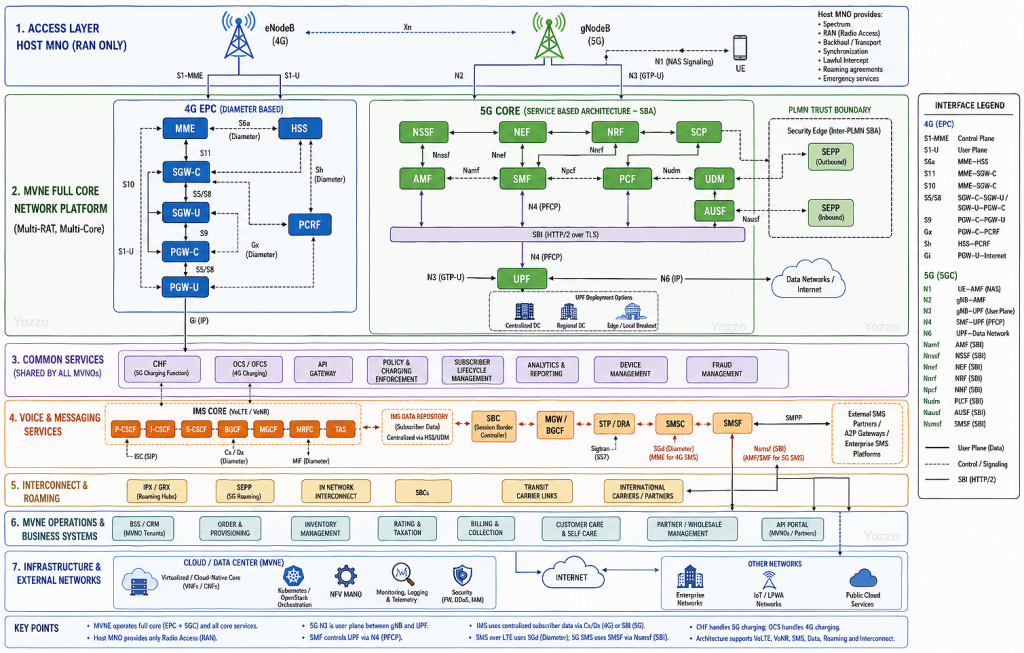
The architecture diagram below illustrates a production-grade, 3GPP-aligned Full-Core MVNE platform. It shows how the system keeps different MVNO brands securely seperated while managing voice, data, messaging, and real-time billing.
MVNE Architectural Breakdown by Functional Layers
A modern MVNE platform is structured across seven distinct logical layers to guarantee zero data leakage between competing MVNO tenants, independent session routing, and flexible data breakouts.
1. MNO Integration (Plugging into the Host MNO)

The topmost layer represents the Host Mobile Network Operator’s (MNO) physical footprint. The MVNE does not own spectrum or towers; instead, it plugs directly into the MNO’s Radio Access Network (RAN), which includes the physical cell towers (eNodeB for 4G, gNodeB for 5G).
Control vs. User Plane: The architecture immediately splits communication into two paths. Control signaling (dashed lines) handles background tasks like finding a signal or authenticating a user. User plane data (solid lines) carries the actual internet traffic, YouTube streams, and web requests.
The Interfaces (S1, N2, N3, N1): These labels are standard telecom protocols. S1 and N2/N3 act as the digital pipelines connecting the MNO’s towers to the MVNE’s core. Notably, N1 (NAS) is a direct, secure line of communication between the user’s phone (UE) and the MVNE core to verify who the subscriber is, bypassing the tower’s internal logic entirely.
2. The Packet Core (The Brain of the MVNE)
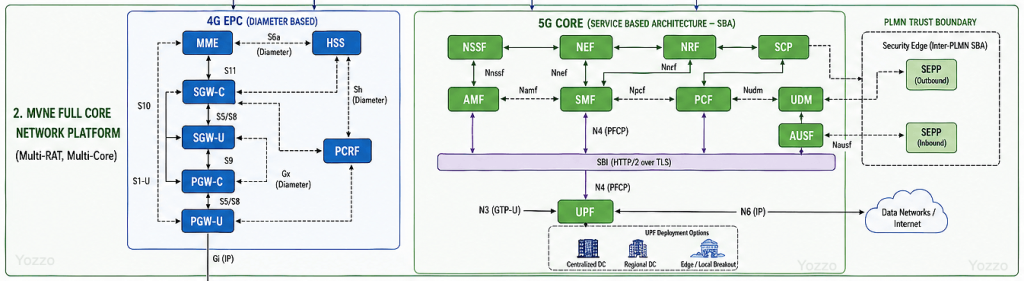
This is the central brain of the MVNE. To support hybrid networks where subscribers constantly switch between 4G and 5G, the core platform runs both generations simultaneously over a virtualized cloud layer.
4G EPC (CUPS Model): Modern MVNEs deploy 4G using Control and User Plane Separation (CUPS). The Serving Gateway Control Plane (SGW-C) handles mobile session tracking, while the Packet Data Network Gateway Control Plane (PGW-C) manages IP addresses and interfaces with the policy engine (PCRF). They hand off the heavy lifting of actual user data routing to their twin user-plane counterparts (SGW-U and PGW-U).
5G Core Service-Based Architecture (SBA): A fully cloud-native framework where core functions talk to each other like microservices over a secure internal software bus. Key functions include the AMF (manages subscriber location and mobility), SMF (manages data sessions), and the UDM / AUSF (the master subscriber database and security authenticator).
PLMN Trust Boundary & Border Security: The SCP acts as a traffic cop inside the 5G core to route internal messages safely. The SEPP functions sit at the outer perimeter trust boundary, acting as a security firewall for inbound and outbound 5G roaming when subscribers travel onto other global networks.
N6 Internet Breakout: The UPF (User Plane Function) terminates the secure carrier tunnels and drops the subscriber’s raw internet traffic onto the N6 interface, sending it out to the public internet, corporate VPNs, or localized data networks. It supports flexible deployment options across centralized, regional, or edge data centers.
3. Common Services (Shared by All MVNO Tenants)

This layer acts as the primary middleware engine, executing policies, security checks, and backend processing shared across all hosted virtual brands.
Policy Engines (PCRF / PCF): Operating via the Policy & Charging Enforcement block, the 4G PCRF and 5G PCF are the rule makers. They dictate quality of service, throttle speeds if a data cap is hit, or enable zero-rated data for specific apps.
Converged Charging Framework: This block contains the real-time billing engines. For 4G traffic, the legacy OCS / OFCS tracks prepaid balances. For 5G, the modernized CHF (5G Charging Function) handles real-time accounting natively over the 5G cloud bus, allowing the MVNE to cut off a data session the exact millisecond a prepaid balance hits zero.
Platform Middleware: Houses essential shared utilities including the API Gateway for secure external software connections, Subscriber Lifecycle Management, Analytics & Reporting, Device Management, and Fraud Management.
4. Voice & Messaging Service Plane (IMS & SMSF)

Voice and text messaging are separated into a dedicated layer to ensure phone calls connect instantly without lag.
IMS Core (Voice over LTE/5G): This handles high-definition voice (VoLTE and VoNR). It is anchored by the CSCF (which acts as a call routing switchboard) and SBCs (Session Border Controllers, which protect the voice network from cyber threats and translate voice data between different networks). These systems talk to a shared IMS Data Repository so the voice network instantly recognizes a subscriber’s profile.
SMS Integration (SMSF): Rather than routing text messages through slow, external third-party loops, the MVNE uses a dedicated 5G SMSF (Short Message Service Function). It pulls text messages directly out of the 4G/5G signaling streams and routes them straight to the SMSC (the central text message warehouse) or to external enterprise SMPP gateways for bulk commercial messaging.
5. Interconnect & Roaming

This layer manages how calls, data, and messages travel outside of the MVNE network to connect with the rest of the world.
Global Hubbing: Features IPX / GRX Roaming Hubs to manage international data connectivity, along with specialized signaling transit through the STP / DRA over legacy Sigtran/SS7 lines.
Carrier Links: Manages secure transitions through international carriers, transit carrier links, and third-party Session Border Controllers (SBCs) to handle inbound and outbound off-network voice traffic.
6. Operations & Business Systems (BSS/OSS) solutions for MVNOs

This is the foundational business layer where the MVNE handles wholesale operations for multiple MVNOs simultaneously.
Multi-MVNO Tenant Isolation: Through a shared Operations Support System (OSS) and Business Support System (BSS), the MVNE abstracts the complex telecom core into separate, simple software management portals.
Brand Autonomy: Using secure APIs and strict database isolation, the platform allows multiple different MVNO brands to run their own custom BSS/CRM setups, Order & Provisioning flows, Inventory Management, Billing & Collection, eSIM onboarding apps, digital web shops, and custom retail pricing plans completely independently, without any risk of data overlapping or leaking to a competitor.
7. Infrastructure & External Networks

The baseline physical and virtual layer that keeps the entire MVNE operational.
Cloud & Data Center Architecture: Powered by orchestration engines like Kubernetes / OpenStack and NFV MANO to spin up and scale virtualized or cloud-native core network functions (VNFs/CNFs) on demand.
Security & Monitoring: Backed by continuous Monitoring, Logging & Telemetry alongside advanced telecom security frameworks (including Firewalls, DDoS protection, and Identity & Access Management). This layer links securely to the open internet, corporate enterprise networks, IoT/LPWA environments, and public cloud services.
MVNE Case Stories
Case 1: E-Plus Germany
Although the number of subscribers in the German market grew 11% between 2002-2005, the share for E-Plus grew just 4% in the same period, and the company’s EBITDA margin declined from 32% to 24%.
E-Plus recognized the potential of MVNOs and launched its MVNE and wholesale campaign in 2005.
The results was striking. E-Plus’s subscriber base grew by 18% between 2005 – 2008, and its EBITDA margin grew from 24% to 39%.
By 2009, E-Plus had launched 34 MVNOs through its MVNE and wholesale setup and increased its overall revenues to reach an EBITDA margin of 42% in 2010.
In 2014 Telefonica acquired E-plus for USD 9.7 billion to create the largest telecom services in Germany with almost 47 million customer.

Case 2: Tele2 Russia’s “MVNO Factory”
In May 2017, the Russian telecom operator Tele2 launched its “MVNO factory” strategy.
The strategy enabled Tele2 to host a range of MVNOs in various niches, and by mid-2017, it had six MVNOs operating, and contracts with eight more.
In 2018, MVNO subscribers in Russia grew to 3.2M with Tele2´s MVNOs accounting for 1.75M of those.
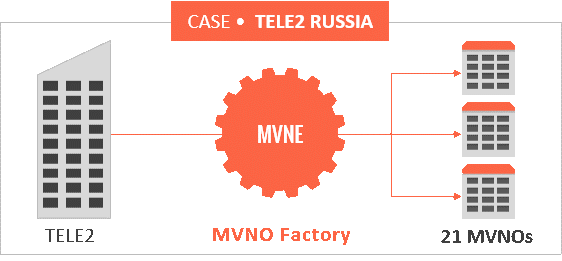
At the end of 2019, Tele2 had 21 MVNOs on its “MVNO factory”, serving 3.75M subscribers out of 10M total MVNO subscribers in the market – increasing Tele2’s revenue from the “MVNO factory” 133% year on year. Tele2’s goal is to occupy 10-12% of the market by 2023.
By the end of 2025, T2’s (Formerly Tele2) MVNO base had grown by 20%, and revenue by 16% year-on-year. One in five, of all users on T2’s network are MVNO subscribers, giving T2 a network market share exceeding 60% of the total MVNO subscriber base. The total number of MVNOs has reached 35.
Case 3: Internet Initiative Japan (IIJ)
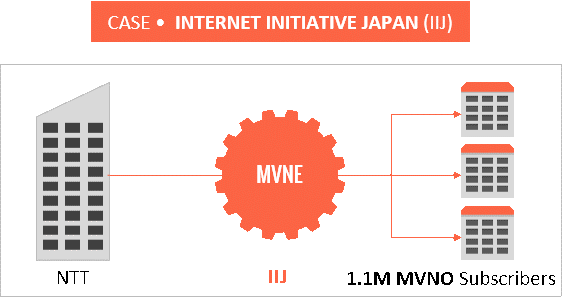
Internet Initiative Japan (IIJ), runs a MVNE on the telecom operator NTT- catering to MVNOs, Internet of Things (IoT) and M2M providers.
From 1Q – 3Q 2017, the MVNO subscribers going through IIJ´s MVNE was 744,000 providing IIJ with a service revenue of USD 70M.
In the period 1Q – 3Q 2018, the number of subscribers grew by 254,560 to 998,892 total providing IIJ with a service revenue of USD 96.3M up 37.8% YoY.
As of March 31, 2026, the IIJ Mobile MVNO Platform Service (MVNE) supported 1,365,657 MVNO subscribers.
Case 4: MVNA/MVNE Surf Telecom Brazil
In September 2015, the NRA, (Anatel) granted the company EUTV S.A, MVNO authorization. EUTV used its ”Surf Telecom” brand and the network of TIM Celular SA (TIM) to provide services as a MVNA/MVNE.
As of February 2021, Brazil had a total of 82 licensed MVNOs with 36 of them enabled by Surf Telecom.
Among the MVNOs enabled by Surf Telecom are the Brazilian Post Office and several football teams.
As of Q1 2025, Surf Telecom and its MVNO partners had a total of 937,190 subscribers.

See Related: MVNO Benefits for MNO for more case stories of MNO/MVNE partnerships.
MVNE vs. MVNA: What is the Difference?
While both Mobile Virtual Network Enablers (MVNE) and Mobile Virtual Network Aggregators (MVNA) act as crucial B2B intermediaries between the host operator and the Mobile Virtual Network Operators (MVNO), they solve entirely different operational challenges.
The core difference lies in technology versus commercial scale.

MVNE = Technology Enabler
An MVNE provides the technical core network platform, BSS/OSS middleware, voice engines, and real-time billing frameworks (as detailed in the architecture blueprint above).
However, an MVNE generally does not provide the mobile airtime. The incoming MVNOs must still negotiate its own commercial wholesale airtime contract directly with the host MNO.
MVNA = Commercial Aggregator
An MVNA buys mobile airtime (Voice, SMS, Data) from a host MNO in bulk quantities at highly discounted rates.
It then splits and resells this airtime to MVNOs taking advantage of economies of scale (buying on behalf of several MVNOs).
An MVNA handles the MVNO wholesale contract, bulk pricing, and commercial management.
In short, if an aspiring MVNO already has a commercial wholesale airtime deal with an operator but needs the software, billing, and technical core to run it, they partner with an MVNE. If they need access to better priced bulk airtime rates and a ready-to-go commercial wholesale framework without direct carrier negotiations, they partner with an MVNA.
How to choose an MVNE platform
MVNO Turnkey • TaaS • MVNO In-a-Box • Carrier of Records • Embedded Connectivity • OS for Mobile Services
While terms like MVNE and MVNA represent recognized regulatory and structural industry standards, the market has introduced several commercial concepts designed to bundle technology and airtime together. When evaluating these options, it is essential to separate standard architectures from modern marketing terms.
MVNO Turnkey Solutions (MVNA/MVNE in One)
A traditional business framework where a provider bundles technical enablement and commercial wholesale airtime under a single contract. Instead of dealing with an MVNE for technology and an MNO or MVNA for airtime, a turnkey provider hands the MVNO an all-in-one package ready for immediate launch.
Compared to a stand-alone Full Core MVNE:
- Advantage: Significantly less internal telecom expertise required, as the provider eliminates the need for the MVNO to source separate technical and commercial wholesale partners.
- Disadvantage: Higher wholesale margins over the long term, because the turnkey provider takes a commercial cut for managing both the airtime and the technology under one invoice, reducing the MVNO’s ultimate profitability as it scales.
MVNO in a Box (The Light Setup)
This is a restricted, entry-level turnkey solution designed specifically for startups or brands looking to add a basic mobile offering to their existing portfolio with minimal friction. The provider delivers a pre-packaged, standardized environment that handles the basic connectivity requirements.
Compared to a Full Core MVNE:
- Advantage: Fast track to launch with minimal upfront capital expenditure, removing the complexity of building a brand from scratch.
- Disadvantage: Severe commercial rigidity. While it offers a faster launch, the MVNO operates as a “Light MVNO,” meaning it has limited control over the operation and little to no ability to customize its own unique offers or data bundles.
Embedded Connectivity / Carrier of Records
Embedded Connectivity, OS for Mobile Services, and Carrier of Record are marketing buzzwords used to target companies that only want to offer mobile plans natively inside their existing apps via a single API integration. The platform provider operates as a vertically integrated MVNE/MVNA, meaning they handle the underlying network access, billing infrastructure, and regulatory compliance (in some markets).
Compared to a Full Core MVNE:
- Advantage: Maximum development speed for software companies, allowing an enterprise to embed mobile subscriptions into an existing user interface without touching raw telecom hardware or compliance pipelines.
- Disadvantage: Total vendor lock-in. The setup is entirely API-driven, acting as a restrictive API Proxy. This limits the control the MVNO has over its operation, opportunities, and scale, making it next to impossible to migrate subscribers to a different network host without replacing the software architecture entirely.
Telecom As a Service (TaaS)
These are broad IT marketing buzzwords popularized by platforms to describe a fully unified, cloud-native MVNE and MVNA combined into a single service. Instead of stitching together separate software vendors and negotiating multiple regional carrier contracts, the TaaS provider runs an autonomous cloud core network and aggregates multi-carrier wholesale data access under one umbrella.
Compared to a Full Core MVNE:
- Advantage: Predictable subscription pricing models that completely eliminate upfront data center capital infrastructure investments, alongside native multi-carrier or multi-country coverage access out of a single integration portal.
- Disadvantage: Limited architectural customization. Because the underlying cloud core is built on a shared, multi-tenant public cloud infrastructure, an individual MVNO cannot easily request unique 3GPP interface modifications, custom deep-core signaling configurations, or specialized local breakouts.
Strategies For a Strong MNO, MVNE, MVNO Partnership
1. Establish Clear Communication and Transparency:
Foster open and transparent communication channels between the MVNO and MVNE teams. This will ensure regular exchange of information, address concerns promptly, and build trust.
Establish clear expectations and objectives for the partnership, outlining roles, responsibilities, and performance metrics. This will prevent misunderstandings and ensure alignment.
Maintain regular meetings and communication channels at various levels within both organizations. This will facilitate collaboration, problem-solving, and ongoing relationship management.
2. Align on Strategic Goals and Market Opportunities:
Develop a shared vision and long-term strategic plan that aligns the MVNO’s business trajectory with the MVNE’s technical capabilities. This requires a deep assessment of target markets, customer segments, and product offerings.
Collaborate on market analysis and customer insights to identify untapped segments and emerging trends. This allows you to jointly address new market opportunities and adapt your offerings to consumer demands.
Translate these goals into actionable milestones. Ensuring the relationship remains productive and both parties stay invested in the long-term growth of your MVNO.
3. Ensure Effective Service Level Agreements (SLAs):
Establish comprehensive SLAs that clearly define the responsibilities of both parties. This includes network performance metrics, QoS guarantees, and response times for technical issues.
Regularly review and update SLAs to reflect changes in business requirements, market conditions, and technological advancements to ensure the SLAs remain relevant and effective.
Implement monitoring and reporting mechanisms to track SLA performance, identify potential issues, and measure the effectiveness of the partnership. This provides data driven insights to improve performance.
4. Foster Collaborative Problem-Solving and Dispute Resolution:
Establish clear protocols for handling disputes and resolving issues that may arise during the partnership. This will ensure a structured approach to conflict resolution.
Encourage open communication and a willingness to compromise to find mutually beneficial solutions to challenges. This will foster a collaborative problem-solving environment.
Consider involving external mediators or arbitration if necessary to reach an agreement and maintain the integrity of the partnership. This will ensure a neutral and impartial approach to dispute resolution.
5. Promote Continuous Learning and Knowledge Sharing:
Encourage regular knowledge sharing between the MVNO/MVNE’s technical teams. This will help both parties stay updated on technological advancements and best practices.
Facilitate joint development programs to enhance skills, and understanding of the partnership’s objectives. Ensuring both teams are equipped to support the partnership.
Promote a culture of open innovation and experimentation, allowing both to learn from each other’s experiences and successes. This will foster a dynamic and innovative partnership.
6. Regularly Evaluate and Adapt the Partnership:
Conduct periodic reviews of the partnership’s performance, assessing progress against agreed upon goals, customer satisfaction metrics, and financial objectives. This will identify areas for improvement.
Identify areas for improvement, potential synergies, and opportunities to expand the scope of the partnership. This will ensure the partnership remains relevant and effective.
Adapt the partnership strategy based on market trends, technological advancements, and changing customer needs. This will ensure the partnership remains aligned with the evolving market landscape.
See more on our: 10 Key factors for MVNO success explained
MVNE Pricing Models & Costs Structures
Now that we have covered the technical architecture, let us look at the financial and operational structures that determine long-term project viability.
Partnering with an MVNE transforms technical infrastructure into a predictable, service-based cost structure. Rather than owning the network core and BSS/OSS systems, the MVNO pays the MVNE for the right to use these platforms and for the ongoing support required to manage the connection to the host network.
The following table summarizes the typical fee structures found in these MVNO-MVNE partnerships.
Table: MVNE Pricing Models – Typical Fee Structures
| Fee Category | Description | Common Charging Model |
|---|---|---|
| Setup & Implementation | One-time fees for integrating the MVNO into the MVNE platform, including systems configuration and testing. | Flat project fee or phased milestone payments. |
| Platform Subscription | Ongoing monthly fee for access to the BSS/OSS suite, including CRM, billing, and provisioning tools. | Monthly recurring charge (often tiered by system complexity). |
| Per-Subscriber Fee | Variable cost based on the number of active users on the platform; covers ongoing support and infrastructure load. | Per-subscriber/per-month (PSPM) fee. |
| Maintenance & Support | Fees for technical support, platform updates, and ongoing network integration management. | Annual maintenance percentage or included in the PSPM fee. |
| Professional Services | Costs for bespoke customizations, additional integrations, or strategic consulting support. | Hourly, daily, or project-based rates. |
| Wholesale Data/Traffic | Pass-through costs for network usage, interconnect, and roaming services managed via the MVNE. | Variable rates based on volume or traffic consumption. |
It is important to note that the ideal cost structure depends on the specific needs of your business. There is a difference between an MVNO focused on consumer telephony services such as – voice, SMS, data – and a machine-to-machine (M2M) or Internet of Things (IoT) focused MVNO.
Consumer models typically prioritize flat-rate simplicity and predictable monthly billing, whereas IoT models require specialized features like device pooling, usage-based billing, and remote provisioning, which can alter the fee landscape significantly.
The MVNE costs are intentionally structured to align with the MVNO’s growth phase. Early stage MVNOs often negotiate lower per subscriber rates or tiered pricing that scales as their user base increases.
This helps preserve cash during the launch phase while ensuring that the infrastructure costs remain proportional to the actual revenue being generated. Over time, as the MVNO gains scale, the unit costs typically decrease, improving the overall margin profile of the business.
MVNE Tiered Pricing and Scaling
The cost structure for an MVNO is often dynamic, utilizing tiered pricing models to align infrastructure expenses with the growth of your subscriber base. In the industry, these expenses are managed as a Monthly Recurring Charge (MRC), with the variable component typically calculated as a Per-Subscriber-Per-Month (PSPM) fee.
This model is designed to shift your infrastructure costs from a heavy, fixed-investment burden to a predictable variable operating expense. As you scale, the effective PSPM cost decreases because the fixed overhead required to maintain your platform is spread across a larger number of users, improving your overall margin efficiency.
The following table demonstrates how a typical PSPM cost structure might shift as you move through different volume milestones:
Table: MVNE Tiered Pricing and Scaling -Per-Subscriber-Per-Month (PSPM)
| Subscriber Milestone | Cost per Active SIM (Monthly) | Economic Impact |
|---|---|---|
| 0 – 10,000 | $1.25 – $1.75 | Initial investment recovery; fixed costs are spread over a smaller base. |
| 10,001 – 50,000 | $0.85 – $1.15 | Improved margins as fixed platform costs are amortized. |
| 50,001 – 100,000 | $0.50 – $0.75 | Economies of scale take effect; high operational efficiency. |
| 100,000+ | < $0.50 | Volume discounting maximizes profitability. |
In this model, the MVNE incentivizes your growth by lowering the unit cost as you hit higher tiers. At the 0–10,000 range, you are often paying a premium to cover the base platform access cost. Once you pass the 50,000 threshold, the business model shifts from being driven by high overhead to being driven by volume, which allows for much healthier profit margins.
Note: The figures in the table above are provided solely as an illustrative example. Actual costs will vary significantly based on your specific market, country of operation, expected subscription volume, and the target Average Revenue Per User (ARPU) for your service.
Factors That Influence High vs. Low MVNE Costs
The Thin MVNO vs. Full MVNO Model: If you are a Thin (Light) MVNO, you are simply using the MVNE’s BSS/OSS (billing and CRM) tools, and the host carrier handles the network core. In this case, costs are significantly lower—often pennies per subscriber. If you are a Full MVNO, the MVNE manages the core network elements, which is far more expensive.
Market ARPU: In markets with high ARPU, paying $1.50 per subscriber is often manageable. In low-ARPU markets, where an entire monthly plan might cost only $3.00 to $5.00, high platform fees can be unsustainable.
Data vs. Voice/SMS: IoT and M2M businesses typically operate on razor-thin margins and utilize extremely low-cost, low-bandwidth connections. In the IoT space, you might see per-subscriber platform costs closer to $0.10 to $0.50.
Bundled Wholesale Costs: Sometimes, the “per-subscriber fee” quoted by an MVNE can actually includes the wholesale cost of the SIM or a baseline data allotment if the MVNE is also providing MVNA wholesale services. If those connectivity costs are bundled into that fee, it will naturally appear much higher than a technical platform-only fee.
Operational Considerations With MVNE
When finalizing your agreement, be aware of standard industry contractual mechanisms:
Tiered Charging: Discounts often apply in “bands.” The initial band charge applies to that specific volume, and the next band charge applies to the subsequent volume, continuing until your total SIM volume is reached.
Minimum Monthly Charge: To ensure platform sustainability, many MVNEs include a “floor.” If your total monthly fees fall below this minimum, the minimum amount is invoiced instead. It is common to negotiate a “ramp-up” period, such as a grace period of three months following your commercial launch where no minimum applies.
Active SIM Definition: Ensure you understand the partner’s definition of “Active.” Usually, this is an IMSI/MSISDN that has been provisioned in the HLR/HSS and is in a lifecycle state associated with a sold or used service.
Conclusion: MVNEs Bridging the Gap Between MNOs and MVNOs
In conclusion, MVNEs are critical facilitators in the mobile telecommunications industry, empowering MVNOs to launch and grow by overcoming significant barriers to entry, while simultaneously enabling MNOs to expand market reach and revenue with reduced operational burden and risk.
The success of the MVNO sector over the last decade are largely due to the maturation of the MVNE model. By abstracting the complexity of the core network and standardizing the integration layer, MVNEs have democratized access to mobile infrastructure.
This has enabled a wave of innovative brands to enter the MVNO market without needing to build their own network core, handle complex regulatory compliance, or navigate the intricacies of interconnect agreements.
As a result, launching an MVNO is no longer a multi-year, capital intensive infrastructure project. It has shifted into a more agile, software defined business model where success is driven by branding, customer experience, and target market focus rather than network engineering.
The role of MVNE continues to evolve with the adoption of technologies, incorporating new architectural components to support advanced services and network capabilities. As the industry moves toward more virtualized functions, the MVNE’s ability to provide a flexible and scalable driven foundation will remain an important factor in the ongoing expansion of the global MVNO ecosystem.
Ready to Select Your MVNE Partner?
Partnering with an MVNE is a strategic decision that defines your long-term operational success.
If you are currently in the vendor evaluation phase, check out our MVNO Consulting Services and contact us to discuss how we can help you navigate your market entry, refine your expansion strategy, or select the right technology partners.
For technical advisory on MVNE platform selection, see our MVNO Technology & Operations Optimization service.
MVNE - Frequently Asked Questions
What is a Mobile Virtual Network Enabler (MVNE)?
A Mobile Virtual Network Enabler (MVNE) is an intermediary entity that provides infrastructure and services to both mobile network operators (MNOs) and Mobile Virtual Network Operators (MVNOs).
Essentially, MVNEs create a platform with technical solutions and business infrastructure services that facilitate the launch and operation of MVNOs, allowing them to offer services on an MNO’s network. Unlike MVNOs, MVNEs do not provide public telecom services directly to end-users and therefore are generally not subject to telecom regulation or licensing requirements.
How does an MVNE differ from other MVNx models, especially in terms of regulation?
An MVNE significantly differs from MVNOs and Mobile Virtual Network Aggregators (MVNAs) because it does not provide public telecommunication services or have direct contact with end-users.
Consequently, MVNEs are typically not subject to the telecom regulations or licensing requirements that often apply to MVNOs and MVNAs in many markets.
While rare exceptions exist where a national regulatory authority might include MVNEs under a licensing scheme, this is generally seen as an anomaly or a misunderstanding of the MVNE’s role. If an MVNE were to start providing services to end-users, it would then be subject to regulation as an MVNO.
What are the key challenges faced by prospective MVNOs that an MVNE helps to mitigate?
Prospective MVNOs often encounter significant barriers to entry due to a lack of relevant experience in the wireless service delivery chain.
These challenges include high initial investment for IT infrastructure, a lack of specialized telecom knowledge and expertise, difficulty achieving economies of scale, limited understanding of the MNO/MVNO ecosystem’s technological and architectural aspects, and the overall operational complexity of running a telecom business (e.g., billing, customer service, SIM management).
MVNEs mitigate these issues by providing ready-made infrastructure, expert guidance, and a comprehensive platform, allowing MVNOs to focus on customer acquisition and service differentiation.
How do MVNEs benefit both MVNOs and MNOs?
MVNEs provide substantial benefits to both MVNOs and MNOs. For MVNOs, MVNEs act as a partner, drastically reducing initial capital and operational expenditure (Capex and Opex), offering faster return on investment, and eliminating many integration issues.
They provide access to create and manage service plans, offer expert guidance, achieve economies of scale for lower rates/greater margins, and allow MVNOs to concentrate on customer acquisition by outsourcing operational complexities.
For MNOs, MVNEs save on infrastructure and subscriber acquisition costs, reduce the administrative workload associated with launching and operating individual MVNOs, and enable them to gain network market share and revenue with minimal risk.
MVNEs also help MNOs achieve better utilization of their network capacity and address specific/niche market segments through a diverse portfolio of MVNO clients.
What are some of the core network and infrastructure elements provided by an MVNE?
An MVNE provides a comprehensive suite of technical solutions and business infrastructure services. This often includes Business and Operations Support Systems (BSS/OSS) for customer management, billing, and network operations. Key core network elements provided or managed by an MVNE can span across different mobile generations.
For instance, legacy components like Intelligent Network (IN)/Service Control Point (SCP), Signaling Transfer Point (STP), Home Location Register (HLR), and Short Message Service Center (SMSC), are often part of the MVNE stack.
For 4G and 5G, MVNEs integrate elements like:
- Home Subscriber Server (HSS)/Unified Data Management (UDM),
- Session Border Controller (SBC),
- Online Charging System (OCS)/Charging Function (CHF),
- Packet Data Network Gateway (P-GW)/User Plane Function (UPF),
and for 5G, new functions like:
- Access and Mobility Management Function (AMF),
- Session Management Function (SMF),
- Network Slice Selection Function (NSSF),
- Network Repository Function (NRF),
- Policy Control Function (PCF).
What is the distinction between MVNE-provided components and MNO-provided components, especially in a 5G environment?
The MVNE provides the platform, technical solutions, and business infrastructure services to enable MVNOs. This includes BSS/OSS, core network elements (which can be hosted by the MVNE or provided through the HNO), and managed services.
The Host Network Operator (HNO), on the other hand, is responsible for providing the underlying physical mobile network infrastructure. This always includes the Radio Access Network (RAN), which consists of cell towers and antennas (gNodeB in 5G).
In a 5G environment, the HNO also provides key 5G core network functions such as:
- User Plane Function (UPF),
- Session Management Function (SMF),
- Access and Mobility Management Function (AMF),
- Authentication Server Function (AUSF),
- Unified Data Management (UDM).
Additionally, the HNO manages the Voice Core (IMS), overall signaling and routing (including Diameter Routing Agent for 4G and SBA for 5G), database management (HSS, EIR, UDM), and essential connectivity to the internet.
What are Business Support Systems (BSS) and Operations Support Systems (OSS) in the context of an MVNE?
Business Support Systems (BSS) and Operations Support Systems (OSS) form the overarching IT layer that handles the business and operational processes of a mobile network.
For an MVNE, these systems are critical for supporting MVNOs.
BSS encompasses functionalities related to customer interactions and revenue management, such as Customer Relationship Management (CRM), billing, charging (e.g., Online Charging System/Charging Function), and service management. OSS, conversely, focuses on managing the network infrastructure and services.
This includes network inventory management, fault management, performance monitoring, and service provisioning. In a 5G context, these systems are enhanced to handle a wider range of services, including advanced features like network slicing.
Why is there no such thing as an "MVNE license"?
There is no specific “MVNE license” required because an MVNE does not provide public telecommunication services directly to end-users.
Their role is upstream, providing infrastructure and services to other entities (MVNOs and MNOs) rather than interacting with the final consumers of telecommunication services.
As they do not offer services that are subject to public telecom regulation, they are exempt from the licensing schemes that apply to MVNOs and MVNAs. Any instance of a regulatory authority imposing an MVNE license is typically considered an anomaly or a confusion with other MVNx models.
Additional MVNE Information
For a visual deep-dive, watch our video on Enabling MVNO Success • A Guide to MVNE.

You Can Read the Full Video Transcript Here
MVNE – The Hidden Engine of the Mobile World
0:03 [Music]
0:04 Hi, and welcome to Yozzo’s podcast dedicated to empowering mobile virtual network operators with the insights they need to succeed. This is the place where we break down the complexities of the MVNO ecosystem. Let’s get started.
0:16 Today, we’re going to pull back the curtain on one of the most critical, yet almost totally unknown, players in the mobile world: the MVNE.
0:28 Here’s a question you’ve probably never thought to ask, but once you hear it, it kind of gets in your head. If you think about who actually owns the cell towers, the antennas, all that physical stuff—it’s only a few giant companies, right? So how is it possible that there are hundreds, maybe even thousands, of different mobile brands all competing for our business? Where do they all come from?
0:45 To figure this out, we first need to lay out all the pieces of the puzzle.
0:49 ### The Mobile Brand Puzzle
0:49 The world of mobile carriers is a little more complicated than it looks on the surface.
0:54 So on one side, you have the MNOs, the mobile network operators. These are the titans, the big guys who build and own the actual infrastructure.
1:05 Then you’ve got the MVNOs, mobile virtual network operators. These are all the brands we actually know—the ones who lease access to those networks to sell service to us.
1:11 But there’s this huge, huge gap between having a cool brand and actually getting your customers connected to that network. And that gap, well…
1:22 ### The “Great Walls” of Telecom
1:22 It’s protected by some seriously high walls. Trying to start a mobile brand isn’t like opening a new online store. The barriers to get into this game are just immense.
1:32 What this really means is even if you’ve got a killer brand and a ton of loyal followers, you still run smack into three massive hurdles:
1:37 1. You need a crazy amount of money up front for all the IT and systems.
1:43 2. You need incredibly specialized telecom knowledge, which most companies just don’t have.
1:48 3. The day-to-day complexity of running it all, from billing to SIM cards, is just mind-boggling.
1:53 It’s enough to make almost anyone give up before they even start. But here’s the thing: it’s a two-sided problem. It’s not just the new guys struggling to get in. The big MNOs have their own headaches.
2:04 For them, setting up every single new brand is this huge administrative nightmare. It’s a massive drain on their time and resources, especially for a partner that might start out small. Both sides really needed a better way to do this. And that better way, it has a name. This is that aha moment where the hidden engine finally steps into the light.
2:22 ### Meet the “Enabler”
2:22 It’s called the Mobile Virtual Network Enabler or the MVNE.
2:27 So, what on earth is an MVNE? It’s the ultimate middleman, really. It’s a company that specializes in building a bridge over those great walls of telecom. It creates a turnkey platform with all the complex tech and business stuff an MVNO needs and then plugs that platform straight into the big M’s network. And get this: they don’t have any customers of their own. So they aren’t regulated like a normal telecom. They just enable others.
2:58 ### The MVNE Value Chain
2:58 To make this crystal clear, think of it like this: an MVNE is the general contractor for building a mobile company.
3:03 If you’re the brand, you don’t have to go out and hire the telecom equivalent of electricians and plumbers and architects. The MVNE has all those experts under one roof and they just hand you the keys to a finished house.
3:19 The MVNE handles all the incredibly complicated backend stuff. This frees up the brand, the MVNO, to focus only on what it’s truly good at: marketing, building a community, and actually taking care of its customers.
3:30 So, let’s just quickly break down the impact here.
3:35 ### How MVNEs Empower
3:35 When you partner with an MVNE, bam, your startup costs are slashed. Bam, you can launch in a fraction of the time. You instantly get a whole team of telecom experts. And like we just said, you get to focus on your customers. Those barriers to entry, they just kind of crumble.
3:51 ### Proof in the Profits
3:51 Now, this all sounds great on paper, but does it actually work in the real world? Oh, yeah. The MVNO model isn’t just a theory. It’s been a massive, measurable success story for the network operators who were smart enough to embrace it.
4:01 Let’s take a look at E-Plus in Germany. Back in the early 2000s, they were in a tough spot. Their growth was slowing down and, more importantly, their profits were shrinking. To put a number on it, their profit margin, what’s called the EBIDTA margin, had dropped all the way to 24%. So, what did they do?
4:23 They made a huge shift. They launched their own MVNO platform to make it super easy for new partners to join their network. And the result? Their margin didn’t just bounce back—it skyrocketed to 42%. They completely transformed their business by making it easier for others to succeed.
4:41 Okay, let’s jump to another example. Tele2 in Russia decided to go all in on this. They created something they actually called an “MVNO factory.” The whole goal was to become the number one go-to platform for any brand that wanted to launch a mobile service in the country. And the result of that factory? At one point, their revenue from this MVNO business grew by an unbelievable 133% year-over-year. They basically built a machine that just printed new revenue on top of the network they already had.
5:10 Okay, our last case study takes us down to Brazil where an MVNE called Surf Telecom did more than just help one network operator. They basically shaped the entire national market.
5:28 In early 2021, Brazil had 82 licensed MVNOs. Out of all of them, nearly half—36 to be exact—were all running on Surf Telecom’s single platform. Think about that. One company became the hub that allowed everyone from the Brazilian post office to major soccer teams to launch their own mobile brands.
5:45 So, we’ve seen what an MVNE is, how it works, and we’ve looked at the proof. But let’s bring it all back home.
5:51 ### Why It Matters
5:51 Why should you or I care about this invisible technical layer of the mobile world? Well, because MVNOs are fundamentally engines for competition and innovation.
6:02 By tearing down those huge walls, they let way more players get into the game. And that means more variety, more niche services for specific communities, and way more pressure on the big guys to give us all a better deal.
6:13 So when you zoom all the way out, the takeaway is pretty clear.
6:18 ### The Takeaway
6:18 The MVNO model directly leads to more brands, which for us means way more choice. It fuels faster innovation across the whole industry. And maybe most importantly, it gives entrepreneurs with a great idea a real shot at competing in one of the biggest markets in the world.
6:38 And that wraps up another episode of Yozzo’s podcast.
6:42 If you want to dive deeper into today’s topic, you can find much more resources at yozzo.com. We’ll be back next time with more insights. Until then, keep innovating.
6:48 [Music]





LET’S TALK MVNO
If you have any questions, please fill out the form and a member of our team will get in touch with you. We are always open for talks on how we can add value to your MVNO.