
What Happens When MVNO Growth Stops
Quick Summary
MVNO growth rarely stops suddenly. It slows gradually, and when it does, most operators make the same mistake: they assume it is a marketing problem and spend more to fix it. In most cases, slowing MVNO growth is a signal that something deeper has changed in the business – the original segment has been exhausted, acquisition costs have risen beyond sustainability, or the product has lost the differentiation it once had.
Key observations:
- Early growth hides operational weakness: problems that are manageable at 20,000 subscribers become significant at 200,000. The growth phase can mask issues in billing accuracy, acquisition cost sustainability, and operational scalability that only become visible when growth slows.
- Slower growth is rarely just a marketing problem: the immediate reaction is usually to spend more on advertising or cut pricing. The real question is why growth stopped – and the cause determines the correct response.
- The causes vary significantly: exhausted niche, unsustainable acquisition costs, weakened product differentiation, and a model that has hit a structural ceiling all require very different responses.
- Broadening the target market is risky: moving away from the original niche to chase scale often removes the competitive advantage that made the MVNO viable in the first place.
- Operational scalability becomes critical: systems and processes acceptable at launch become expensive bottlenecks at volume – particularly in billing accuracy and revenue assurance.
- Retention becomes as important as acquisition: when replacing customers becomes more expensive than keeping them, the business model has to change accordingly.
For the full analysis – why growth stops, how to diagnose the real cause, and what operators that successfully move beyond the plateau actually do differently – read on below.
One of the biggest misconceptions in the MVNO industry is that the hardest part of the journey is launching.
Getting the first customers, completing the technical integration, passing testing, finalizing the wholesale agreement and putting the first SIMs into the market are all difficult achievements requiring significant effort, coordination and investment.
However, many MVNOs discover that launch is not where the real business challenge begins. The more difficult phase often starts after the initial growth period, when subscriber acquisition slows and the company has to prove that it has built a sustainable business rather than simply achieved early momentum.
Why Early MVNO Growth Hides Operational Weakness
The early growth phase can create a misleading picture of performance. New customers are arriving, revenue is increasing, the market is responding positively and internal teams are focused on expansion. During this period, many operational weaknesses remain hidden because the business is moving quickly.
A manual process that creates problems at 20,000 subscribers may be manageable. The same process at 200,000 subscribers becomes a major operational cost.
A billing discrepancy that seems insignificant when monthly wholesale spend is low can become a serious financial issue once usage volumes increase.
A customer acquisition strategy that works with the first few thousand customers may become economically impossible when the company has to reach a much broader audience.
When growth slows, these hidden issues become visible.
Slower MVNO Growth Is Rarely Just a Marketing Problem
A mistake many MVNOs make at this stage is assuming that slower MVNO growth is simply a marketing problem. The immediate reaction is often to increase advertising spend, introduce discounts, reduce pricing or launch new promotions.
Sometimes this works temporarily, but often it creates a bigger problem – the company is trying to buy growth without understanding why organic MVNO growth has slowed.
The real question is why the MVNO growth stopped. There are several very different reasons, and the solution depends entirely on the cause:
- The company has reached the natural limit of its original target market.
- Customer acquisition costs have increased beyond sustainable levels.
- The product has become less differentiated as competitors have responded.
- The business model itself has reached a structural ceiling.
A serious MVNO needs to diagnose which problem exists before deciding how to respond.
Table 1: Diagnostic Table for Identifying the Root Causes of MVNO Growth Plateaus
| Symptom | Real Root Cause | Strategic Fix |
|---|---|---|
| High Cost Per Acquisition for new leads | Market Saturation | Pivot to adjacent niche/product |
| Flat subscriber count | Declining Product Relevance | Re-invest in differentiation |
| Volume up, Profit flat | Operational Inefficiency | Automate / Revenue assurance |
| Stagnant Customer Lifetime Value | Structural Ceiling | Shift B2C to B2B or higher tier |
When the Original Niche Segment Has Been Exhausted
One common scenario is that the original customer segment has been exhausted. Many MVNOs launch with a specific niche segment in mind – a community, a membership base, a geographic group, a professional segment or a specific consumer profile. This is often the right approach because focused targeting creates a stronger value proposition than competing across the whole market.
The challenge comes when the first wave of customers has been acquired. The initial customers are usually the easiest to win – they may already know the brand, already trust the organization, already have a relationship with the distribution channel or already have a strong reason to switch.
The next group of potential customers is often much harder because they require more education, more marketing investment and a stronger reason to change providers. This is where some MVNOs discover that they built a successful niche but not a scalable mass-market proposition.
The response is often to broaden the target market – a company originally positioned around a specific community may decide to become a general mobile provider. This can be dangerous, because the original competitive advantage may disappear. The company moves away from the segment where it had credibility and enters a market where it competes directly against established operators with stronger brands, larger budgets and existing customer relationships.
Customer Acquisition Cost After the Easy Wins Are Gone
During the launch phase, MVNOs often underestimate how difficult and expensive customer acquisition becomes once the obvious channels are exhausted. The first customers may come from existing relationships, partnerships, community access or targeted campaigns. As the business attempts to scale, it often has to rely on broader advertising channels where competition is much higher.
Digital advertising, influencer marketing, search campaigns and promotions can create visibility – but they also create a direct financial question: how much does it cost to acquire a customer, and how long does it take to recover that investment?
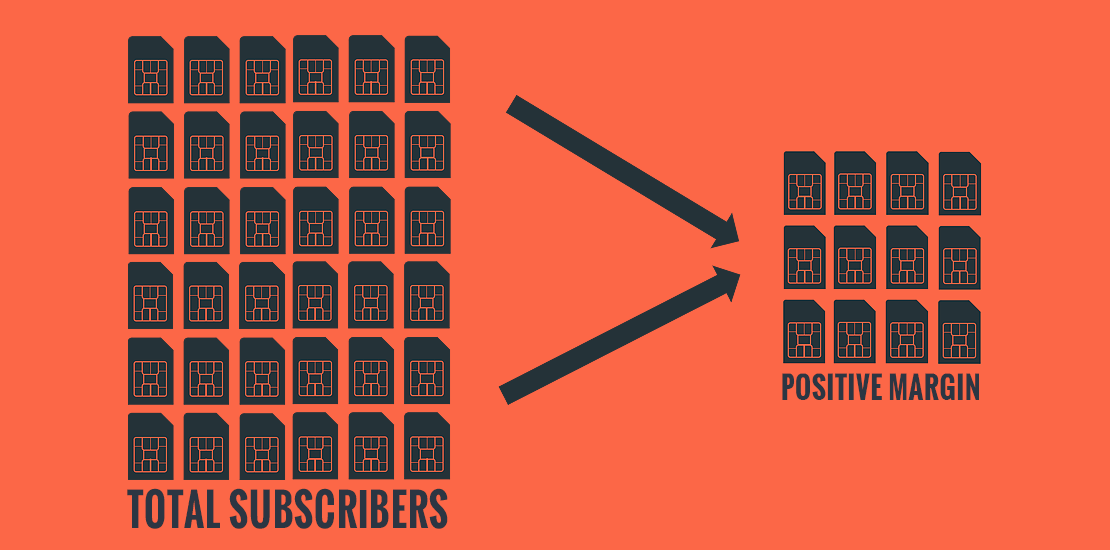
A subscriber generating monthly revenue does not automatically represent a profitable customer. The operator must consider wholesale costs, customer support, billing operations, payment processing, marketing costs, subsidies, commissions, platform fees and churn. If the customer leaves before the acquisition cost has been recovered, growth can actually destroy value.
This is why mature MVNO operators pay close attention to customer lifetime value rather than simply subscriber numbers.
The quality of growth matters. An operator adding customers through aggressive discounts may look successful from the outside, but those customers may have low loyalty and high price sensitivity – and leave as soon as another provider offers a cheaper plan. The MVNO then enters a cycle of constantly replacing lost customers instead of building a stable base.
Operational Scalability
Many MVNOs launch using systems that are perfectly acceptable for an early-stage business. The platform supports activation, billing, customer management and reporting. The team handles exceptions manually. Problems are solved quickly because the customer base is still manageable. As the company grows, the same approach becomes expensive.
Telecom operations contain many processes that are invisible to customers but critical to the business – SIM lifecycle management, number portability, billing accuracy, usage mediation, roaming management, customer support workflows and reconciliation processes all become more complex as volume increases.
A company that has not invested in operational maturity eventually finds that growth increases workload faster than it increases profit. This is particularly common in billing and revenue assurance.
At small scale, an MVNO may accept wholesale invoices from its host MNO and focus mainly on customer acquisition.
At larger scale, the financial impact of inaccurate charging, unclear usage records or inefficient reconciliation becomes significant.
The MVNO needs confidence that wholesale charges match actual usage, that retail billing is accurate and that margin calculations are based on reliable information. Without this visibility, the MVNO can appear successful while quietly losing profitability.
Table 2: The Scalability Gap – Comparison of operational processes between early-stage and scale-stage MVNOs.
| Process Area | Early-Stage (20k subs) | Scale-Stage (200k+ subs) | Hidden Cost of Delay |
|---|---|---|---|
| Billing | Manual Reconciliation | Automated Mediation | Revenue Leakage |
| Support | Founder / Small Team | Automated CRM | High Cost-to-Serve |
| Onboarding | Personalized / Hand-held | Digital-First / Zero-touch | Churn due to Friction |
| Strategy | Growth at all costs | Profitability per Cohort | Value Destruction |
How MVNO Growth Changes the Host MNO Relationship
Growth also changes the relationship with the host MNO. During the early stage, the MVNO is often seen as a promising partner. The host MNO may provide strong support because the relationship represents incremental revenue and strategic opportunity. As the MVNO becomes larger, the relationship naturally becomes more commercial and more complex.
The MVNO may request better pricing, improved service levels, more flexibility or access to additional capabilities. The host MNO will evaluate those requests based on its own commercial priorities.
This is why scale matters beyond revenue – subscriber growth creates negotiating leverage. However, that leverage only exists if the MVNO has built a genuinely valuable business. A large customer base with poor margins does not necessarily create strong negotiating power.
Defending the Position When Competitors Respond
An MVNO may enter the market with an attractive proposition because existing operators are not addressing a particular need. If the MVNO proves that the segment is valuable, larger operators may respond – launching competing products, adjusting pricing, improving digital experiences or targeting the same audience. The MVNO then has to defend its position.
This is where differentiation becomes critical. If the only reason customers joined was price, the operator is vulnerable. A larger competitor can easily match or beat pricing. If customers joined because of trust, community, specialized service, unique distribution or a broader ecosystem, the MVNO has a stronger foundation.
When growth stops, the operator must also examine whether the original product still matters.
Features that once created differentiation become standard. A plan structure, app experience or pricing model that looked innovative at launch may no longer be meaningful several years later.
The focus should be on whether the MVNO continues solving a meaningful customer problem – not on adding features for the sake of appearing to innovate.
Subscriber Retention Becomes as Important as Acquisition
During the early growth period, companies often focus almost entirely on acquisition. When growth slows, retention becomes equally important because replacing customers becomes increasingly expensive. Understanding churn requires more than measuring cancellations. Operators need to understand why customers leave:
- Are they unhappy with pricing?
- Is the network experience poor?
- Is onboarding weak?
- Is support ineffective?
- Did the original reason they joined disappear?
Reducing churn requires understanding the customer relationship, not simply offering retention discounts.
As you scale, the temptation to chase subscriber numbers at any cost is immense. However, it is vital to distinguish between vanity growth and value creation.
The chart below illustrates the divergence between an “Empty Growth” model, where aggressive acquisition erodes margins, and the “Sustainable Path”, where operational maturity and retention drive higher profitability per subscriber as the business matures.
Chart: Quality of Growth vs. Margin Erosion
What the Strongest MVNOs Do Next
MVNOs that successfully move beyond the growth phase usually make several changes:
- They improve operational discipline.
- They focus on profitable customer segments rather than subscriber numbers.
- They improve automation.
- They strengthen their differentiation.
- They become more precise about where they compete and where they do not.
Some MVNOs discover that their next phase of growth requires changing direction. A consumer-focused operator may move into B2B. A community operator may expand through partnerships. A digital operator may focus on a narrower segment. A low-margin business may reposition around higher-value services.
The important point is that growth stopping is not automatically a sign that the business has failed. It is the moment where the company is forced to understand whether it has built something sustainable.
The real challenge is not simply finding more customers – it is understanding what kind of business the MVNO has actually built, and whether that business can continue creating value as the market becomes more competitive.
A mature MVNO eventually has to move beyond the question of how many subscribers it can acquire, and focus on the more important questions: which customers are valuable, why they stay, how efficiently the company serves them and whether the business has a defensible position.
That is the point where an MVNO stops being a launch project and becomes an operator.
Summary
When growth slows, the instinct is often to address it as a marketing challenge. In most cases it is not. Slower growth is usually the signal that an underlying business issue has become visible – acquisition costs that were always too high, a niche that has been exhausted, a product that has lost its differentiation, or operational processes that cannot scale efficiently.
The operators that navigate this phase successfully are those that diagnose the real cause rather than applying a short-term fix, focus on customer value rather than subscriber volume, and use the plateau as the point at which they build a more operationally mature and commercially resilient business.
See how acquisition economics and subscriber value connect in How Many Subscribers Does an MVNO Really Need, or explore how operating model choices affect long-term flexibility in MVNO Types and Operational Models.





LET’S TALK MVNO
If you have any questions, please fill out the form and a member of our team will get in touch with you. We are always open for talks on how we can add value to your MVNO.