
NBTC Draft MVNO Notification: Yozzo’s Public Hearing Submission and Key Recommendations

Stakeholders attending the NBTC public hearing session for the draft MVNO notification in Bangkok, Thailand July 2026.
Thailand’s telecom regulator, the NBTC, is currently holding a formal public consultation and hearing for the (Draft) Notification on Mobile Virtual Network Operator (MVNO). The public comment period runs from June 21 to July 21, 2026, following a physical public hearing session that took place on July 1, 2026, to gather input from stakeholders, operators, and the public.
Yozzo Submission & Key Recommendations For NBTC MVNO Public Hearing
This submission by Allan Rasmussen, Managing Director, Yozzo Co., Ltd. is made pursuant to Section 28 of the Frequency Allocation and Telecommunications Business Regulation Act B.E. 2553, in response to the public hearing on the Draft NBTC Announcement on MVNO Services in Thailand.
It draws on written submissions made at NBTC MVNO focus group meetings from 2019 to 2025, all of which are on record. Many of the issues raised in those submissions remain unresolved, with several appearing verbatim on the agenda of this hearing.
We must state clearly at the outset that this submission will not be confined to the ten preset questions defined by the NBTC for this hearing. That framing is a procedural device, not a limit on stakeholder rights under Section 28. Where the NBTC’s questions fail to address issues of fundamental importance, this submission raises and addresses those issues regardless.
The record shows that the core problems facing this market have been raised formally with the NBTC at several consecutive focus group meetings. In fact, the NBTC board agenda item covering this reform of the MVNO announcement has been deferred by the board more than 50 times since 2024.
Currently, no commercial end-user MVNO has successfully launched on the networks of AIS or True. Furthermore, licensed MVNA operators cannot determine from the current regulatory framework what infrastructure they are legally permitted to install.
The Draft Announcement does not resolve any of these systemic failures. Revising the language of a failed framework without addressing the structural causes of that failure will inevitably produce the same result.
This submission sets out the evidence, the analysis, and the specific regulatory actions recommended. It is submitted in good faith and with the expectation that the NBTC will engage with it substantively.
However, it is an undeniable truth that the feeling that all of this is just a grand theatrical performance – a form of regulatory theater – is entirely reasonable and supported by clear evidence.
Over a decade of unenforced MVNO access rules and merger conditions demonstrate that regulation tends to be strictly enforced on smaller players, while offering no real protection against large, market dominant corporations.
Having to draft pages of in-depth reports, knowing full well that the system is structurally biased toward the major Mobile Network Operators (MNOs), is incredibly exhausting and discouraging.
But this, and other submissions are far more than just a piece of paper. In the legal and political arena of telecommunications, documents like this establish a permanent paper trail. They record the exact mathematical, technical and legal distortions introduced into the market. Should future litigation lead to the Courts, or should a margin-squeeze scenario occur, this submission will serve as crucial evidence demonstrating the regulator’s neglect of its duties.
SECTION 1: PRELIMINARY STATEMENT - EVIDENCE OF SYSTEMIC FRAMEWORK FAILURE
Before addressing any specific clause of the Draft Announcement, the factual record must be established. This is not a submission about minor regulatory improvements.
It is a submission about a framework that has failed by every measurable indicator, whose failure has been documented over more than a decade, and whose causes have been formally raised with NBTC at three consecutive focus group meetings without producing any corrective action.
1.1 The MVNO Market in Thailand Has Gone Backwards
The number of active MVNO operators in Thailand has declined continuously since the original MVNO announcement. Over 65 MVNO licenses have been issued by NBTC. The vast majority of those licensees have closed or become inactive.
The Draft Announcement acknowledges this in its preamble. What it does not acknowledge is that this outcome was not a market accident – it was the predictable consequence of issuing licenses without establishing and enforcing a clear, non-discriminatory access framework from the dominant MNOs.
NBTC issued the licenses. NBTC did not enforce the access. The licensees paid the price.
1.2 Agenda Item 4.16 MVNO Announcement - Deferred More Than 50 Times
The NBTC board agenda item covering reform of the MVNO announcement, formally listed as item 4.16, has been deferred on the NBTC board’s agenda more than fifty times since 2024. This is not procedural delay. This is a documented pattern of institutional avoidance of a statutory responsibility.
The issues now presented in this public hearing have been ready for board-level decision for years. The stakeholders who have engaged in good faith with NBTC’s consultation processes – attending focus group meetings, submitting written comments, raising formal disputes – have been waiting while the board repeatedly postponed action.
This fact must be acknowledged in NBTC’s post-hearing determination and NBTC must explain what governance mechanism will prevent further deferral of the actions required by the final announcement.
1.3 No MVNO Has Launched on AIS or True For 13 Years
No end-user focused MVNO or MVNA has successfully obtained wholesale network access from AIS or True – the two mobile network operators in Thailand.
This failure has been formally raised at a minimum of three consecutive NBTC focus group meetings. It has not been resolved.
The Draft Announcement contains no provision that directly addresses it. Every other provision in the Draft Announcement – wholesale offers, negotiation timelines, promotion measures, dispute procedures, is commercially meaningless to an operator that cannot access the network in the first place.
1.4 The AIS 3-Year Experience Pre-Condition - A Catch-22 Accepted by NBTC
AIS has incorporated into its wholesale access process a requirement that an MVNO applicant demonstrate three years of prior experience operating a mobile virtual network.
NBTC has not rejected this requirement. This condition is self-evidently anti-competitive and circular: an operator cannot acquire three years of MVNO operating experience without first obtaining network access, which requires demonstrating three years of experience.
It is a structural impossibility designed to prevent market entry. It has no basis in any NBTC announcement, the Telecommunications Business Act, or the Frequency Allocation Act.
The grounds on which an MNO may refuse wholesale access are exhaustively listed in the existing announcement. Experience is not among them. NBTC’s failure to act on this condition after it was raised formally in prior hearings is a regulatory failure of the first order.
The NBTC, not the operators, makes the rule of law in this country. This condition must be prohibited in the body of this announcement and directed for immediate removal.
1.5 The TRUE/DTAC MVNO Merger Conditions - 3½ Years of Non-Enforcement
The merger of TRUE and DTAC was approved by NBTC subject to conditions that included MVNO access obligations. Those conditions have now been in place for more than three years and 8 months. NBTC has not enforced them.
The merged entity – now the largest MNO in Thailand by subscriber base, with associated companies holding approximately 95% of the retail market – has not provided access to end-user focused MVNOs as required. This is not a commercial dispute between private parties. These are regulatory conditions imposed by NBTC as part of its approval of a major market consolidation. Failure to enforce them is a failure of NBTC’s statutory duty.
This submission formally demands that NBTC enforce the TRUE/DTAC merger MVNO access conditions immediately, and that the status of that enforcement be reported publicly within 30 days of this announcement taking effect.
1.6 The Dispute Over Permitted MVNA Infrastructure - A Case Study in Regulatory Failure
The MVNA (MVNO Services Co., Ltd.) brought a formal dispute to NBTC regarding the infrastructure and systems that an MVNA licensee is permitted to own and operate.
The MNO parties argued the MVNA could not install specific network and IT systems. NBTC took more than one year to reach a determination. When it did, NBTC agreed with the operator’s position. The licensee then asked NBTC to provide a written document specifying what an MVNA is and is not permitted to install. NBTC has not produced that document.
As of the date of this submission, NBTC has not and apparently cannot define the infrastructure rights of its own licensees. This is a fundamental failure of regulatory competence with direct financial consequences for a licensed operator.
The same ambiguity that produced this dispute is present in the Draft Announcement, which uses the same “such as” illustrative language as the 2013 original. It will produce the same result.
1.7 The Triple Tax Problem
The same mobile service airtime is currently subject to NBTC annual license fees three times when it passes through the chain MNO to MVNA to MVNO:
- The MNO pays a revenue-based license fee on the airtime it sells to the MVNA,
- The MVNA pays a revenue-based fee on the same airtime it sells to the MVNO,
- The MVNO pays a revenue-based fee on the same airtime it sells to end-users.
This triple fee structure creates a direct and compounding price and margin disadvantage at every layer below the MNO.
The Draft Announcement’s fee reduction in Chapter 6 reduces the rate at the MVNA and MVNO layers for three years, but does not address the structural tripling of fees on the same service. The appropriate solution is that the MNO pays the annual revenue fee as the primary license holder and spectrum holder, and the MVNA and MVNO layers are exempt from revenue-based fees on the same airtime. This is consistent with the principle that fees should reflect regulatory cost, not be levied multiply on the same economic activity.
Ultimately, these compounding costs are passed down to the end-user through artificially inflated bills, effectively acting as a hidden tax that goes against the NBTC’s statutory duty to protect consumer interests and ensure fair, competitive retail rates.
1.8 Unlimited Retail vs Per-Megabyte Wholesale - Documented Margin Squeeze
MNOs in Thailand offer unlimited data plans to retail consumers while charging MVNOs on a per-megabyte basis. This is a direct and concrete example of the margin squeeze that the wholesale rate framework is supposed to prevent.
An MVNO that buys data wholesale at a per-MB rate cannot compete with an MNO that sells unlimited data to consumers at a fixed monthly price.
The Retail Minus formula, as applied to data services in this environment, produces a negative or near-zero margin for the MVNO. NBTC has been made aware of this issue in prior hearings. It remains unaddressed in the Draft Announcement.
1.9 What NBTC Has Not Answered
The following questions were raised formally in the 2023 and 2025 focus group submissions. NBTC has not answered them on the record. This submission formally resubmits them and requests written answers before the final announcement is adopted:
- Which NBTC department is responsible for the outcome of MVNO focus group meetings, and what were the documented outcomes of the 2019 to 2025 meetings?
- What are NBTC’s KPIs for MVNO market development, and what was the outcome against those KPIs for each of the past five years?
- What happened to the “urgent policies for MVNOs” presented by NBTC in 2023, including the “one-region-one-MVNO’ concept”?
- What action has NBTC taken on the enforcement of the TRUE/DTAC merger MVNO access conditions?
- What is NBTC’s plan for MVNOs and their consumer base following NT’s announcement that it can no longer support MVNOs?
- Why has the NBTC Telecommunications Commissioner not participated in the MVNO focus group hearings 2019 – 2025?
SECTION 2: CRITICAL ISSUES NOT ADDRESSED BY NBTC'S PRE-SET QUESTIONS
Issue A: Spectrum Auction Eligibility Must Be Conditional on MVNO Access
Status: Highest priority. The most powerful enforcement lever available to NBTC.
This proposal was submitted formally to NBTC in the April 2025 focus group submission. NBTC has not responded to it. It is resubmitted here with greater urgency.
AIS and True are the anticipated bidders in upcoming spectrum auctions. Neither has provided wholesale access to MVNO or MVNA operators despite regulatory obligations, merger conditions, and more than a decade of licensing activity.
NBTC has the authority to set eligibility conditions for spectrum auction participation. It should exercise that authority as follows:
- TRUE should not be qualified as a bidder in any upcoming spectrum auction until it fully complies with the MVNO access conditions imposed as part of the TRUE/DTAC merger approval, demonstrated by providing a copy of at least one signed wholesale agreement with at least one MVNA and at least one MVNO.
- AIS should be required to demonstrate compliance with its existing license conditions on MVNO access by providing a copy of at least one signed wholesale agreement with at least one MVNA and at least one MVNO as a condition for spectrum auction participation.
This measure uses a commercial lever – spectrum, which is the foundation of each MNO’s business – to incentivize access compliance in a way that no regulatory fine or direction has achieved. It is proportionate, legally grounded in NBTC’s spectrum management authority, and directly addresses the documented failure of access negotiations. It was proposed in 2025 and warrants an explicit response from NBTC in this hearing’s determination.
Issue B: MVNA/MVNO Technical Capability Matrix - Mandatory, Not Optional
Status: Fundamental. Existing licensees are operating without defined rights.
The definitions of MVNO tiers and MVNA in Clause 4 of the Draft Announcement (Thin, Medium, Full MVNO) use illustrative “such as” language that does not define the individual network elements, IT systems, and functional capabilities each tier is permitted to own and operate.
This is the same approach taken in the 2013 announcement. It produced a year-long dispute and an NBTC determination that left the underlying question of MVNA infrastructure rights unanswered.
The Nigerian NCC License Framework (Annexure) provides a complete visual and textual mapping of every network element – RAN, Core Network System, IP Multimedia Subsystem, HLR/EIR/AuC/HSS, VLR, SGSN/SGW, PGW/GGSN, MSC/MME, Intelligent Networks, VAS, SMS/MMS, Tariff and Metering, CRM and Billing, Sales, Distribution, Branding, Devices – against each MVNO tier, showing exactly which elements are permitted at each level.
The NCC Business Rules (Schedule B) then provide detailed textual confirmation tier by tier. There is no ambiguity. Thailand needs this. Not as a nice-to-have addition – as the minimum content required for the announcement to have regulatory meaning.
For the MVNA specifically: the MVNA’s commercial function is to act as an enabling platform for MVNOs – precisely the role Clause 7 of the Draft Announcement assigns to it. That function requires ownership of HLR/HSS, IN platforms, OSS/BSS systems, SIM management infrastructure, and potentially switching and interconnect elements.
The Draft Announcement must confirm explicitly that an MVNA may own and operate the full range of network and IT infrastructure necessary to provide wholesale and enabling services, subject only to the prohibition on providing retail mobile services to end-users.
Crucially, a technical analysis of Slide 13 of NBTC’s presentation reveals that the Core Network segment relies entirely on legacy 2G, 3G, and 4G technical elements (specifically listing MSC/GMSC, SGSN/GGSN, and HLR/HSS).
The draft framework completely lacks any definition or inclusion of 5G Core network functions, such as the User Plane Function (UPF), Access and Mobility Management Function (AMF), Session Management Function (SMF), and Unified Data Management (UDM).
Regulating a modern telecom market using hardware definitions from previous decades creates an immediate technological anachronism. The final notification must explicitly map these 5G Standalone components to safeguard the rights of Full MVNOs and MVNAs to own and manage modern, cloud-native 5G architecture.
Required Action
Publish a mandatory Technical Capability Matrix as Annex A to the announcement, specifying for each MVNO tier and for the MVNA: Permitted network layer elements, Permitted IT and OSS/BSS systems, Switching and interconnect rights. SIM issuance rights, Numbering rights, Retail service permissions and expressly prohibited elements.
Additionally, confirm in Clause 4 that an MVNA may own and operate the full network and IT stack necessary for wholesale and enabling operations similar to a full MVNO, and explicitly update all definitions to encompass 5G architecture elements (UPF, AMF, SMF, UDM).
Issue C: The Reference Access Offer Model Must Replace the Letter of Intent
Status: The current “letter of intent” approach is too loose and generates false requests.
The Draft Announcement’s negotiation framework relies on a “letter of intent” as the trigger for wholesale negotiations. This instrument is too informal and non-binding to serve as an effective gateway to structured negotiations.
Based on experience across multiple markets, the letter of intent generates low-quality requests that consume MNO processing capacity without producing agreements, and provides MNOs with scope to reject requests on vague grounds.
The appropriate instrument is a Reference Access Offer (RAO) – a standardized, downloadable form published on a dedicated wholesale webpage at each MNO’s website.
The RAO model was proposed in the 2023 submission to NBTC. It was not adopted. It should be mandated in this announcement. Each MNO’s dedicated wholesale website should include:
- The RAO form – a downloadable, structured document for the requesting party to complete, identifying itself, its intended service scope, its technical requirements, and its confirmation that it is a licensed MVNO or MVNA seeking wholesale access
- Guiding principles for wholesale access negotiations, published in both Thai and English
- The MNO’s Reference Offer setting out commercial principles, capacity thresholds, payment terms, numbering arrangements, and technical specifications
- API documentation and technical interface specifications for each MVNO tier
- Named contact details for the person responsible for wholesale access requests
- A Frequently Asked Questions section covering the wholesale access process
- Confirmation that a copy of each completed RAO will be provided to NBTC automatically, enabling NBTC to monitor compliance with negotiation timelines without waiting for complaints.
This structure converts the wholesale access process from an informal bilateral negotiation into a transparent, monitored, and standardized process. It also makes non-compliance immediately visible to NBTC.
Issue D: Dominant MNO Obligations Must Be Asymmetric
Status: Structural. Identical obligations for dominant and non-dominant operators perpetuates the access failure.
The Draft Announcement imposes the same wholesale obligations on all MNOs regardless of their market position, spectrum holdings, or documented history of access denial.
In a market where two operators dominate by every measurable metric and have demonstrated that they will not provide wholesale access without compulsion, treating all MNOs identically is not regulatory neutrality, it is regulatory protection for the dominant players.
NBTC has the authority under existing telecommunications law to conduct market analyses and designate operators with significant market power.
It should do so within 60 days of this announcement taking effect and apply to designated operators:
- A presumption that refusal to wholesale is unjustified where technical capacity exists,
- Mandatory publication of a Reference Access Offer within 60 days of designation,
- Accelerated negotiation timelines,
- Mandatory arbitration with a 45-day determination period.
Issue E: Wholesale Pricing Must Reflect Modern Network Economics
Status: The Retail Minus model has not kept pace with the shift to data-dominated services.
The Retail Minus approach was appropriate for a voice and SMS-dominated market in 2005. It has not kept pace with the economics of a data-dominated, 4G/5G environment.
The following changes in the market since the model was introduced are on record from the 2025 submission and remain unaddressed in the Draft Announcement:
- Data has replaced voice as the dominant service. Prices for data have fallen sharply, making per-unit Retail Minus calculations less meaningful.
- MNOs offer unlimited retail data at fixed monthly prices while MVNOs are charged per megabyte wholesale. This structural asymmetry makes MVNO data services commercially unviable under the current model.
- IoT and M2M services operate on data-only, high-volume, low-price models that do not fit within a per-unit Retail Minus framework.
- 5G network slicing creates a defined slice allocation model that requires a completely different pricing structure from shared-network retail minus calculations.
- Full MVNOs and MVNAs bring their own infrastructure to the arrangement, reducing the cost the MNO actually incurs – a factor that Retail Minus does not capture.
- MVNOs are buying excess network capacity – approximately 40% of MNO capacity is unused at any given time. This excess capacity has near-zero marginal cost to the MNO. The payment MVNOs make for it is essentially pure incremental profit. The pricing model should reflect this.
The backstop pricing mechanism recommended in the 2025 submission – and not responded to by NBTC – is the Norwegian NKOM margin squeeze test methodology, which applies three tests to determine whether a wholesale rate is appropriate:
- Whether the MNO could operate profitably at the disputed wholesale price if it used that price itself.
- A package-specific margin squeeze test to ensure that MVNOs can operate profitably with a competing retail offer.
- A segment-specific margin squeeze test to ensure MVNOs can operate profitably with a portfolio of the MNO’s current flagship retail offers.
This methodology is grounded in economic reality and has been applied successfully in multiple European markets. NBTC should adopt it as the backstop for wholesale rate disputes, replacing the current approach under which NBTC adjudicates rate disputes without a defined analytical framework.
Additionally, the Nigerian NCC Business Rules (May 2026) provide a concrete revenue share structure by tier that NBTC should adopt as a reference framework:
- Tier 1 Reseller MVNOs at 25% MVNO / 75% MNO;
- Tier 2 (Thin) at 30% / 70%;
- Tier 3 (Medium) at 40% / 60%;
- Full MVNO and MVNA at 50% / 50%.
This structure reflects the actual infrastructure investment and operational responsibility each tier takes on – the more the MVNA/MVNO owns and operates, the lower the MNO’s contribution and the higher the MVNO’s share.
Issue F: Future Technology Access Must Be Guaranteed
Status: The announcement must cover 4G, 5G NR (encompassing both Non-Standalone and Standalone architectures), VoLTE, and future evolutions.
The service list in Clause 13 of the Draft Announcement – Voice, SMS, MMS, Mobile Internet – reflects 2G and 3G era categories. The announcement should require MNOs to provide MVNO access to all technologies they deploy commercially, including 4G LTE, VoLTE, 5G NR (encompassing both Non-Standalone and Standalone architectures), and future evolutions, subject to technical feasibility and negotiation of commercial terms. Specifically:
- Where an MNO is the first operator to launch a new technology, it must make that technology available for MVNO access within 8 weeks of commercial launch
- Where a new technology has already been commercially launched by a competing MNO, the access period is 4 weeks
- MNOs may not restrict MVNO wholesale access to older generation technologies while withholding newer generation access
- 5G network slicing access rights must be addressed explicitly, as slicing requires a fundamentally different commercial model from shared-network access
These provisions were proposed in the 2023 submission. They remain absent from the Draft Announcement.
Issue G: Analysis of the Technology Platform Cost Calculation Presented by the NBTC
Status: Commercial and Technical. The fixed percentage deduction introduces severe mathematical distortions and anti-competitive margin squeezes.
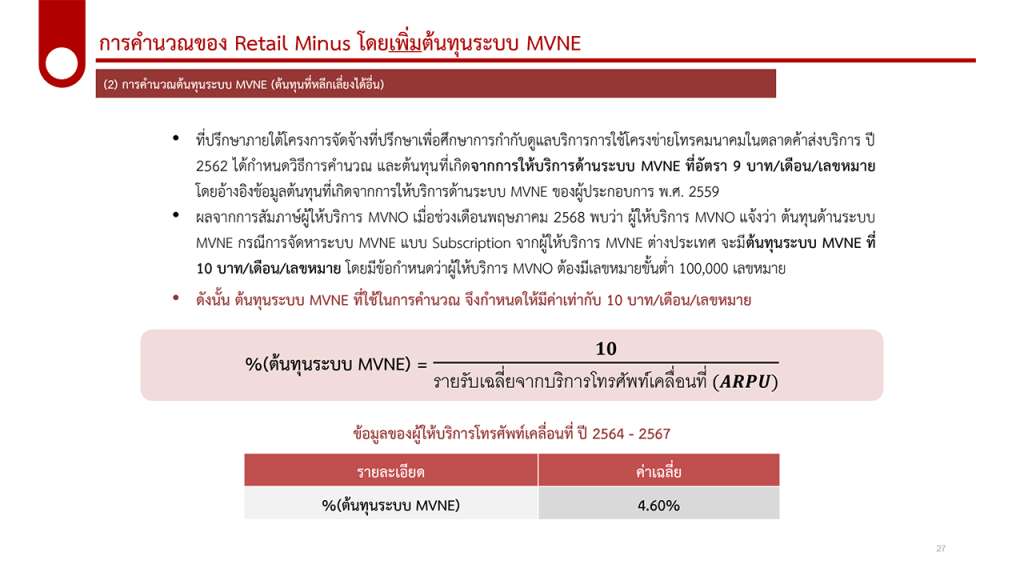
During the public hearing, the NBTC presented a methodology for calculating platform system costs within the Retail-Minus framework, setting a fixed 4.60% reduction based on a hypothetical baseline cost of 10 Baht per month per number. Careful economic and technical scrutiny reveals five critical flaws in this calculation that must be addressed.
Heavy Reliance on Outdated Data (2016–2019): The calculation models presented by the NBTC explicitly state that the baseline calculation was derived from a consultant study from 2019.
That study utilized host network operating cost data dating back to 2016 to determine a base price of 9 Baht per month per number. In the telecommunications sector, the costs of computing, cloud virtualization, and core network infrastructure have declined significantly over the past decade.
Applying hardware costs from 2016 into a 2026 legal framework aimed at regulating modern cloud-native architectural stacks and high-volume operations is a fundamental anachronism.
The Minimum Volume Limit Creates an Un-operational Closed Circuit: The NBTC justifies the 10 Baht baseline by citing a survey of MVNOs in May 2025. This survey found that international subscription-based platforms charged at that rate under the strict condition of a minimum threshold of 100,000 numbers. This creates a serious legal conflict.
Because the NBTC has not yet successfully enforced wholesale network access from market-dominant MNOs, virtual operators have been unable to launch services or expand their subscriber base. Setting a baseline cost that assumes an initial volume of 100,000 numbers creates an anti-competitive Barrier to Entry Bootstrapping Loop.
This closed-circuit model effectively locks in prices that are too expensive for new market entrants before their first SIM card is even activated.
The Mathematical Illusion of Blended MNO ARPU: The NBTC calculates its 4.60% reduction by dividing the flat 10 Baht rate by the historical average mobile ARPU of dominant MNOs, which sits at approximately 217 Baht.
This equation is economically flawed because it assumes a homogeneous market.
MVNOs do not achieve the same high ARPUs as MNOs, whose metrics consist of a blended mix of premium postpaid and prepaid enterprise portfolios. Instead of using the MNOs’ blended ARPU data, the NBTC should have utilized the specific ARPU metrics of operating MVNOs, which reveal a realistic operational range of 50 to 100 Baht.
If an MVNO’s target ARPU is 50 Baht, a flat 10 Baht technology platform cost represents 20% of its total retail revenue, not 4.60%.
By applying a static percentage derived from the legacy, high ARPUs of massive MNOs, the NBTC’s formula mathematically prohibits MVNOs from offering viable low-ARPU or IoT services, forcing wholesale pricing to remain artificially high and squeezing market niches.
%(Technology Platform Cost) =
Average Mobile ARPU (MNOs)
≈ 4.60%
Flawed Legacy Averages vs. Digital-First Efficiencies The draft seeks to reduce the MNO’s recognized retail cost baseline from the historic 30% down to 27.50% based on MNO financial statements from 2021–2024.
Comparing the sprawling, physical retail infrastructure of dominant MNOs to the digital-first retail structure of a modern MVNO is an asymmetric and incorrect cost allocation. There are now only two dominant operators in the market, where one parent entity (CP Group/True) effectively controls 95% of the premium physical retail distribution for telecom products via 7-Eleven and Lotus’s.
By using a flawed legacy average based on that physical infrastructure, the regulatory framework essentially normalizes and protects the high cost of maintaining a physical monopoly.
It forces a digital-first competitor to operate under a pricing model designed for a brick-and-mortar giant, completely wiping out the operational cost efficiencies that MVNOs is supposed to bring to consumers.
Conceptual Error in Regulatory Nomenclature (“MVNE Cost”) The framework explicitly labels this baseline expense as “MVNE Cost,” which introduces a fundamental conceptual error. Using this term legally pre-supposes that a third-party Enabler (MVNE) must be present in the commercial architecture.
In reality, this overhead represents basic Wholesale Technology Platform Costs or Core Telecom Technology Overheads. By framing the regulation around an “MVNE cost,” the NBTC creates a regulatory blind spot. It completely fails to account for infrastructure-owning MVNAs or Full-Tier MVNOs who build their own cloud-native stacks, databases, and core switching networks.
Labeling a broad technological requirement after a specific third-party business model forces an artificial commercial structure onto the market and penalizes operators who invest directly in their own technology.
Complete Disregard for Full-Tier Operational Realities: The framework erroneously applies a per-subscriber subscription fee model to infrastructure-owning operators.
Full-Tier MVNOs and MVNAs build, own, and operate their own core switching networks, databases, and billing/BSS platforms. Their cost structures are driven by capacity CapEx and asset depreciation on their own balance sheets. Applying a generic platform subscription fee to Full-Tier operators is an economic fiction completely disconnected from their financial realities.
Undermining the Investment Ladder Principle of Tiered Architecture: The foundational premise of dividing virtual operators into distinct regulatory tiers – Thin, Medium, Full MVNO, and MVNA – is to establish a progressive investment ladder. In a functional wholesale market, the more infrastructure, core network elements, and IT systems a virtual operator brings to the table, the higher the commercial margin it should receive. This margin reflects the reality that the operator is taking over technical and operational tasks that the host MNO would otherwise have to perform and finance.
By applying a flat, monolithic percentage deduction across the board, the NBTC’s current Retail-Minus proposal completely flattens this investment ladder. A Full MVNO or MVNA that heavily invests CapEx into building cloud-native core elements is penalized with the same structural margins as a low-investment Reseller or Thin MVNO.
Without a dynamically tiered wholesale pricing structure that links increased technical investment to higher margin retention, the regulatory framework removes all commercial incentive for operators to move up the ladder, ultimately stifling infrastructure investment in Thailand’s digital economy.
Alignment with International Regulatory Benchmarks
The European Commission Precedent: Under the European Union margin squeeze framework established under Article 102 of the Treaty on the Functioning of the European Union (TFEU), regulatory cost allocations for wholesale access must strictly adhere to the Equally Efficient Operator (EEO) or Reasonably Efficient Operator (REO) principles. The European Commission dictates that downstream operational costs, such as technology and billing platform stacks, are absolute technical overheads driven by network volume and architectural deployment, never a variable percentage tied to fluctuating consumer retail prices.
International Telecommunication Union (ITU) Standards: The ITU explicitly mandates under Recommendations D.50 and D.192 that wholesale telecom cost modeling must utilize Long-Run Incremental Cost (LRIC) methodologies based on Modern Equivalent Asset (MEA) valuations. This international standard directly prohibits regulators from using historical infrastructure costs to calculate forward-looking tariffs, as doing so introduces severe technological anachronisms. The calculation presented by the NBTC relies heavily on a legacy consultant study from 2019 using host network operating data from as far back as 2016 to derive its baseline network system costs.
UK Ofcom: United Kingdom regulator Ofcom handles mobile virtualization and wholesale access markets by utilizing a Glide Path or Sliding Scale Cost Model specifically designed for new market entrants. International regulatory cost models explicitly acknowledge that a new virtual network operator starts at zero subscribers and cannot immediately leverage massive economies of scale.
Recommended Action:
- The NBTC should completely abolish the use of a fixed macroeconomic percentage for core technology platform costs, replacing it with a dynamic cost-plus model based on the actual network architecture of each operator tier.
- The regulatory framework must legally enforce that any host MNO provide the 100,000-volume wholesale price tier from Subscriber Number 1 for the first 24 months of an MVNO’s operation to resolve the closed-circuit trap.
- The Commission must legally mandate that all telecom system cost data be updated every 2 years using current cloud-native, virtualized architecture costs, discarding any data older than 24 months.
- The final notification must insert a legal clause explicitly stating that Full-Tier MVNOs and MVNAs owning their own core network and BSS/OSS components are entirely exempt from the platform subscription cost calculation framework, as these costs are irrelevant to their internal infrastructure operations.
The NBTC must legally mandate that the wholesale pricing framework—whether via Retail-Minus or Cost-Plus—incorporates a sliding scale of margins that directly tracks the investment ladder, ensuring that Full MVNOs and MVNAs retain a significantly higher percentage of the retail baseline to account for the heavy operational and infrastructure costs they assume from the host MNO.
Issue H: Retail Minus Framework Without a Verified and Enforced Retail Baseline
Status: Enforcing a wholesale price based on unverified, potentially non-compliant retail baselines creates an administrative and legal vacuum.
The foundational premise of any Retail-Minus model is the existence of a stable, lawful, and verified Retail Price Base from which a predefined percentage can be subtracted. However, NBTC is currently attempting to mandate a wholesale price structure while failing to establish or enforce the legal baseline of the retail market. This structural failure stems from critical, unresolved regulatory issues.
Unenforced 12% Merger Condition: When the NBTC acknowledged the merger between True Corporation and DTAC, it imposed a mandatory condition requiring the merged entity to reduce average retail service fees by at least 12%. This condition was supposed to be strictly verified through independent, external third-party auditors.
Regulatory Vacuum: Years after the merger, the NBTC has failed to finalize or transparently publish a comprehensive independent audit confirming compliance with this 12% reduction. Public consensus, the Thailand Consumers Council, and parliamentary oversight committees have repeatedly highlighted that retail prices have instead concentrated and risen through the elimination of entry-level promotional packages.
The Mathematical Impossibility of the Pricing Base: If the dominant market player’s current retail prices are artificially inflated or unverified by 12%, any wholesale price derived via Retail-Minus is automatically skewed. NBTC is effectively calculating wholesale margins using non-compliant retail prices as the starting variable, which institutionalizes an anti-competitive margin squeeze.
35%
Retail-Minus
Remains
Too High
Margin
Erased
Arbitrary Regulatory Double Standards: The NBTC cannot aggressively enforce an exact mathematical deduction framework on virtual operators while allowing a “regulatory slumber” regarding the 12% retail price obligations of market-dominant infrastructure owners. A wholesale tariff cannot be legally established when its core component (the retail baseline) remains an unverified issue.
Recommended Action:
The NBTC should immediately halt the finalization of the Retail-Minus percentage calculation until it formally establishes the legal retail baseline. The regulation must explicitly state that the “Retail” variable used in the formula must be the theoretically adjusted retail price reflecting the mandated 12% reduction condition, or a cost-oriented proxy based on verified network expenses.
If the NBTC cannot verify the 12% reduction across the MNO’s retail packages, it must discard the Retail-Minus framework entirely and pivot to an absolute Cost-Oriented LRIC+ Pricing Model to ensure wholesale pricing is insulated from non-compliant retail market distortions.
Issue I: Breach of Procedural Fairness and Transparency - Withholding Dissenting Commissioners' Rationales from Public Scrutiny
Status: The structural delay in publishing official meeting minutes deprives stakeholders of the material information necessary to provide fully informed public hearing submissions.
In the formal invitation to this public hearing, the NBTC explicitly named the individual Commissioners who voted on the draft, revealing a highly divided 4:3 split vote in favor of moving forward with the current public hearing text. However, the NBTC has failed to provide stakeholders with the minority or majority rationales underpinning this razor-thin vote:
Transparency Deficit: During the physical public hearing, stakeholders explicitly requested the formal reasoning and dissenting arguments raised by the three Commissioners who voted against this draft. Access to these arguments is critical, as the minority opinions directly relate to whether the current draft contains hidden anti-competitive mechanisms, unconstitutional provisions, or calculation errors that will harm MVNA/MVNOs.
Administrative Delays as a Structural Barrier: The NBTC is routinely delayed in the finalization, approval, and publication of its official Board Meeting Minutes on its public website by months. Consequently, stakeholders are legally forced to draft and submit their formal consultation responses in a information vacuum.
Violation of Due Process: A public consultation cannot be deemed legally sound or genuinely transparent if the regulator deliberately highlights a deep internal schism but structurally suppresses the official records containing the substance of that disagreement until after the public comment window has permanently closed. This administrative failure deprives the industry of its right to review, support, or expand upon the regulatory arguments raised by the dissenting Commissioners.
Recommended Action:
The NBTC should immediately extend the public consultation submission deadline.
The revised deadline must be legally bound to a date no less than 30 days after the official, unedited meeting minutes and individual voting rationales of the specific board meeting that approved this hearing draft are fully published on the NBTC website.
Alternatively, the NBTC must immediately issue an official, transparent Addendum to this hearing packet detailing the exact economic and legal objections raised by the three dissenting Commissioners, allowing stakeholders an equitable opportunity to evaluate and incorporate those arguments into their final submissions.
SECTION 3: RESPONSES TO NBTC PUBLIC HEARING QUESTIONS 1 – 10
The following responses address each of the ten questions posed by NBTC.
They should be read together with Section 2 above, which addresses issues not covered by the pre-set questions and which are of greater structural importance.
Question 1: Enforcement Authority Provisions (Clause 3)
Position: Directionally correct but structurally incomplete without asymmetric obligations and explicit enforcement authority.
Clause 3 correctly extends this announcement’s scope to cover wholesale and resale activities. This eliminates a source of regulatory ambiguity.
However, extending scope is only meaningful if the announcement provides adequate substantive rules for those activities – and as detailed throughout this submission, it does not.
More critically, Clause 3 does not restate NBTC’s authority to issue individual access directions to specific MNOs.
That authority exists under the telecommunications law framework, but its absence from this announcement leaves the enforcement picture unclear.
NBTC must make explicit in Clause 3 that it will exercise its direction authority where:
- a licensed MVNO or MVNA has been unable to conclude a wholesale agreement within the announcement’s timelines,
- an MNO has imposed access conditions not authorized by the announcement,
- or the wholesale market is not operating competitively.
Nigeria Comparison: Section 2 of the NCC Business Rules explicitly states that the rules supplement the Act and that the Act prevails where provisions conflict.
The NCC framework contains explicit Commission intervention and direction authority throughout – not as background legal competence but as named operational powers at specific trigger points. NBTC should replicate this approach.
Recommended Amendment:
Clause 3 must include:
- an express prohibition on any access pre-condition not authorized by this announcement, naming experience requirements specifically;
- explicit NBTC authority to issue individual access directions;
- and a provision that any condition imposed by an MNO that has no basis in this announcement is void ab initio.
Question 2: MVNA/MVNO Definitions & Elements (Clause 4)
Position: Fundamentally deficient. The most important deficiency in the Draft Announcement.
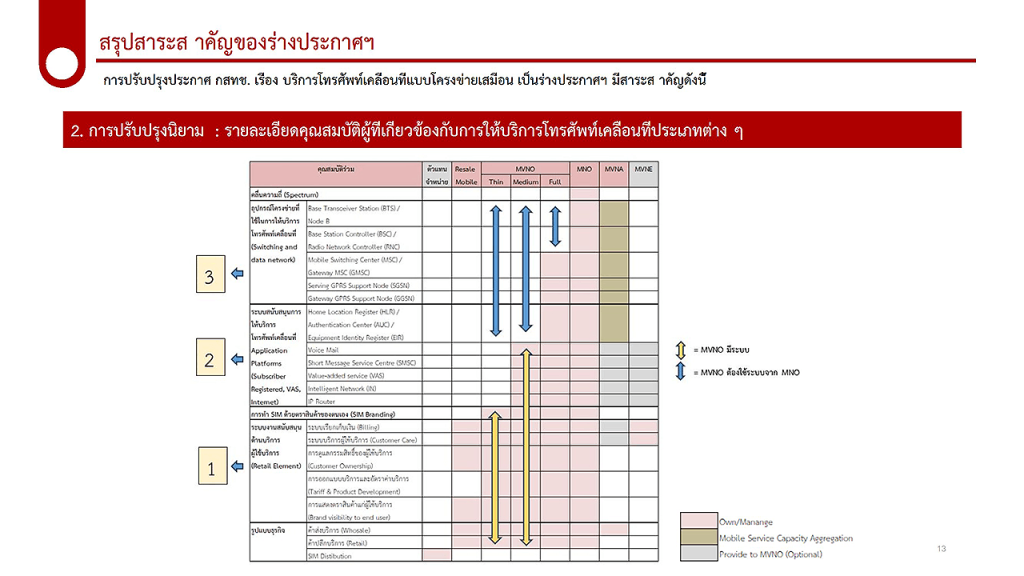
The definition section is the foundation of the regulatory framework. Imprecise definitions produce imprecise enforcement. The Draft Announcement’s definitions of MVNO tiers and MVNA contain the same structural deficiency as the 2013 announcement: they describe functional categories without specifying the individual elements within those categories.
Thin MVNO: “Retail support systems such as a Billing system or Customer Care system” – the phrase “such as” is not a definition. The announcement does not confirm whether a Thin MVNO may own an SMSC, VAS hosting platforms, a CRM system, a customer-facing mobile application, or analytics infrastructure. Each is a potential investment decision subject to NBTC discretion under the draft.
Medium MVNO: “Application Platforms such as SMS, MMS or VAS” does not confirm whether a Medium MVNO may own its own HLR/HSS, AuC, EIR, IN platform, PCRF, or SIM issuance infrastructure. These are the defining capabilities that distinguish a Medium from a Thin MVNO in every international framework. Their omission renders the definition commercially non-functional.
Full MVNO: “Core Network with authority to manage network and traffic” does not specify which core network elements are included – MSC/MSC-S, MME, PGW/SGW, GGSN/SGSN, PCRF, IMS/P-CSCF, MGCF, IBCF – nor whether virtualized or cloud-based implementations are permitted. For an MVNO considering the investment that genuine core network ownership requires, these are not details. They are the entire business case.
MVNA – The Most Critical Gap: As documented in Section 1.6, NBTC spent more than a year adjudicating a dispute about MVNA infrastructure rights and produced a determination that did not result in a publishable ruling on the question. The MVNA definition in the Draft Announcement uses the same approach as the 2013 original. It will produce the same result. An MVNA must own HLR/HSS, IN platforms, OSS/BSS, SIM management infrastructure, and switching and interconnect elements to fulfil the enabling function that Clause 7 assigns to it. A MVNA must be able to be classified the same as a Full MVNO. This must be stated explicitly and cannot be left to case-by-case NBTC discretion.
NCC Comparison: The NCC License Framework provides a complete visual diagram mapping every network element against each tier. The NCC Business Rules (Schedule B) provide detailed textual confirmation tier by tier, specifying EIR/HLR/AuC/HSS, billing platforms, intelligent network elements, switching and interconnect components individually. Zero ambiguity.
Thailand needs this minimum standard.
Recommended Amendments:
- Replace all “such as” illustrative language in tier definitions with exhaustive element lists.
- Add Technical Capability Matrix as mandatory Annex A.
- Confirm MVNA may own and operate full network and IT stack for wholesale and enabling.
Update all tier definitions to cover 4G LTE, VoLTE, 5G NR (NSA/SA), IMS architectures, and virtualized or cloud-based implementations.
Question 3: Chapter 1 - General Provisions
Position: The fair dealing obligation is improved but unenforceable without interim relief and asymmetric obligations.
Clause 6’s fair dealing obligation with burden-shifting is a positive development. The 20-day readiness response and integrated refusal notification window, alongside the automatic dispute right, are clear improvements over the legacy framework.
However, these provisions operate at the level of principle without defining what constitutes a breach in operational terms, and without providing interim relief during dispute resolution.
The financial status refusal ground in Clause 9 is drafted without objective criteria. As proposed in the 2023 submission, the MNO’s published Reference Offer should specify in advance the measurable financial criteria, such as minimum paid-up capital, bank guarantee requirements, and audited financial statements, that apply consistently to all MVNO and MVNA applicants.
An MNO that refuses access citing financial status must demonstrate the applicant failed against those published criteria.
A provision must be added requiring each MNO to publish a Reference Technical Access Offer, distinct from and more detailed than the commercial wholesale offer, containing:
- Network architecture options for each MVNO tier,
- API documentation,
- Interface specifications,
- Test environment requirements,
- Acceptance criteria,
- Service readiness checklist.
This was proposed in the 2023 submission as the Reference Access Offer model and is mandated under Section 8(1) of the NCC Business Rules.
It should have been in the 2023 announcement, and it must be in this one.
Recommended Amendments:
- Clause 6: Add that any access condition not authorized by this announcement is void and constitutes a material breach. Add an interim direction mechanism requiring the NBTC to issue binding provisional access orders within 15 business days of referral.
- Clause 9: Require MNOs to publish objective financial criteria for wholesale applicants. Refusal on financial grounds must be demonstrated against those criteria.
- New Clause: Mandate publication of Reference Access Offer and Reference Technical Access Offer within 90 days of the announcement taking effect.
Question 4: Chapter 2 - Wholesale Offer
Position: Improved structure, deficient technical content, pricing mechanics not fit for a data-dominated market.
The requirement that MNOs offer services using all technologies they can provide (Clause 13) is positive. The addition of repair and fault rectification timelines is a practical improvement.
However: The service list in Clause 13 is pre-4G. The announcement must explicitly cover 4G LTE, VoLTE, 5G NR (encompassing both Non-Standalone and Standalone architectures), IMS-based services, and emerging technologies per the framework in Issue F above.
The minimum offer content in Clause 14 does not require technical interface specifications – the signaling interfaces (SS7, Diameter, SIP, HTTP/2 APIs), HLR/HSS integration reference points, MSC/GMSC interconnect interfaces, provisioning APIs, SIM management interfaces, SLA parameters, test environment specifications, or capacity planning methodology.
Without this, an MVNO cannot evaluate whether integration with a given MNO is feasible for its intended tier.
On the compensation rate in Clause 16: the Retail Minus approach with a 35% floor is vulnerable to manipulation through unlimited data retail pricing, as documented in Section 1.8.
The retail price floor proposal in NBTC’s own public comment form is correct and must be adopted – where the MNO’s retail price falls below the calculated wholesale rate, the lowest retail price becomes the ceiling.
Cost Plus methodology should be available as an alternative, with NBTC defining permitted cost elements.
The NKOM margin squeeze tests described in Issue E should be the backstop for rate disputes.
NCC Comparison: The NCC Business Rules (Section 10) establish a Commission-approved Benchmark Selling Price for voice, data, SMS and USSD, with Shareable Revenue calculated as Benchmark Selling Price less only objectively verifiable permitted deductions – limited to interconnect costs for voice/SMS and bandwidth costs for data.
Revenue sharing percentages by tier are specified. This model provides commercial certainty that the NBTC framework does not.
Recommended Amendments:
- Update Clause 13 service list to include 4G LTE, VoLTE, 5G NR (encompassing both Non-Standalone and Standalone architectures), IMS, network slicing.
- Expand Clause 14 to require API specifications, interface references, SLA parameters, test environment detail, capacity planning methodology.
- Adopt retail price floor in Clause 16. Add Cost Plus alternative with defined cost elements. Adopt NKOM margin squeeze tests as backstop for rate disputes.
- Adopt NCC tier-based revenue share reference framework: Tier 1 25/75, Tier 2 30/70,
Tier 3 40/60, Full MVNO/MVNA 50/50.
Question 5: Chapter 3 - Negotiation Procedures
Position: Timelines are improved, but consequences for non-compliance remain absent. The framework still rewards delay.
The 15-day information provision requirement (Clauses 21 and 22) and explicit letter of intent content requirements (Clause 20) are a step in the right direction.
However, the fundamental problem is unchanged: timelines without consequences are unenforceable. If an MNO misses a deadline, the resulting dispute process takes months, meaning the cost of delay to the MNO is zero while the MVNO cost is its entire commercial timeline.
This asymmetry structurally favors obstruction. To correct this structural asymmetry, NBTC must adapt a definitive timeline framework. The final announcement must be amended to incorporate the following operational milestones:
- 10 Days for Acknowledgment: The proposed host network must formally acknowledge an access request in writing within 10 days of receipt, explicitly identifying its technical and negotiation leads.
- 20 Days for Readiness Response: Within 20 days of receiving the required documents, the host must deliver a comprehensive, reasoned statement confirming its technical and commercial readiness. If the host declines the request, a fully justified written explanation must be submitted simultaneously to both the applicant and the NBTC within this same 20-day window.
- 120-Day Absolute Negotiation Cap: All commercial and technical agreements must be concluded and executed within a maximum period of 120 days from the initial formal request. Internal corporate restructuring, network expansion programs, or internal corporate approval processes cannot override or extend this 120-day deadline.
- 10 Days for Working Group Activation: The parties must constitute a joint onboarding working group and adopt a formal project plan within 10 days of executing the principal commercial agreement.
- 14 Days for Regulatory Filing: The finalized commercial agreement must be filed with the NBTC within 14 days of execution.
By hardcoding these exact windows into Chapter 3, the NBTC will eliminate open-ended negotiations and prevent the stalling-by-design tactics that have historically paralyzed market entry in Thailand.
The Reference Access Offer model proposed in Issue C above would transform this framework: a standardized RAO form submitted through the MNO’s dedicated wholesale portal, with a copy automatically sent to NBTC, creates a transparent and monitored process in which non-compliance is immediately visible.
MCMC (Malaysia) Comparison: MCMC mandates that dominant network operators publish a standardized Reference Access Offer (RAO) online.
The framework enforces a strict negotiation cap of 4 months to finalize a wholesale agreement where no prior contract exists, dropping to 3 months if updating an active commercial agreement.
NCC Comparison: NCC Business Rules Section 8 requires acknowledgement within 10 days, readiness confirmation within 20 days, and commercial agreement within 120 days.
Section 8(10) explicitly states that internal MNO restructuring, competing corporate priorities, and non-regulatory approvals do not constitute justification for onboarding delay.
Section 9(5) requires that internal approval processes shall not override the 120-day commercial agreement deadline. Section 17 names unreasonable onboarding delay as a material breach subject to sanctions.
Anatel (Brazil) Comparison: Resolution rules eliminate strategic delay by enforcing firm negotiation windows alongside mandatory technical and architectural disclosures. This framework prohibits hosts from leveraging information asymmetry or unapproved operational pre-conditions to stall onboarding.
Recommended Amendments:
- Replace “Letter of Intent” with a standardized Reference Access Offer (RAO) framework submitted via a wholesale portal and copied directly to the NBTC.
- Incorporate a 10-day milestone for the host network to formally acknowledge an access request and identify its technical and negotiation leads.
- Mandate a comprehensive technical and commercial readiness statement within 20 days, requiring full written justification to both the applicant and the NBTC if declined.
- Enforce a 120-day absolute negotiation cap that cannot be extended or bypassed due to internal MNO approvals, corporate restructuring, or competing business priorities.
- Require both parties to form a joint onboarding working group and adopt a formal project plan within 10 days of executing the principal agreement.
- Incorporate a strict 14-day deadline to file the finalized commercial agreement with the NBTC following its execution.
Add escalating consequences for missing the 15-day information provision deadline, progressing from a public NBTC notification to a formal warning, and finally deeming the gap resolved in the MVNO’s favor.
Question 6: Chapter 4 - Regulatory Measures
Position: 45-day continuity provision is positive. Chapter remains reactive rather than proactive oversight.
The 45-day service continuity obligation in Clause 32 is a genuine improvement. The obligation on the ceased operator to bear all costs is appropriate. The remainder of Chapter 4 is event-triggered.
NBTC cannot detect emerging market failures without routine information flow on the commercial and technical health of wholesale relationships.
NBTC needs continuous visibility of:
- Subscriber numbers by MVNO,
- Revenue and settlement status between each MVNO and its wholesaler,
- Network quality indicators,
- Number of access requests received and refused by each MNO,
- Capacity allocated to wholesale versus own-use.
Additionally, Chapter 4 must address the situation of MVNOs on NT’s network following NT’s announcement that it can no longer support MVNOs.
What happened to those MVNOs and their subscribers?
The 45-day continuity provision addresses involuntary cessation, but the NT situation was a planned wind-down. NBTC needs a specific provision addressing planned network exit by an MNO that hosts MVNO operators.
Recommended Amendments:
- Add quarterly MVNO/MVNA reporting covering subscriber numbers, revenue by service type, settlement status, quality indicators, outstanding disputes.
- Add annual MNO reporting covering wholesale access requests received and refused, capacity allocated to wholesale, active wholesale agreements.
- Add NBTC audit authority with 30-day document production timelines.
- Add specific provision for planned MNO network exit covering MVNO and subscriber protection obligations with a minimum 4-month notice period.
Question 7: Chapter 5 - Dispute Resolution
Position: Structural improvements are welcome, but the draft adjudication process remains too slow to deter deliberate obstruction. The NBTC must completely abandon the proposed 150-day timeline, introduce mandatory interim relief, and enforce clear escalation ladders.
While the one-year limitation period (Clause 35) and the use of cost data benchmarks (Clause 37) are appropriate additions, allowing a full dispute adjudication to drag on for up to 150 days is entirely unacceptable.
During this extended five-month period, an MVNO denied access has no network, no service, and no revenue.
For a dominant MNO, triggering a dispute costs nothing and successfully buys five months of continued market exclusion.
This structural bottleneck must be replaced by a mandatory 45-day fast-track adjudication window.
To break this bottleneck entirely, the NBTC should adapt a mandatory dispute avoidance and escalation framework similar to other national regulatory authorities.
Rather than allowing disputes to linger indefinitely in a technical waiting room, the announcement must mandate a strict, multi-tiered escalation ladder.
Any technical dispute affecting onboarding, integration, or service continuity must be formally escalated to the designated technical leads of both parties within 5 days of a deadlock.
If the issue is not resolved at the working group level within 10 days of the deadlock, it must be immediately escalated to the executive representatives of both companies.
If executive negotiations fail, either party has the right to refer the matter to the regulator.
Crucially, the NBTC must add an interim direction mechanism, requiring the commission to issue binding provisional access orders within 15 business days of referral while the final fast-track adjudication is pending.
This structured path prevents projects from being held hostage by technical complexity, forcing fast commercial resolution and ensuring that operators are not penalized by protracted corporate standoffs.
The dispute described in Section 1.6 took more than a year and produced no publishable ruling on the underlying principle.
NBTC must be required to publish, within 30 days of any determination, a statement of the regulatory principle decided, not only the outcome for the specific parties.
Without this, each dispute starts from zero, the same questions recur, and NBTC’s own inconsistency between cases cannot be identified or challenged.
NCC Comparison: NCC Business Rules Section 16 provides a structured escalation ladder:
- technical disputes to named technical leads within 5 days;
- commercial disputes to executive representatives within 10 days;
- then Commission referral with authority to issue interim directions.
- Pending final resolution, no retaliatory measures.
The Commission can issue binding interim measures. This is the minimum standard for a functional dispute resolution framework.
Ofcom (UK) Comparison: Ofcom rules limit the timeline to resolve telecom access stalemates by allowing operators to escalate unresolved disputes to independent adjudication after 6 weeks (reduced from 8 weeks).
If an MNO issues a formal “Deadlock Letter” acknowledging an impasse earlier, the access seeker can bypass the remaining timeframe entirely and seek immediate regulatory intervention.
MCMC (Malaysia) Comparison: The framework requires a multi-tiered, sequential escalation process.
Access seekers must formally exhaust designated internal technical and commercial dispute channels before the Commission will accept a referral for binding regulatory intervention.
Recommended Amendments:
- Mandate a strict, multi-tiered escalation ladder, limiting technical deadlocks to 5 days and commercial deadlocks to 10 days before regulatory referral is permitted.
- Introduce an interim direction mechanism requiring the NBTC to issue binding provisional access orders within 15 business days of receiving an access refusal dispute.
- Establish a mandatory 45-day fast-track adjudication window with zero extensions allowed for access refusal disputes under Clause 35, replacing the draft’s passive 150-day timeline.
- Require the NBTC to publish a clear statement of the underlying regulatory principle within 30 days of any dispute determination to create a binding public precedent.
- Adopt NKOM margin squeeze tests as the mandatory analytical framework for rate dispute adjudications under Clause 37.
Question 8: Chapter 6 - Promotion Measures
Position: Positive but addresses the wrong problem. Fee reductions doesn’t create access.
The dominant barrier to MVNO market development in Thailand is not cost of operation.
It is inability to obtain wholesale network access from the dominant MNOs. A reduction in NBTC license fees is commercially meaningless to an MVNA/MVNO that cannot access the network. Chapter 6 benefits MVNOs that have already overcome the access barrier (None). It does nothing for MVNA/MVNOs currently locked out. NBTC must not use Chapter 6 as a substitute for structural access reform.
On the triple fee structure: the fee reduction in Clauses 38(1) and (2) reduces the rate at the MVNA and MVNO layers for three years but preserves the structural tripling of fees on the same airtime. The correct solution is that the MNO pays the annual revenue fee as the primary spectrum and network license holder, and MVNA and MVNO revenue from the same airtime is exempt. This eliminates the triple fee and is more commercially significant than any percentage reduction.
On the fee rate structure: NBTC’s own public comment form (Question 6 in Part 5) correctly notes that fixed percentage rates require amendment whenever the standard rate changes. The reduced rates should be expressed as a percentage of the prevailing standard rate – for example, 20% of the applicable annual license fee rate for MVNO and MVNA, and 50% for MNO on wholesale revenue. This is self-adjusting and removes the need for repeated announcement amendments.
On the three-year period: it should run from each MVNA/MVNO’s commercial service launch date, not the announcement effective date. An MVNA/MVNO taking 12 months to complete integration would receive only two years of benefit from a three-year scheme, during the most commercially critical period of its existence.
On MNO incentives: the current framework contains no positive incentive for MNOs to wholesale. The fee reduction applies to MVNO/MVNA. MNOs that achieve a specified minimum level of wholesale revenue from independent MVNA/MVNOs – for example, 5% of total mobile revenue – should receive an additional reduction on their wholesale revenue fee during the promotion period. This creates a commercial incentive for MNO participation that is otherwise entirely absent.
Recommended Amendments:
- Restructure annual fee obligations so that MNO pays the single fee as primary spectrum holder; MVNA and MVNO exempt from revenue fees on the same airtime to eliminate the triple fee.
- Express promotion period fee rates as a percentage of the prevailing standard rate, not as fixed figures.
- Calculate 3-year promotion period from each MVNA/MVNO’s commercial service launch date.
- Add MNO incentive: additional fee reduction on wholesale revenue where MNO achieves minimum wholesale revenue threshold from independent MVNA/MVNOs.
- Mandate outcome review at end of promotion period with automatic extension and strengthened access obligations if fewer than three independent MVNA/MVNOs are commercially active.
Question 9: Transitional Provisions
Position: Adequate for existing contracts, but critically deficient for unlaunched licensees.
Clause 39 (interim validity of existing wholesale offers) and Clause 40 (validity of existing contracts) are appropriate. The 90-day deadline for updated wholesale offers is reasonable.
The transitional provisions do not address the situation of licensed MVNO and MVNA operators who hold valid licenses but have been unable to conclude wholesale agreements with any MNO.
Under the transitional provisions as drafted, those operators’ position does not change the day the announcement takes effect. The announcement contains no mechanism to use the transition period to resolve the access failures that have accumulated over more than a decade. This is the most important thing the transitional provisions should do, and they currently fail to do it.
Required Amendment:
A new transitional clause must provide that within 60 days of this announcement taking effect, the NBTC shall execute four specific actions.
- First, it must conduct a formal review of all MVNO and MVNA licensees that have not concluded wholesale agreements with any MNO.
- Second, the NBTC must issue individual directions to AIS and True requiring them to commence formal negotiations with those licensees within 10 days and conclude all wholesale agreements within a strict 120-day maximum limit.
- Third, it must require the immediate removal of any access pre-conditions not authorized by this announcement.
Finally, the NBTC must publish a public report naming the unlaunched licensees, the MNOs from which access has been sought and denied, and the specific reasons given. This provision is the minimum required to give the announcement practical effect for operators who have been waiting for years to access the network.
Question 10: Additional Issues
Issues not addressed in Questions 1–9.
10A – eSIM and Remote Subscriber Onboarding
The Draft Announcement does not address eSIM provisioning or remote subscriber onboarding. As the Thai market moves toward eSIM adoption, MVNO operators need regulatory clarity on profile download rights, remote SIM provisioning responsibilities, KYC obligations, deactivation procedures, and regulatory compliance in a remote onboarding context.
The NCC Business Rules (Section 12) provide a detailed model. NBTC should add equivalent provisions.
10B – Number Portability for MVNO Subscribers
The announcement does not address mobile number portability rights for MVNO subscribers.
MVNO subscribers should have identical portability rights to any other mobile subscriber. The announcement must confirm their coverage under the existing MNP framework and specify the respective responsibilities of the MVNO and its host MNO in the porting process.
10C – License Type Specification
The announcement should specify which type of telecommunications business license (Type 1, 2 or 3) is required for each MVNO tier and for the MVNA in a table within the announcement. Applicants should not be required to determine this independently.
10D – Anti-Circumvention
The announcement must include a provision stating that no MNO, MVNA or MVNO may use contractual structures, technical architectures, routing arrangements, outsourcing models, or any other means to achieve indirectly a result that would be prohibited if done directly under this announcement.
This is directly relevant to the experience pre-condition: an MNO cannot avoid the prohibition by embedding an unauthorized condition in a subsidiary process document rather than in its published wholesale offer.
10E – Accountability Questions NBTC Must Answer:
This submission formally requests written answers to the following questions, on the record, as part of NBTC’s post-hearing determination:
- What were the documented outcomes of the 2019 to 2025 MVNO focus group meetings and to whom were summaries presented?
- What are NBTC’s KPIs for MVNO market development and what was the outcome against those KPIs for each of the past five years?
- What action has NBTC taken on the enforcement of the TRUE/DTAC merger MVNO access conditions, and what is the current compliance status?
- What is NBTC’s plan for MVNOs and their consumer base following NT’s announcement that it can no longer support MVNOs?
- Why has agenda item 4.16 been deferred more than fifty times on the NBTC board agenda, and what governance mechanism will prevent further deferral of actions required by the final announcement?
SECTION 4: CONSOLIDATED SUMMARY OF RECOMMENDED AMENDMENTS
| Priority | Clause / Issue | Required Action |
|---|---|---|
| Critical | New Clause: AIS/True Spectrum Auction | Prohibit AIS and True from participating in spectrum auctions without demonstrating an active wholesale agreement with at least one MVNA and one MVNO. |
| Critical | New Clause: AIS Experience Condition | Expressly prohibit all access pre-conditions not authorized by the announcement. Direct individual removal orders within 30 days. |
| Critical | New Annex A: Technical Capability Matrix | Mandatory annex specifying permitted elements for each MVNO tier and MVNA across network, service, operations, and business layers. No ambiguity permitted. |
| Critical | New Transitional Clause | Within 60 days: review all unlaunched licensees; direct MNO negotiations; require removal of unauthorized access conditions; publish a public report on access failures. |
| Critical | Clause 3: Enforcement Authority | Add explicit NBTC direction authority. Prohibit experience conditions by name. Void all non-authorized access conditions ab initio. |
| Critical | Clause 4: MVNA Definition | Confirm MVNA may own and operate a full network and IT stack for wholesale/enabling operations. No further dispute on this point is permissible. |
| Critical | TRUE/DTAC Merger Conditions | Immediate enforcement of merger MVNO access conditions. Public compliance report within 30 days of announcement. |
| High | Clause 4: Tier Definitions | Replace “such as” illustrative language with exhaustive element lists for Thin, Medium, and Full MVNOs. |
| High | Clause 4: Technology | Update all definitions to cover 4G LTE, VoLTE, 5G NR (NSA/SA), IMS, NFV/SDN, and cloud-based implementations. |
| High | Clause 4: License Type | Specify the required license type (Type 1/2/3) for each MVNO tier and MVNA within a clear matrix. |
| High | Clause 6: Fair Dealing | Add that unauthorized access conditions are void and constitute a material breach. Add an interim direction mechanism with binding provisional access orders issued within 15 business days. |
| High | Clause 9: Refusal Grounds | Define objective, published financial criteria for the financial status ground. Apply consistently to all applicants. |
| High | Clause 13: Service List | Update to include 4G LTE, VoLTE, 5G NR (NSA/SA), network slicing, IMS services, and a future technology access timeline. |
| High | Clause 14: Offer Content | Require API specifications, interface references, SLA parameters, test environments, and capacity planning methodologies. |
| Critical | Clause 16: MVNE Cost Formula | Abolish the 4.60% fixed deduction framework. Replace with dynamic cost-plus modeling based on actual operator tier architecture. |
| Critical | Clause 16: Volume Threshold | Mandate that the 100,000-subscriber volume pricing tier must be legally applied by the MNO from Subscriber Number 1 for the first 24 months of operation. |
| High | Clause 16: Full-Tier Exemption | Insert a clear legal clause completely exempting Full-Tier MVNOs and MVNAs from all hypothetical MVNE per-number subscription cost calculations. |
| High | Clause 16: LRIC Cost Data | Mandate a review of system costs every 2 years. Cost data used must reflect modern cloud-native, virtualized architecture and be no older than 24 months. |
| High | Clause 16: Compensation Rate | Adopt a retail price floor. Add a Cost Plus alternative. Adopt NKOM margin squeeze tests as a backstop. Add NCC revenue share percentages by tier as a reference framework. |
| High | Clause 16: Triple Fee Structure | MNO pays a single annual revenue fee as the primary spectrum holder. MVNAs and MVNOs are exempt from fees on the same airtime. |
| Critical | Clause 16: Retail Base Validation | Suspend Retail Minus implementation until the 12% merger-conditioned retail reduction is independently audited. Legally define the baseline “Retail” variable as the compliant, post-reduction price tier, or substitute with a Cost-Oriented LRIC+ baseline. |
| Critical | Clause 16: Investment Ladder Pricing | Mandate a sliding scale for wholesale margins, ensuring that as an operator moves from Thin to Medium to Full/MVNA, their retained margin increases proportionally to reflect their infrastructure investment. |
| Critical | Clause 21 & 22: Info Deadlines | Add escalating consequences for missing the 15-day information provision deadline, progressing from public notification to a formal warning, and finally deeming the data gap resolved in the MVNO’s favor. |
| Critical | Clause 22: Onboarding Windows | Allow 10 days for formal host acknowledgment and lead assignment, and 20 days for a definitive readiness response or justified refusal sent to both the MVNO and the NBTC. |
| Critical | Clause 23: Negotiation Limit | Enforce a hard 120-day cap from the initial formal request to conclude all commercial and technical agreements, explicitly preventing internal MNO approvals or restructuring from delaying the project. |
| High | New Clause: Reference Access Offer | Mandate an RAO model: standardized form, dedicated wholesale website, automatic copy to the NBTC, named contact, FAQ, and API documentation. |
| High | New Clause: Project Launch | Mandate joint onboarding working group formation within 10 days of contract execution, and require filing with the NBTC within 14 days. |
| High | SMP Designation | NBTC to conduct market analysis within 60 days and designate dominant MNOs with enhanced asymmetric access obligations. |
| High | Chapter 5: Dispute Escalation | Implement a strict escalation ladder (5 days technical / 10 days executive), followed by immediate NBTC referral backed by a mandatory 15-business-day interim provisional access order mechanism. |
| High | Chapter 5: Adjudication Fast-Track | Establish a mandatory 45-day fast-track adjudication window with no extensions allowed for access refusal disputes under Clause 35. |
| High | Chapter 5: Precedent Publication | Require the NBTC to publish a clear statement of the underlying regulatory principle within 30 days of any dispute determination to establish a binding public precedent. |
| Medium | Clause 29: Termination | Require NBTC interim direction within 30 days of a contested termination notice. |
| Medium | Clause 38: Fee Rates | Express fees as a percentage of the prevailing standard rate, rather than fixed figures. |
| Medium | Clause 38: Promotion Period | Calculate the 3-year period from the commercial launch date per operator, rather than the announcement effective date. |
| Medium | Clause 38: MNO Incentives | Add an MNO fee reduction on wholesale revenue when the MNO achieves a minimum wholesale revenue threshold from independent MVNOs. |
| Medium | Clause 38: Review | Mandatory outcome review. Automatic extension and strengthened access obligations if fewer than 3 independent MVNOs are active at the end of the period. |
| Medium | Chapter 4: Oversight | Quarterly MVNO/MVNA reporting. Annual MNO wholesale capacity reporting. NBTC audit authority. Planned network exit provision. |
| Medium | New Clause: 5G / Future Tech | Wholesale obligation extends to all technology generations. 8-week (first to market) and 4-week access timelines for new technology launches. |
| Medium | New Clause: eSIM | Add eSIM provisioning rules, KYC responsibility allocation, and a regulatory compliance framework. |
| Medium | New Clause: Number Portability | Confirm MVNO subscribers are covered by the existing MNP framework. Specify MVNO and host MNO porting responsibilities. |
| Medium | New Clause: Anti-Circumvention | Prohibit the indirect achievement of prohibited outcomes through any contractual, technical, or operational structure. |
| Critical | Administrative / Procedural Due Process | Suspend the final closure of the submission window until 30 days after the official NBTC meeting minutes and individual voting rationales for the 4:3 split vote are fully published online, or issue an immediate Addendum detailing the minority objections. |
SECTION 5: CONCLUSION
This submission has been prepared on the basis of direct knowledge of the dispute and access denial processes and cases described herein, and more than two decades of global MVNA/MVNE/MVNO/MNO, and regulatory consultancy experience.
It builds directly upon formal written submissions delivered to the NBTC during focus group meetings held consecutively from 2019 through 2025.
Several provisions of the Draft Announcement are genuine improvements, including the fair dealing obligation, the 20-day readiness response window, the 45-day service continuity provision, and the promotion package in Chapter 6. These are acknowledged and supported.
But improvements to a failed framework are not sufficient. The NBTC board agenda item for MVNO reform has been deferred more than fifty times. Over 65 MVNO licenses have been issued, yet the vast majority of those operators have closed. No end-user focused MVNO has launched on AIS or True.
- An MVNA licensee spent more than a year in a dispute about what it is permitted to install, receiving no definitive published answer.
- AIS imposes a three-year experience condition that makes market entry structurally impossible, and NBTC has not acted.
- The TRUE/DTAC merger MVNO conditions have been completely unenforced for over three years and eight months.
- MNOs sell unlimited retail data while charging MVNOs per megabyte.
- These are not regulatory details, but rather systemic failures accumulated over more than a decade that the Draft Announcement does not address.
The five actions that would have the greatest impact on market development, and that NBTC has the authority to take immediately, are:
- Condition spectrum auction eligibility on demonstrated wholesale access compliance. This is the single most powerful enforcement lever available and requires no new law.
- Prohibit, in the body of this announcement, every access pre-condition not authorized by the regulatory framework – including AIS’s experience requirement – and direct its immediate removal.
- Publish a definitive Technical Capability Matrix as a mandatory annex, resolving permanently the question of what each MVNO tier and the MVNA is permitted to own and operate.
- Add a transitional provision directing NBTC to act within 60 days on the situation of all unlaunched licensees.
- Add an interim direction mechanism to the dispute resolution process so that an MVNO with a refused access request receives provisional regulatory relief within 15 business days, backed by a mandatory 45-day fast-track adjudication window to completely eliminate the current 150-day bottleneck.
If these actions are taken, this announcement will have a material chance of developing a viable MVNO market in Thailand.
If they are not taken, the market will continue on its current trajectory: fewer operators, no access to the dominant networks, and another set of focus group meetings in two years covering the same agenda items.
The submitting party remains available to provide further technical or commercial information to the NBTC in support of any position taken in this submission.
The NBTC is formally requested to provide a written response addressing every issue raised, including those in Section 2 that go beyond the pre-set hearing questions, before the final announcement is adopted.
Allan Rasmussen
Managing Director, Yozzo Co., Ltd.
July 2026
ANNEX: INTERNATIONAL REGULATORY BENCHMARK
Supporting Evidence for the NBTC MVNO Public Hearing Submission
PURPOSE OF THIS ANNEX This annex collects regulatory precedent from other jurisdictions that directly supports the positions taken in the main submission.
Each case below shows that a specific reform proposed for Thailand already exists, has already been tested, or has already been ruled on by a court or regulator elsewhere.
This is offered to demonstrate that the requests made in the main submission are not unusual: rather they reflect established international practice in functioning telecommunications markets.
A. Spectrum Licensing Conditional on MVNO Wholesale Access
This is the single most important precedent in this annex. It directly supports the proposal that AIS and True should not be eligible to bid in spectrum auctions without demonstrating compliance with MVNO wholesale access obligations.
Service Provider Obligation embedded in 2019 5G spectrum auction conditions, and reinforced by court order in 2024
BNetzA’s spectrum award decision for the 2019 5G auction (2 GHz and 3.6 GHz bands) included a binding ‘service provider obligation’ – a requirement for winning bidders to negotiate wholesale network access with MVNOs as part of their license conditions, not as a voluntary commercial matter.
When BNetzA later softened this obligation under alleged political pressure, two MVNOs – Freenet and EWE Tel – challenged the decision in court. The Cologne Administrative Court ruled that the license conditions had been established unlawfully and ordered BNetzA to reconsider the wholesale access conditions. The German Federal Administrative Court upheld this ruling on appeal in 2024.
Separately, in October 2021, BNetzA issued a binding dispute resolution decision confirming that MVNOs may directly invoke the service provider arrangements attached to the 2019 spectrum licenses, and that mobile network operators are legally required to negotiate MVNO access as a result.
German law expressly authorizes this approach: Sections 60/61 of the Telekommunikationsgesetz (Telecommunications Act) allow spectrum auctions and tender procedures to include pre-conditions such as a binding commitment to provide MVNO wholesale access.
Telefónica required to provide MVNO with up to 30% network capacity as a condition of merger
As a condition of approving Telefónica’s acquisition of E-Plus in 2014, the European Commission required Telefónica to provide the MVNO Drillisch (later 1&1 Drillisch) with access to up to 30% of its network capacity, with an option to acquire a further 10%.
This is a direct precedent for treating MVNO wholesale access as a condition attached to a major market consolidation event – exactly the situation in Thailand following the TRUE/DTAC merger, where MVNO access conditions were imposed but have not been enforced.
Drillisch used this guaranteed capacity to grow its market share significantly over the following years, demonstrating that mandated access, when actually enforced, produces real competitive entry – not merely a paper license.
Wholesale MVNO access embedded directly in 700 MHz and 5G spectrum auction terms
The ČTÚ included binding MVNO wholesale access obligations directly within the license conditions for the 700 MHz auction, recognizing Full MVNO and MVNE explicitly within the auction terms.
The Czech regulator also examined extending the same obligation to higher frequency bands (3400–3600 MHz) and considered offering reduced spectrum fees as an incentive to operators who voluntarily extended wholesale access commitments across their full spectrum holdings – directly comparable to the MNO incentive structure proposed in the main submission.
Separately, in a related 2021–2023 proceeding, when the regulator could not establish joint dominance to justify broader ex ante wholesale regulation, the European Commission itself pointed to spectrum license conditions as the appropriate enforcement tool, noting explicitly that ‘in case O2 would refuse or delay giving access for unjustified reasons, CTU has the necessary legal instruments to enforce conditions under O2’s spectrum license.’ This confirms that spectrum-linked enforcement is recognized at EU Commission level as a valid and sufficient regulatory tool for compelling MVNO access – independently of whether formal dominance can be proven.
MVNO support written directly into spectrum license empowerment obligations
ICASA’s high-demand spectrum licensing framework includes binding empowerment obligations on successful bidders, explicitly including a requirement to support mobile virtual network operators as a condition of holding the spectrum license.
ICASA’s framework defines licensees partly by reference to their wholesale obligation: a licensee is defined as one that ‘controls access to its radio access network and is capable of providing IMT services on a wholesale basis to roaming and MVNO customers.’ This shows MVNO wholesale capability being treated as a structural feature of what it means to hold a major spectrum license, not an optional commercial add-on.
WHY THIS MATTERS FOR THAILAND
These four cases show that linking spectrum access to MVNO wholesale compliance is established, lawful regulatory practice – used in Europe and Africa, embedded in primary telecommunications law in Germany, upheld by courts when regulators tried to weaken it, and recognized as a sufficient enforcement tool by the European Commission itself. NBTC’s upcoming spectrum auctions present exactly this opportunity. This is not a novel or radical proposal – it is catching up to where comparable regulators already are.
B. The Reference Access Offer (RAO) Model - Already Operating in Malaysia
The submission proposes replacing the informal “letter of intent” approach with a standardized Reference Access Offer published on each MNO’s website. This is not a theoretical proposal – it is a live, operating regulatory requirement in a comparable Southeast Asian market.
Mandatory Standard on Access requires every Access Provider to publish
a binding Reference Access Offer, including for MVNO access specifically
Under Malaysia’s Communications and Multimedia Act and the Mandatory Standard on Access (MSA) issued by MCMC, network operators designated as Access Providers are required to publish and maintain a Reference Access Offer (RAO) – a standing, structured document setting out the commercial and technical terms on which access seekers, including MVNOs, may obtain wholesale access.
U Mobile’s published RAO (effective 1 May 2023) is a public, downloadable document that specifically addresses MVNO Access as a distinct access category, with defined commercial terms including invoicing cycles, security deposit requirements (a bank guarantee), good faith negotiation obligations cross-referenced to the MSA, and defined response timeframes measured in business days.
This RAO model gives effect to exactly the structure proposed in the main submission: a standing, published, structured wholesale offer rather than an ad hoc negotiation triggered by an informal letter.
WHY THIS MATTERS FOR THAILAND
Malaysia already operates the system being proposed for Thailand. Every major Malaysian operator publishes a standing Reference Access Offer including MVNO terms. This removes the ambiguity created by Thailand’s informal “letter of intent” process and gives the regulator and the access seeker a clear, public starting point for negotiation.
Adopting this model is not asking NBTC to invent something new – it is asking NBTC to adopt a proven model already used by a comparable regional regulator.
C. Strict Negotiation and Dispute Resolution Timelines
This section directly supports the proposal that the NBTC must abandon open-ended timelines and instead hardcode strict negotiation caps, fast-track dispute resolutions, and anti-delay penalties to prevent structural obstruction by host networks.
Mandatory Standard on Access enforces hard negotiation caps and structured dispute escalation
MCMC enforces a strict negotiation cap of 4 months (120 days) to finalize a wholesale agreement where no prior contract exists.
This cap drops to 3 months if the parties are updating an active commercial agreement.
For disputes, the framework requires a multi-tiered and sequential escalation process.
Access seekers must formally exhaust designated internal technical and commercial dispute channels before the Commission will accept a referral for binding regulatory intervention.
This prevents endless technical stalling at the lower levels of management.
Mandated MVNO Framework utilizing Final Offer Arbitration and Anti-Delay Enforcement
In recent 2026 decisions, the CRTC explicitly ruled that delay tactics during the implementation and onboarding phase contravene the national Telecommunications Act.
The CRTC actively sets hard dates for commercial agreements to be finalized if parties reach an impasse.
If a host operator and an MVNO cannot agree on wholesale rates within a set timeframe, the CRTC forces both parties into Final Offer Arbitration.
Each side submits a final price, and the regulator picks one.
This creates a massive financial risk for MNOs that attempt to stall or artificially inflate prices during negotiations.
Fast-track dispute adjudication and the “Deadlock Letter” mechanism
Ofcom rules limit the timeline to resolve telecom access stalemates by allowing operators to escalate unresolved disputes to independent adjudication after a strict 6-week window (recently reduced from 8 weeks to accelerate market entry).
Crucially, if an MNO issues a formal “Deadlock Letter” acknowledging an impasse earlier than the 6-week mark, the access seeker can bypass the remaining timeframe entirely and seek immediate regulatory intervention.
This prevents MNOs from running down the clock just to delay a competitor’s launch.
Elimination of strategic delay through firm negotiation windows
Anatel resolution rules eliminate strategic delay by enforcing firm negotiation windows alongside mandatory technical and architectural disclosures.
This framework strictly prohibits host networks from leveraging information asymmetry or unapproved operational pre-conditions to stall onboarding.
WHY THIS MATTERS FOR THAILAND
These benchmarks demonstrate that relying on open-ended negotiations without enforceable deadlines is a regulatory anomaly that favors incumbents. Regulators in Malaysia, Canada, the UK, and Brazil recognize that dominant MNOs use time as a weapon.
Hard caps on negotiations, fast-track dispute mechanisms, and severe arbitration penalties for stalling are standard global tools.
The NBTC must adopt these mechanisms to break the current market paralysis and ensure that a missed deadline carries an actual cost for the host network.
D. Asymmetric Obligations on Dominant Operators
The submission proposes that NBTC designate AIS and True as having significant market power and impose enhanced wholesale obligations on them specifically, rather than treating all MNOs identically.
Significant Market Power (SMP) designation as the standard mechanism for imposing access,
non-discrimination, transparency and price control obligations on dominant mobile operators
The EU regulatory framework for electronic communications gives national regulators the power to designate operators with significant market power in a defined wholesale market and to impose ex ante obligations on those operators specifically – including access obligations, non-discrimination requirements, accounting separation, and price control. This is precisely the asymmetric model proposed in the main submission.
Even in the Czech case where the European Commission rejected a specific attempt to designate joint dominance, it did so because the evidence for collective dominance was judged insufficient – not because asymmetric regulation of dominant operators is improper in principle. The Commission’s own alternative recommendation was to rely on existing spectrum-linked access obligations on the dominant operator O2, reinforcing the spectrum-conditionality approach in Section 1 above.
Spain provides a clear positive example: BEREC-documented research shows that Spain introduced MVNO access obligations specifically as a remedy for joint significant market power, and that this requirement did not reduce – and in fact was associated with increased – mobile network investment by the designated operators.
WHY THIS MATTERS FOR THAILAND
This directly answers the objection that asymmetric regulation is unusual or unfair.
It is the normal approach used across the EU specifically for markets where a small number of operators dominate wholesale access – precisely the situation with AIS and True in Thailand.
And the empirical evidence from Spain directly rebuts the argument that mandatory access obligations discourage network investment.
The submission proposes a Technical Capability Matrix defining exactly what each MVNO tier and the MVNA may own and operate, and a tiered revenue share model reflecting the level of infrastructure investment at each tier.
Business Rules for Mobile Virtual Network Operations (May 2026) and License Framework for the Establishment of MVNOs
The NCC’s regulatory framework – referenced extensively in the main submission – provides the clearest contemporary model of exactly what the Thai framework is missing: a complete, element-by-element Technical Capability Matrix (Annexure D of the License Framework) mapping every network layer (RAN, Core Network, Service Layer, Operations, Business Support) against each license tier.
The NCC Business Rules also specify a tiered revenue share structure directly tied to the level of infrastructure each tier owns: 25% MVNO / 75% host for the lowest tier, rising to 50/50 for Full MVNO and MVNA tiers – reflecting the principle that revenue share should track actual investment and operational responsibility, not be set by a single uniform formula.
Critically, the NCC framework also defines binding operational timelines (a 10-day acknowledgement requirement, a 20-day readiness response, and a 120-day maximum for concluding a commercial agreement) with an explicit statement that internal MNO approval processes do not excuse delay – directly supporting the timeline reforms proposed in the main submission.
WHY THIS MATTERS FOR THAILAND
Nigeria is a market at an earlier stage of MVNO development than Thailand, yet its regulatory framework is significantly more detailed and operationally complete.
This is the clearest possible evidence that Thailand’s regulatory framework is below the minimum standard expected of a functioning telecommunications regulator in 2026.
F. Margin Squeeze Testing As The Pricing Backstop
The submission proposes adopting the Norwegian NKOM-style margin squeeze test methodology as the backstop for wholesale rate disputes, rather than relying solely on the Retail Minus formula with a fixed deduction floor.
Norway – Norwegian Communications Authority (Nkom)
Norway’s telecommunications regulator (Nkom) has applied a structured margin squeeze test methodology to mobile wholesale access disputes, examining whether a dominant operator’s retail pricing strategy – including flagship and promotional packages – would allow a reasonably efficient competitor purchasing at the equivalent wholesale rate to compete profitably.
This approach directly addresses the documented Thai market problem of MNOs selling unlimited retail data at fixed prices while charging MVNOs per megabyte wholesale – a structure that a margin squeeze test is specifically designed to detect and prevent.
This methodology is well established in Nordic and broader European regulatory practice as the appropriate analytical tool when a Retail Minus formula alone does not protect against price manipulation through promotional or bundled retail offers.
Summary: International Precedent Mapped To Submission Proposals
| Proposal in NBTC Submission | International Precedent | Jurisdiction |
|---|---|---|
| Condition spectrum auction eligibility on demonstrated MVNO wholesale access | Service Provider Obligation in spectrum license; merger remedy requiring 30% capacity access. | Germany (BNetzA, 2014 & 2019) |
| Spectrum-linked access as a valid enforcement tool, even without formal dominance finding | European Commission confirmed spectrum license conditions are a sufficient enforcement mechanism. | Czech Republic / European Commission (2023) |
| MVNO support written into spectrum license conditions as empowerment obligation | High-demand spectrum licensing includes binding MVNO support obligation. | South Africa (ICASA) |
| Replace informal letter of intent with standardized, published Reference Access Offer | Mandatory Standard on Access requires every Access Provider to publish a binding RAO, including MVNO-specific terms. | Malaysia (MCMC) |
| Designate AIS and True as having significant market power with enhanced obligations | SMP designation framework with ex ante access, non-discrimination, and price control obligations. | Spain (BEREC framework) |
| Mandatory Technical Capability Matrix defining exactly what each tier may install | Element-by-element capability matrix published as binding regulatory annex. | Nigeria (NCC, May 2026) |
| Tiered revenue share reflecting level of infrastructure investment | 25/75 to 50/50 tiered revenue share model by license tier. | Nigeria (NCC Business Rules) |
| Binding negotiation timelines with no excuse for internal MNO delay | 10/20/120-day timeline framework with explicit anti-delay provision. | Nigeria (NCC Business Rules) |
| Margin squeeze test as pricing backstop against unlimited-retail vs per-MB wholesale abuse | Structured margin squeeze test methodology applied to mobile wholesale pricing. | Norway (Nkom) |
| Courts will enforce MVNO access rights even against political or regulatory backsliding | MVNOs won binding court order forcing regulator to reinstate stronger wholesale obligations. | Germany (Cologne Court, 2024) |
| Binding negotiation timelines with no excuse for internal MNO delay | Strict negotiation cap of 4 months and structured dispute escalation. | Malaysia (MCMC) |
| Mandatory interim relief and fast-track dispute resolution | 6-week fast-track adjudication and “Deadlock Letter” bypass mechanism. | United Kingdom (Ofcom) |
| Automatic consequences for timeline non-compliance and stalling | Anti-delay enforcement rulings and mandatory Final Offer Arbitration. | Canada (CRTC) |
Sources cited in this annex were retrieved from public regulatory and industry sources in July 2026.