
Why MVNOs Fail & What Successful MVNOs Do Differently

Quick Summary
Most MVNO failures are not caused by technology, wholesale pricing, or regulation. They are caused by a failure to build a sustainable business. Operators that launch successfully, grow subscriber numbers, and still fail usually share the same underlying weaknesses = acquisition costs that never become sustainable, differentiation that competitors can replicate, and economics that scale amplifies rather than fixes.
The industry often treats MVNO success as a telecommunications challenge. Experience consistently suggests it is a business challenge that happens to operate within telecommunications.
Key observations:
- Launch proves almost nothing: many failed MVNOs launched perfectly successfully – their systems worked, their products functioned, their journeys operated as designed. Failure came later, in the business economics, not the technical execution.
- Price-based differentiation rarely lasts: operators that consistently outperform hold advantages that exist outside the tariff – existing relationships, trusted channels, community access, or distribution that competitors cannot easily replicate.
- Acquisition economics matter more than wholesale economics: an MVNO that acquires customers efficiently can survive a mediocre wholesale agreement. One with excellent wholesale rates can still fail if acquisition costs are unsustainable.
- Market size is not market opportunity: identifying a large addressable demographic creates no advantage on its own. Traditional operators and every other MVNO can see the same demographic. The advantage is in the ability to reach, serve, or retain that audience more effectively.
- Scale amplifies existing economics: growth is not a remedy for weak fundamentals. It magnifies whatever is already there, good or bad.
- Time and capital run out before opportunity does: many potentially viable businesses fail not because the opportunity disappears, but because patience, funding, or strategic flexibility runs out first.
For the full analysis – why launch is the easiest part, what durable differentiation actually looks like, and the questions subscriber counts cannot answer – read on below.
Why Do Some MVNOs Fail?
The question is asked so often it has almost become a cliché within the telecom industry. Every conference has a panel on the topic. Every consultant has a framework. Every vendor has a presentation explaining how their platform solves the problem.
The result is that there is no shortage of answers but most explanations focus on symptoms rather than causes. They point to insufficient funding, poor marketing, weak differentiation, regulatory complexity, lack of scale, inadequate customer experience, technology limitations, or aggressive competition from incumbent operators.
None of these explanations are entirely wrong. The problem is that they are rarely specific enough to explain why one operator succeeds while another fails despite operating in identical conditions, same host network, same wholesale market, similar technology platforms, sometimes even similar commercial propositions.
Table 1. Common Reasons MVNOs Fail vs. the Factors That Actually Determine Success
| Common Industry Explanation | What Actually Determines Success |
|---|---|
| Poor technology | Sustainable customer acquisition |
| Weak wholesale pricing | Customer retention |
| Insufficient funding | Healthy unit economics |
| Aggressive competition | Differentiation competitors can't easily copy |
| A successful launch | Long-term commercial execution |
Why MVNO Failure Rarely Happens at Launch
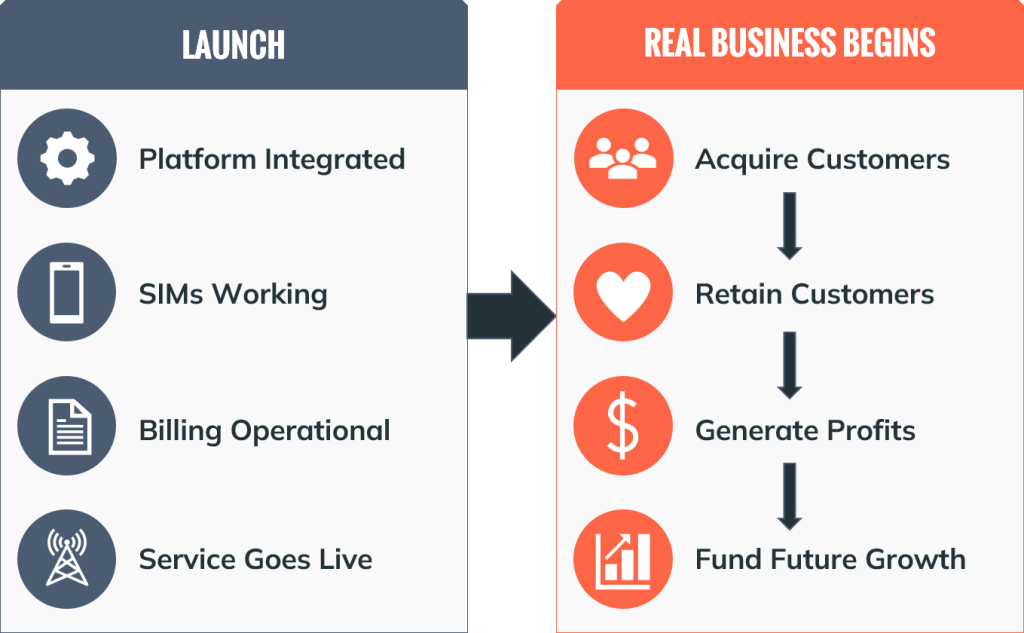
The first mistake many people make is assuming that launching an MVNO is the difficult part. This assumption is understandable because launch is visible. It involves months of preparation, commercial negotiations, technical integration, product development, regulatory approvals, testing, and project management. Teams work toward a clearly defined objective, and when the service finally goes live there is a sense of achievement.
What many founders discover afterwards is that launch proves almost nothing.
A successful launch demonstrates that a service can be deployed. It does not demonstrate that a business can be sustained. Many failed MVNOs launched perfectly successfully.
- Their systems worked exactly as intended.
- Their products functioned properly.
- Their customer journeys operated as designed.
The eventual failure occurred not because the launch failed, but because the business failed to achieve sustainable economics after launch.
This distinction matters because the industry spends enormous effort discussing how to launch and comparatively little discussing what happens afterwards. A significant proportion of business plans devote more attention to technical architecture than customer acquisition, more attention to platform selection than customer retention, and more attention to operational readiness than long-term profitability.
The implicit assumption is that once the service is available, customers will naturally arrive. Experience consistently suggests otherwise.
Illustration: MVNO Launch is the start – not the finish line
Why Customers Don’t Switch Operator as Easily as Forecasts Assume
Most consumers are not actively looking for a new mobile provider. Industry professionals often forget this because they spend their working lives discussing telecom services. The average consumer does not. Mobile connectivity has become a utility. Customers may complain about prices, network quality, or customer support but complaints alone do not create switching behavior.
Most people require a compelling reason to change providers because changing involves effort, uncertainty, and perceived risk. An MVNO therefore faces a challenge that is far greater than many founders initially assume. It must not simply offer a good product. It must offer a sufficiently compelling reason for customers to abandon an existing relationship and establish a new one.
This is where the discussion inevitably turns to differentiation and unfortunately differentiation is one of the most misunderstood concepts in the MVNO industry.
Price-Based Differentiation Rarely Lasts
Many operators believe they are differentiated because they offer lower prices, larger bundles, more generous data allowances, or a more attractive user experience. While these characteristics may be valuable at launch, they are rarely durable.
Traditional mobile operators can reduce prices. They can increase allowances. They can launch digital brands. They can replicate features. In highly competitive markets, they often do exactly that. A value proposition that appears unique during the planning phase can look surprisingly ordinary within a year of launch.
The operators that consistently outperform expectations tend to possess a different type of differentiation. Their advantage is not embedded within the tariff. It exists outside the tariff.
They have access to customers through channels that competitors struggle to replicate – trusted relationships, established communities, recognized brands, existing customer bases, or distribution advantages that reduce acquisition costs and strengthen retention. In these situations, connectivity becomes part of a broader value proposition rather than the sole reason for engagement.
Table 2. Easy-to-Copy vs. Sustainable Sources of MVNO Differentiation
| Easily Copied Differentiators | Sustainable Competitive Advantages |
|---|---|
| Lower prices | Existing customer relationships |
| Larger data bundles | Trusted brand reputation |
| Unlimited data offers | Loyal customer community |
| Feature-rich mobile app | Unique distribution channels |
| Promotional discounts | Integrated ecosystem and customer trust |
Customer Acquisition - Where Most MVNO Business Plans Miss the Mark
If there is one area where business plans consistently underestimate reality, it is acquisition economics. Almost every MVNO model contains assumptions about how quickly customers will join, how much they will cost to acquire, and how long they will remain. These assumptions often look reasonable in spreadsheets. The problem is that customers do not behave like spreadsheets.
- Real customers delay decisions.
- They ignore marketing campaigns.
- They compare alternatives.
- They forget to complete purchases.
- They postpone switching.
- They respond differently than focus groups predicted.
- They churn unexpectedly.
As a result, acquisition almost always proves more expensive and more difficult than forecast.
Many founders become intensely focused on wholesale pricing negotiations because wholesale pricing feels tangible – a reduction of a few percentage points can be measured immediately. Customer acquisition is more uncertain. It involves assumptions about behavior, competition, and market dynamics. Yet acquisition economics often have a greater impact on long term success than wholesale economics.
An MVNO that acquires customers efficiently can survive a mediocre wholesale agreement. An MVNO with excellent wholesale rates can still fail if acquisition costs become unsustainable.
Market Size Is Not Market Opportunity
One of the most common patterns among struggling MVNOs is an overestimation of market demand. This does not necessarily mean the target market does not exist, it means that the willingness of customers to switch providers is often weaker than anticipated.
Business plans frequently assume that a large addressable market automatically translates into a large opportunity. In reality, market size and market accessibility are very different concepts.
Consider the number of MVNOs that have targeted broad demographic groups such as young people, students, families, digital consumers, or budget-conscious users. These groups undoubtedly exist. The challenge is that they are visible to every competitor.
Traditional mobile operators understand them. Other MVNOs understand them. Marketing agencies understand them. Merely identifying a demographic does not create an advantage. An opportunity only becomes meaningful when an operator can reach that segment more effectively, serve it more effectively, or retain it more effectively than competitors.
The strongest MVNOs frequently succeed because they possess advantages that are difficult to observe in traditional market research – existing relationships through retail networks, financial services platforms, membership organizations, media brands, community groups, or enterprise channels.
These relationships reduce acquisition costs because trust already exists. They improve retention because customers receive value beyond connectivity. They create resilience because competitors cannot easily replicate the underlying relationship.
Scale Amplifies Your Existing Economics - Good or Bad
Another area where many operators encounter difficulties is the assumption that scale automatically creates profitability. This belief is deeply embedded within telecom thinking: fixed costs spread across a larger subscriber base, purchasing power improves, operational efficiency increases, margins expand.
While there is truth in this logic, it ignores an important reality = growth amplifies existing economics:
- If acquisition costs are excessive, growth amplifies the problem.
- If churn is high, growth amplifies the problem.
- If margins are weak, growth amplifies the problem.
- If support costs are poorly controlled, growth amplifies the problem.
Illustration: How growth amplifies existing economic challenges in an MVNO business
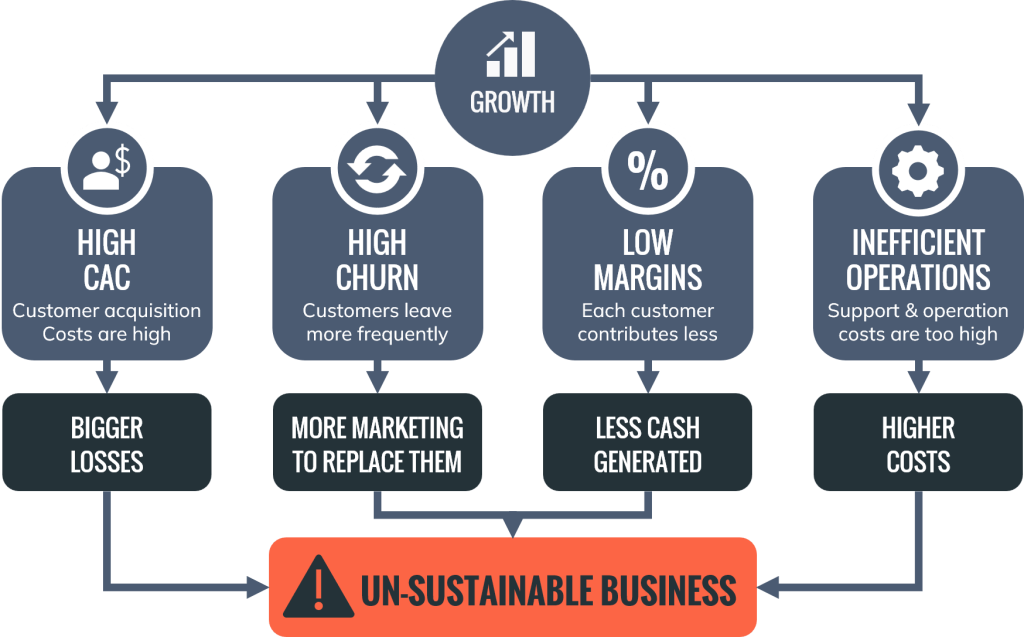
Scale is not a remedy for an unsustainable business model. It merely increases the size of whatever model already exists.
This explains why MVNO subscriber numbers can be remarkably misleading indicators of health. Industry headlines celebrate growth milestones because they are easy to communicate: 10,000 subscribers becomes 50,000, and 50,000 becomes 100,000.
These figures create an impression of momentum. What they do not reveal is whether those customers generate meaningful value.
An operator with 20,000 profitable customers may be in a healthier position than an operator with 200,000 customers acquired through aggressive discounting and retained through constant promotional activity.
The obsession with subscriber counts often obscures more important questions:
- What is the contribution margin per subscriber?
- How long does it take to recover acquisition costs?
- What percentage of customers remain after twelve months?
- How dependent is growth on continued marketing expenditure?
- How resilient are revenues during economic downturns?
These questions receive less attention because they are harder to answer, yet they provide a far more accurate indication of long-term viability.
Table 3. Metrics That Get Attention vs. Metrics That Drive MVNO Success
| Metrics That Get Attention | Metrics That Drive Success |
|---|---|
| Subscriber count | Contribution margin |
| Monthly activations | Customer acquisition cost (CAC) |
| Market share | Customer lifetime value (CLV) |
| Growth rate | CAC payback period |
| Download numbers | 12-month customer retention |
| Press headlines | Profitability and cash generation |
Time and Capital Run Out Before Opportunity Does
Time plays a larger role than many people appreciate. Most MVNO business plans contain timelines that appear logical at the start of a project. Launch occurs on a particular date, growth milestones are achieved within specified periods, break-even arrives according to forecast. Unfortunately, markets rarely cooperate with project plans.
- Customer acquisition takes longer.
- Partnerships develop more slowly.
- Distribution channels require refinement.
- Competitive responses emerge.
- Economic conditions change.
- Regulatory frameworks evolve.
The result is a problem that is not immediately visible in financial projections. Operators do not necessarily run out of opportunity. They run out of patience, capital, or strategic flexibility before the opportunity can fully develop. Investors become impatient. Management becomes increasingly focused on short-term performance. Cost reduction replaces investment. Ambition gives way to caution.
At this point, even potentially viable businesses can enter a downward spiral because the organization no longer possesses the resources or confidence required to pursue growth effectively.
When the Rationale for Launching Was Weak From the Start
It is also worth acknowledging that some MVNOs fail because the underlying rationale for launching was weak from the beginning.
The industry has spent years promoting the idea that almost any brand can become an MVNO. Technically, this is increasingly true, the barriers to launch are lower than they were twenty years ago. Commercially, the question remains far more complicated.
Not every brand benefits from offering mobile services. Not every customer base wants mobile services from the organizations they already use. Not every company possesses the operational capabilities required to compete effectively in telecommunications.
The fact that launching has become easier does not mean success has become easier. In some respects, the opposite is true. Lower barriers to entry have increased competition while making differentiation more difficult.
What MVNO Failure Actually Looks Like
When all of these factors are considered together, a different picture of MVNO failure begins to emerge. Most failures cannot be attributed to a single event or decision. They result from an accumulation of commercial weaknesses that gradually undermine the economics of the business:
- Customer acquisition proves harder than expected.
- Differentiation proves less durable than expected.
- Growth takes longer than expected.
- Margins become thinner than expected.
- Capital requirements become larger than expected.
None of these challenges individually destroys the business but together they create conditions that become increasingly difficult to overcome.
This is why the most useful answer to the question is also the least satisfying.
Most MVNOs fail for the same reason most businesses fail – they never establish a sustainable engine for creating, acquiring, and retaining value.
Telecom technology, wholesale agreements, regulatory frameworks, operational platforms all influence the outcome, but they rarely determine it.
What Successful MVNOs Do Differently
The industry often treats MVNO success as a telecommunications challenge. Experience suggests it is fundamentally a business challenge that happens to operate within telecommunications. MVNOs that understand this distinction tend to make better decisions from the outset:
- They spend less time obsessing over launch and more time understanding customer behavior before it.
- They spend less time searching for marginal improvements in wholesale pricing and more time improving acquisition economics.
- They focus less on subscriber counts and more on subscriber value.
- They recognize that connectivity itself is not the product – it is the vehicle through which a broader proposition is delivered.
That lesson appears repeatedly across markets, business models, and regulatory environments. The technology changes. The trends change. The terminology changes. The underlying principle remains remarkably consistent.
Successful MVNOs are not simply better telecom operators. They are better businesses.
Why MVNOs Fail – Frequently Asked Questions
What is the most common reason MVNOs fail?
The most common cause is not a single event but an accumulation of commercial weaknesses, acquisition costs that never become sustainable, differentiation that competitors replicate, growth that takes longer and costs more than forecast, and capital that runs out before the economics improve. Most failures are business failures, not technology or regulatory failures.
Does wholesale pricing determine whether an MVNO succeeds?
Less than most people assume. Wholesale pricing matters, but acquisition economics typically have a greater impact on long-term viability. An MVNO that acquires customers efficiently can survive a mediocre wholesale agreement. One with excellent rates can still fail if the cost of bringing customers in is never recovered. Founders often negotiate wholesale deals intensely because the numbers are tangible but spend less energy on the harder, less predictable question of how customers will actually be acquired.
Does growing the subscriber base fix weak unit economics?
No, and this is one of the most persistent misconceptions in the industry. Scale amplifies existing economics in both directions. If acquisition costs are excessive, growth makes that problem larger. If churn is high, growth makes that problem larger. Scale only improves margins if the underlying economics are already sound. It is not a remedy for a weak model.
Why do MVNOs targeting large demographic groups often struggle?
Because identifying a large addressable market creates no competitive advantage on its own. Broad demographic groups; young people, families, digital consumers, budget users – are equally visible to traditional operators, other MVNOs, and every marketing agency in the market. The operators that succeed in these segments typically hold an underlying advantage: an existing relationship, a trusted channel, a community connection, or a distribution network that allows them to reach and retain that audience at a lower cost than competitors.
Can any brand become a successful MVNO?
Not automatically. The fact that the technical barriers to launch have fallen does not mean the commercial conditions for success are easier to meet. Not every brand benefits from offering mobile services. Not every existing customer base wants connectivity from organizations they already use in another context. Not every company has the operational depth to compete in telecommunications. Lower barriers to entry have increased the number of launches — and the number of failures.
How important is timing for MVNO success?
More important than most business plans acknowledge. Operators rarely fail because the opportunity disappears – they fail because patience, capital, or strategic flexibility runs out before the business can reach sustainable economics. Investors become impatient, cost reduction replaces investment, and the organization loses the capacity to pursue growth. Many potentially viable MVNOs never reach the point at which their model would have worked.
What do successful MVNOs have in common?
They tend to hold differentiation that exists outside the tariff – relationships, channels, communities, or distribution advantages that competitors cannot simply replicate by cutting prices or increasing data allowances. They understand their acquisition economics before launch, not after. They measure subscriber value rather than subscriber volume. And they recognize that they are building a business that uses connectivity as a vehicle, not a connectivity business that happens to have customers.
See how MVNO strategy and positioning decisions affect outcomes in MVNO Strategy: Market Differentiation and Segmentation, or explore the MVNO Types & Operational Models to understand how the choice of operating model influences long-term commercial flexibility.
Summary
MVNO failure is rarely caused by a single mistake. It is usually the result of an accumulation of commercial weaknesses, acquisition costs that never become sustainable, differentiation built into the tariff rather than the relationship, growth assumptions that underestimate how slowly customers actually switch, and timelines that run out of capital before they run out of opportunity.
The technology, the wholesale agreement, and the regulatory environment all matter. But they rarely determine the outcome. The decisive factor is whether the business can consistently attract customers at a cost that makes economic sense, deliver enough value that those customers stay, and generate margins sufficient to fund the next stage of growth.
MVNO success is not a telecommunications challenge. It is a business challenge that happens to operate within telecommunications. The operators that understand that distinction earliest tend to make the best decisions.





LET’S TALK MVNO
If you have any questions, please fill out the form and a member of our team will get in touch with you. We are always open for talks on how we can add value to your MVNO.