
How Do You Know If Your MVNO Is Actually Profitable?
Quick Summary
MVNO profitability is one of the hardest questions for a management team to answer honestly. Most operators can report subscriber numbers, monthly revenue and ARPU within minutes. Those figures are tracked carefully because they are visible and easy to communicate.
True MVNO profitability requires a different analysis – one that includes every cost associated with creating, activating, serving and retaining customers, not just the revenue those customers generate.
Key observations:
- Subscriber growth is not profitability: a company can add customers while making the underlying economics worse – particularly when growth depends on discounting, expensive acquisition channels or high-usage customers who consume more than they pay for.
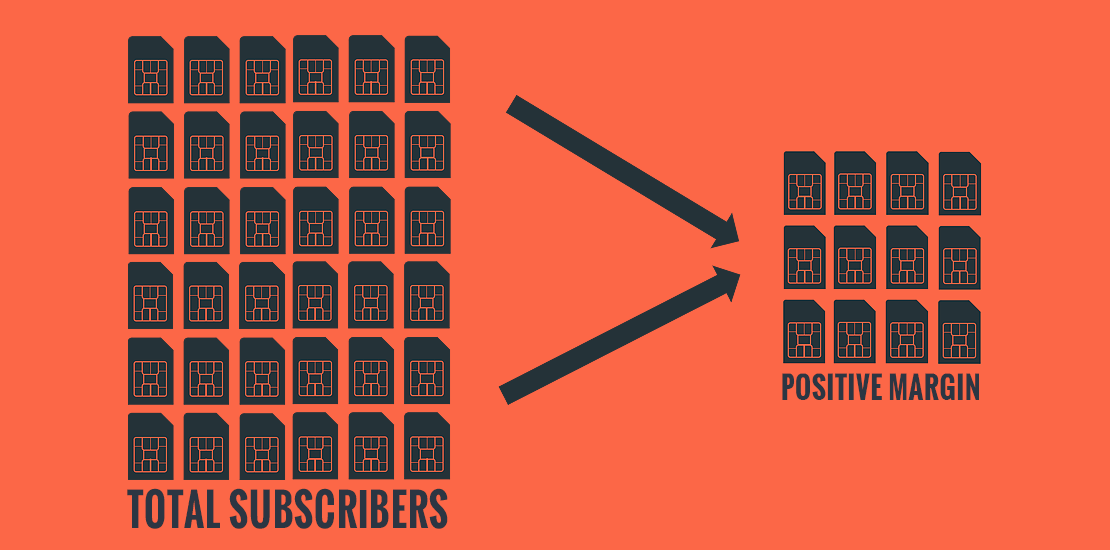
- Contribution margin is the number that matters: if each customer creates positive contribution after all direct costs, growth improves the business. If contribution is negative, growth increases the problem.
- Acquisition cost is often underestimated: the real cost includes commissions, promotions, onboarding, verification and internal effort – not just advertising spend.
- Retention is a profitability metric: every lost customer usually has to be replaced through additional acquisition spending. High churn makes it very difficult to recover acquisition investment.
- Wholesale costs behave differently under real usage: business plan assumptions are based on average behavior. Real customers are not average – and the outliers drive the economics.
- Billing visibility is essential at scale: small discrepancies in charging, reconciliation or usage reporting become significant financial issues as subscriber volumes grow.
- A profitable MVNO understands which customers create value: not just how many customers it has.
For the full analysis – why telecom economics are more complex than most founders expect, where profitability typically breaks down, and what operationally mature MVNOs measure differently – read on below.
One of the hardest questions for an MVNO management team to answer honestly is whether the business is actually profitable.
Most operators can tell you their subscriber numbers, monthly revenue, ARPU, churn percentage and marketing spend within minutes. Those numbers are tracked carefully because they are visible indicators of growth.
The more difficult question is what happens when all of the costs associated with creating, activating, serving and retaining those customers are properly included. This is where many MVNOs discover that the business they thought they were building and the business they are actually operating are not the same.
The reason this happens is that telecom economics are different from many digital businesses. In a software company, the cost of serving an additional customer may become very small once the platform exists.
In an MVNO, every customer creates a chain of operational activity.
- The customer consumes network resources,
- generates charging events,
- requires billing,
- creates support interactions,
- uses payment infrastructure,
- may require regulatory processing,
- depends on multiple suppliers working correctly behind the scenes.
The customer is not simply a line in a subscription database. The customer is an operational responsibility.
| 1. Network Usage | 2. Charging & Billing | 3. Support Interaction | 4. Fraud Exposure |
Why Revenue Alone Does Not Reveal MVNO Profitability
A business plan written before launch often simplifies this reality. It assumes that the company acquires customers at a certain cost, earns a certain monthly revenue and pays a predictable wholesale amount. The problem is that the assumptions behind those numbers usually come from a market model, not from the behavior of real customers using a live service.
Once the MVNO launches, customer behavior starts changing the economics:
- Data usage may be higher than expected.
- Customers may use more support than forecast.
- Promotional customers may leave as soon as the discount ends.
- A channel that appeared to provide cheap acquisition may bring customers with poor retention.
- A partnership expected to deliver thousands of subscribers may deliver many fewer active users than planned.
This is why profitability cannot be measured by subscriber growth alone. Subscriber growth is important, but it is only the beginning of the analysis.
The first question an operator needs to answer is not “How many customers do we have?” The better question is “What economic value does each customer create after every relevant cost has been included?”
Contribution Margin - The Number That Actually Matters
Understanding subscriber economics requires going much deeper than a simple monthly revenue calculation.
A customer paying $20 per month does not create $20 of value for the MVNO. From that amount, the company needs to consider wholesale network costs, platform costs, payment costs, customer care costs, fraud exposure, regulatory costs and the operational resources required to maintain the service. The remaining amount is the contribution margin.
Contribution margin is one of the most important measurements in MVNO economics because it shows whether adding more customers improves the financial position of the business.
If a customer creates positive contribution margin, growth can potentially create value. If a customer creates negative contribution margin, growth simply increases the size of the problem.
This is where some MVNOs get into difficulty. The company can look successful because revenue is increasing and subscriber numbers are rising, while the underlying economics are becoming worse.
A company may report that it added 100,000 customers in twelve months. That sounds impressive. However, the important questions are: how many of those customers are still active, how many are paying, how many generate positive margin, how much did it cost to acquire them, and how long will they stay?
The difference between registered customers, active customers and profitable customers can be significant.
Many MVNOs discover that their customer base contains several very different groups. There are highly valuable customers who stay for a long time, pay consistently and generate predictable usage. There are customers who only joined because of an introductory offer and leave when the commercial incentive disappears. There are customers who generate high support costs. There are customers who consume more network capacity than expected without generating enough revenue to compensate.
Without understanding these differences, the company is managing a subscriber number rather than managing a business.
MVNO Customer Acquisition Cost and Lifetime Value
Customer acquisition cost is often underestimated because companies focus on the marketing channel rather than the full acquisition process. The real cost is not only advertising spend. It can include commissions, promotions, sales partnerships, retail incentives, onboarding costs, verification costs and the internal effort required to convert a prospect into a paying customer.
A customer acquired for 100 may look attractive if the monthly revenue is 25. But if the customer only stays six months and has a low margin after wholesale and operational costs, the business has not created value. It has simply purchased temporary revenue.
This is why retention is so important in MVNO economics. Churn is not only a customer satisfaction metric – it directly affects profitability because every lost customer usually needs to be replaced through additional acquisition spending. An MVNO with high churn can appear to be growing while internally it is constantly replacing customers who never generated enough lifetime value.
| Metric | Sustainable Operator | Temporary Reseller |
|---|---|---|
| CAC Payback | Under 6 months | Over 12 months |
| LTV Drivers | Retention & Upsell | New Logo Volume |
| Margin Impact | Improving at scale | Diluted at scale |
MVNO Wholesale Economics Under Real Conditions
Many new MVNOs focus heavily on the headline wholesale rate because connectivity is one of the largest costs in the model. However, the relationship between wholesale cost and customer profitability is not always straightforward.
The actual cost of serving a customer depends on usage patterns, not only the price negotiated with the host operator. Two customers paying the same monthly fee can have very different economics. One may use moderate data, rarely contact support and remain subscribed for years. Another may consume large amounts of data, require frequent support and leave after a short period.
Wholesale costs also become more complex as the business scales. Early forecasts are often based on average assumptions. Reality is based on millions of individual usage events. The MVNO needs to understand how traffic patterns evolve, whether pricing remains aligned with usage, and whether the wholesale agreement provides enough flexibility as the customer base changes.
A common mistake is building a business model that only works under perfect conditions. A strong MVNO model should still function when customers consume more data than expected, when competition forces lower pricing, when acquisition costs increase and when operational costs grow.
The Hidden Costs That Undermine MVNO Margins
Profitability is also affected by costs that are frequently underestimated during the launch phase.
Customer support is one example. Many digital-first MVNOs assume support will remain minimal because the customer journey is designed around self-service. In reality, telecom creates customer issues that require human intervention – activation failures, number portability problems, payment issues, billing disputes, device compatibility and network questions all create operational demand. The cost of supporting customers at 10,000 subscribers is very different from supporting 500,000 subscribers. Processes that work early often fail when volumes increase.
Fraud and revenue leakage are another area where profitability can disappear quietly. A small percentage of incorrect charging, unmonitored usage, payment failures or reconciliation issues may not appear significant initially. At scale, those small percentages represent substantial financial impact.
Billing Visibility and Revenue Assurance
A mature MVNO needs visibility across the entire value chain. It needs to understand what the network reports, what customers are charged, what suppliers invoice, and whether those numbers match. Without that visibility, the operator is effectively accepting financial information from other parties without being able to independently verify it.
This is particularly important in wholesale relationships. The MVNO is dependent on the host network for connectivity, but it still needs confidence that the commercial relationship is transparent and measurable. Operators that lack this visibility often discover problems only after margins have already been affected.
The strongest MVNOs measure profitability at multiple levels. They analyze customer segments, products, acquisition channels and usage profiles. They understand which customers are valuable and which create cost pressure. They understand which acquisition channels create sustainable growth and which only create temporary volume. They understand whether a new product improves the economics or simply increases complexity.
This level of understanding is what separates an operator from a reseller. A reseller focuses on selling subscriptions. An operator understands the economics behind every subscription.
| Metric | Reseller Mindset | Operator Mindset |
|---|---|---|
| Primary Goal | Subscription Volume | Contribution Margin |
| Data Focus | Total Subscribers | Segmented Profitability |
| Cost Management | Reactive / Ad-hoc | Integrated / Proactive |
| Success Indicator | Revenue Growth | CAC Payback & LTV |
Summary
The ultimate test of MVNO profitability is not whether the company can attract customers. Most companies can attract customers if they spend enough money. The real test is whether the company can build a repeatable model where customers remain valuable over time, operational costs stay controlled, suppliers are managed effectively and growth improves the financial position of the business.
A profitable MVNO is not defined by the number of SIM cards in circulation. It is defined by whether the company understands exactly how each customer contributes to the business and whether that contribution remains positive as the company grows.
See how subscriber economics connect to scale decisions in How Many Subscribers Does an MVNO Really Need, or explore why MVNOs lose money even with customers in Why Do MVNOs Lose Money Even When They Have Customers.


LET’S TALK MVNO
If you have any questions, please fill out the form and a member of our team will get in touch with you. We are always open for talks on how we can add value to your MVNO.