
Thai MVNO regulation 2026 – Its Groundhog Day…again
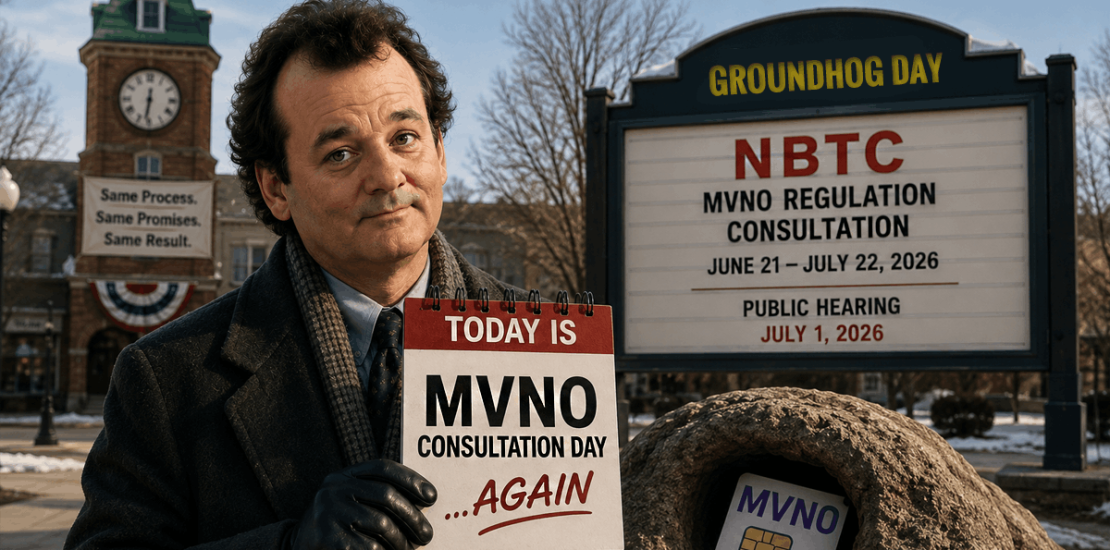
Another year, another NBTC consultation. MVNOs in Thailand hope this 2026 review will finally lead to real competition.
Thai MVNO regulation 2026, appears trapped in a regulatory version of Groundhog Day when it comes to Mobile Virtual Network Operators (MVNOs).
The regulator (NBTC) has once again launched a consultation on MVNO regulation, running from June 21 to July 22, 2026, with a public hearing scheduled for July 1. On paper, that sounds encouraging. In reality, most stakeholders have seen this movie before.
Why The Thai MVNO Regulation 2026 Feels Like an Endless Consultation Loop
For five or so (stopped counting) consecutive years, the MVNOs has been invited to hearings, consultations, focus groups, workshops, and discussions. Yet despite piles of paper and countless hours spent talking about lack of network access, wholesale pricing being higher than retail, and overall lack of regulation, very little (as in nothing) has changed where it actually matters.
The latest proposal contains many of the usual promises. Mandatory access. Non-discriminatory treatment. Dispute resolution mechanisms. All good concepts. Unfortunately, most of them have also appeared in previous versions, where they ultimately became regulatory decoration rather than practical market tools, and the question is whether any of it will ever be enforced.
A good example is the Focus Group Hearing on MVNOs conducted in early 2025. More than a year later, the supporting documentation, stakeholders feedback, and outcomes have still not been delivered to the MVNO participants. That alone tells you everything you need to know about the gap between process and execution.
The Long-Awaited Definitions for Thin, Medium, and Full MVNOs
To be fair, the new draft does contain some overdue improvements.
The proposal finally attempts to distinguish between Thin, Medium, and Full MVNOs. About time. MVNOs have been operating in Thailand for more than a decade, yet the last meaningful attempt to define these categories dates back to a period with voice mail and ringtones – before 4G deployment. Even then, and today the definitions lacked substance, details and practical relevance. By way of example it said a MVNO was allowed to own a IP router!
But do notice it says Full MVNO, so finally – at least on paper – the MVNOs can now update that IP router and voicemail to something meaningful.
Examining MNO Wholesale Obligations and New Cost Relief
The draft also seeks to clarify the obligations of Mobile Network Operators (MNOs) when selling wholesale services. Operators would be expected to provide access to all the technology thy have, and provide clear reasons if rejecting wholesale access requests.
Again, none of this is new. Similar principles have existed in one form or another for more than ten years. Yes now MVNOs have achieved access to the two private network operators left in the market.
The consultation also proposes promotion of MVNO and temporary cost-relief measures for MVNOs over a three-year period. These include reduced license fees on wholesale revenue, a 50% reduction in numbering resource fees, and the removal of certain quality-of-service reporting obligations intended to reduce administrative burden.
All well and good. But none of that means much if an MVNO cannot obtain network access in the first place.
The Path Forward: Access, Enforcement, and Accountability
The fundamental challenge facing the Thai MVNO sector has never been paperwork. It has been access, enforcement, and accountability. Until those three issues are addressed, every new consultation risks becoming another exercise in producing documents rather than producing competition.
The July hearing gives stakeholders another opportunity to push for change. Whether it becomes anything more than another annual ritual remains to be seen. The industry has heard the promises before.
Without a credible mechanism that moves these provisions from paper into practice, expectations remain low that the competitive landscape will change in any meaningful way.
It is like buying a pair of “Adidas” shoes from a stall in Patpong. From a distance, they have the right logos, stripes and colours. Everything looks genuine until you hand over the money, put your feet in them and discover what is actually underneath the packaging.
LATEST MVNO NEWS