
Telecom Regulator Caught With Its Pants Down: What the Meeting Minutes Really Reveal
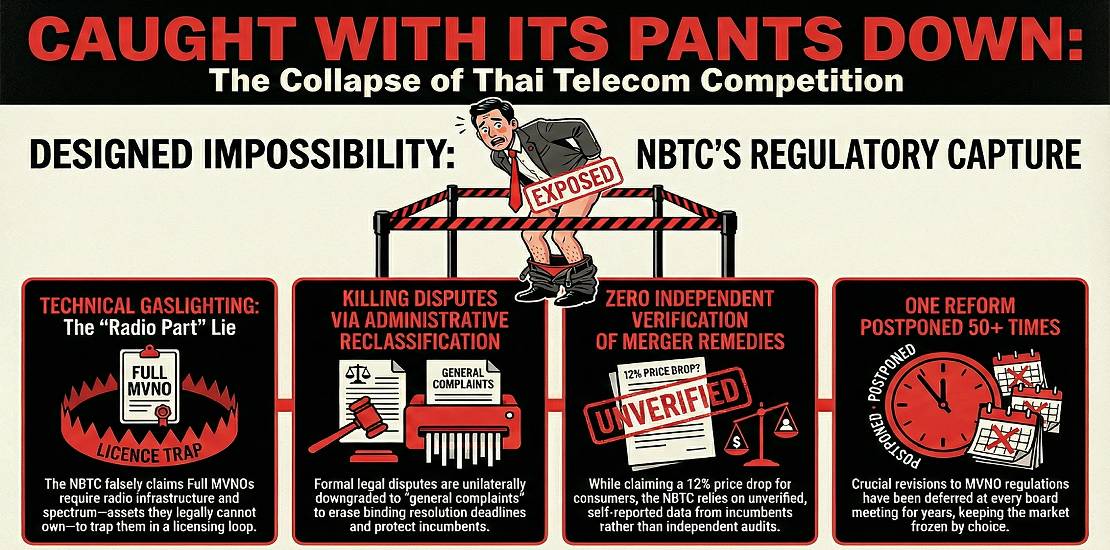
Transparency is a cold shower — when your own records contradict your public mandate
What the National Broadcasting and Telecommunications Commission (NBTC)’s own board minutes reveal – about the collapse of mobile virtual network operator (MVNO) competition in Thailand.
The National Broadcasting and Telecommunications Commission (NBTC) is Thailand’s telecom regulator. It is not a lawmaker. Its statutory role is to protect the public interest by implementing and enforcing existing law, including fair access, competition, and consumer safeguards.
What follows raises the question of whether the NBTC’s own record suggests it is still fulfilling that mandate.
In the interest of public transparency regarding the use of state regulatory powers, this article examines what the NBTC itself has put on the record.
The source material is not rumour, speculation, or anonymous briefings. It is the NBTC’s own board minutes – including Board Meeting No. 36/2025 (Agenda Item 4.20, concerning MVNO frameworks and merger remedies) and separate dispute-resolution deliberations recorded in other board meetings – along with related dispute records and regulatory outcomes.
Thailand talks endlessly about digital transformation, Industry 4.0, and innovation. None of that is possible under a mobile duopoly guarded by a regulator that cannot – or will not – enforce its own rules.
Those minutes of meeting strip away the convenient veneer of “incompetence.” We are no longer looking at a regulator that is “struggling to understand” telecom markets. We are looking at a documented pattern of procedural failure, technical inconsistency, and deviation from established regulatory standards – all with material consequences for competition.
Exhibit A: The “Antenna & Spectrum” Lie - Technical Gaslighting
Perhaps the most revealing exchange in the minutes occurs when an NBTC commissioner asks how Full MVNO, Medium MVNO, and Thin MVNOs are treated under the current regulatory framework.
The NBTC Office responds that a Full MVNO cannot be supported because it involves a “radio part” – antennas and spectrum.
This statement is factually incorrect.

A Full MVNO does not own radio infrastructure. No towers. No antennas. No spectrum. It owns core network elements – subscriber databases, switching, service logic, etc.
This is not controversial – This is telecom 101.
It is settled industry fact across Asia, Europe, North America, Latin America, the Middle East, Africa, and Oceania – in other words, everywhere telecoms are regulated competently.
Yet the NBTC Office chooses to assert the opposite to its own board.

Taken at face value, this is not a misunderstanding. It is a technical mischaracterization presented as regulatory fact. When such a misstatement is made in response to a direct board question, its effect is not neutral. It shapes outcomes.
Why does this matter?
Because it leads to a license trap.
By asserting that Full MVNOs require radio infrastructure, the NBTC Office forces would-be MVNOs to apply for license categories that legally require ownership of spectrum and base stations – assets an MVNO, by definition, does NOT and CANNOT possess.
More importantly, there is no Type 3 MVNO license available to apply for in Thailand.

The result is a perfect regulatory loop:
- MVNOs are told to apply for a license that does not exist.
- The NBTC Office promises future frameworks, consultations, or revisions.
- No timelines are provided.
- No interim remedies are offered.
- No accountability is triggered.
Competition is not rejected – It is deferred indefinitely.
This allows the NBTC Office to claim, with a straight face, that the MVNO market is “under review,” while the practical effect is to push competition further into the long grass.
Delay becomes the enforcement mechanism. Every month without a viable MVNO license framework:
- entrenches the duopoly,
- starves MVNOs of capital,
- and signals to domestic and international investors that Thailand is closed for competition.
This is how regulatory capture operates in practice. Not through outright prohibition, but through designed impossibility.
This is not confusion. It is a system that cannot fail – because it is built to ensure nothing ever starts.
Exhibit B: The Meetings That Never Happened
Following the technical mischaracterization outlined in Exhibit A, the NBTC Office repeatedly pointed to working groups, focus groups, and internal processes as evidence that MVNO issues were being “actively addressed.”
On paper, this sounds reassuring.

In practice, those meetings produced no visible outcomes, no traceable decisions, and no board-level accountability.
What makes the “radio part” claim even more consequential is its context.
In April 2025, the NBTC itself convened a MVNO Focus Group meeting with remaining MVNOs, MVNA operators, and the two mobile network operators (AIS and TRUE).
Crucially, the NBTC Office asked explicitly about Full MVNO models.
Industry participants responded in detail, explaining how Full MVNOs operate in practice. This was not unsolicited advocacy. It was explanation provided in direct response to a regulatory question.
What followed is remarkable.
- The NBTC did not publish minutes of those meetings.
- It did not circulate summaries.
- It did not release records of what was conveyed to the Board.
- Follow-up correspondence went unanswered.
And yet, one year later, the NBTC Office presented official board minutes asserting that Full MVNOs require a “radio part” involving spectrum and antennas.
At that point, this is no longer a matter of misunderstanding.
The most instructive evidence is not found in press statements or public speeches, but in a routine administrative exchange.
On 9 April 2025, the MVNO Focus Group meeting took place. Participants were explicitly assured that:
- the concerns raised would be forwarded to the NBTC Board, and
- supporting documentation would be provided.
Five months later, nothing had been received.
On 18 September 2025, a licensed market participant formally requested what should be routine in any functioning regulatory system:
- a summary of the Focus Group meeting,
- copies of written comments or recommendations sent to the Board, and
- confirmation of what information, if any, had been provided to commissioners ahead of key decisions, including the spectrum auction held in 2025.
The Office’s Written Reply:

The NBTC Office’s written response is revealing.
It confirms that:
- a working group exists,
- the issues have allegedly been discussed “monthly,” and
- matters have been referred onward to subcommittees appointed by the Board.
And yet, in the same letter, the Office states that it is “unable to provide a summary of the Focus Group meeting at this time.”
Read plainly, the implications are stark.
- The meeting occurred.
- Concerns were raised.
- Internal discussions allegedly followed.
But no documentary output – no summary, no recommendations, no board submission – can be produced.

As of the date of publication, none of the requested summaries, submissions, or records have been provided by the NBTC Office.
This is not a question of delay – It is an absence of record.
Process as a Substitute for Outcomes
The same response further explains that timing conflicts between the MVNO Focus Group and the spectrum auction decision were the responsibility of “various bureaus,” and that the issue has merely been “referred” for further consideration.
- Responsibility is diffused.
- No one owns the outcome.
- Nothing reaches the Board in a form that triggers accountability.
What remains is a regulatory process that exists in motion, but not in substance.
- Focus groups are convened.
- Working groups “discuss.”
- Subcommittees are referenced.
Yet when stakeholders request evidence that these processes have influenced policy or board deliberations, none is forthcoming.
Why This Matters
This is not a procedural quibble. It is the mechanism by which delay is normalized.
When a regulator solicits expert input, suppresses the record of that input, and subsequently documents an inverted technical position without explanation, the issue is no longer capacity or confusion. It is a documented deviation between consultation and outcome.
Without minutes, summaries, or board submissions:
- consultations cannot be audited,
- commitments cannot be verified, and
- regulators cannot be held to their own timelines.
Meetings without records do not inform decisions – They insulate them. This is how competition is neutralized without ever being formally rejected.
The meeting happened – The outcomes did not.
And when a regulator cannot produce the basic artefacts of its own consultative process, the issue is no longer whether the process failed – but whether it was ever designed to succeed.
Exhibit C: The Manufactured Margin Squeeze
In March 2023, Thailand’s NBTC decided it did not have the authority to approve or reject the merger between True and dtac, choosing instead to “acknowledge” it. The result was immediate and predictable: Thailand’s mobile market collapsed from three network operators to two.
Any regulator with a pulse understands what that means: higher prices, weaker service, less innovation.
To maintain the appearance of consumer protection, the NBTC imposed a condition: average retail prices must fall by 12% within 90 days. The conditions explicitly required independent verification of cost structures and pricing every four months to ensure the 12% reduction was real.
According to the Board minutes of Meeting No. 36/2025, NBTC leadership continues to assert that this obligation has been met.
Here is the documented problem: The NBTC never independently verified it.

For nearly three years since the merger, a mechanism for independent verification of retail pricing and cost structures – which was an explicit component of the TRUE–dtac merger conditions – has failed to produce any publicly available reports.
While the NBTC has asserted that the 12% price-reduction obligation has been met, it has not disclosed any independent consultant analysis, methodology, or verification outputs.
Instead, enforcement has relied on unaudited, self-reported data supplied by the very incumbents the regulator is tasked with overseeing.
According to the NBTC’s own records, verification of retail pricing has remained subject to “further consideration,” working-level review, or future process – language identical to that used for postponed MVNO framework amendments.
In other words, the verification mechanism exists in principle, appears on agendas, and is repeatedly acknowledged – but never concluded.
In regulatory practice, a remedy that cannot be independently audited is indistinguishable from no remedy at all.
Retail prices may appear lower on paper, but consumers pay through:
- reduced data allowances
- throttled speeds
- shortened validity periods
The effective price per gigabyte has increased – precisely what the merger condition was meant to prevent.
A mandated price reduction without verification is not a remedy – It is a press release.
From a national economic security perspective, this matters. Mobile pricing underpins SME competitiveness, digital inclusion, productivity growth, and investor confidence.
A regulator that cannot independently verify merger remedies is not merely failing consumers – it is weakening the foundations of Thailand’s digital economy.
From Fictional Retail Prices to Impossible Wholesale Prices
Because the NBTC never verified retail pricing, it has no factual baseline on which to calculate wholesale prices.
Yet the NBTC is now advancing wholesale pricing models that allow network operators to charge MVNOs more at wholesale than they charge consumers at retail.

The Baseline Problem: With retail promotions as low as THB 2.18/GB, an unverified “average” price (which includes higher-priced standard rates and legacy packages) might be calculated at THB 20/GB or more.
Wholesale Math: 30% off a THB 20 “average” leads to a wholesale price of THB 14/GB. This creates the impossible situation described: an MVNO must pay THB 14/GB at wholesale to compete with an MNO selling data at THB 2.18/GB at retail.
That is not a policy debate. It is the textbook definition of a margin squeeze – a practice prohibited under competition law in most jurisdictions.
The NBTC has been warned about this repeatedly in public hearings. It has done nothing.
Why? Because a margin squeeze does not harm the incumbents. It suffocates MVNOs quietly and cleanly.
And here is the closed loop that exposes the regulatory deadlock:
- If retail prices were genuinely verified, wholesale pricing would collapse.
- If wholesale pricing were genuinely regulated, the 12% retail reduction would be exposed as fiction.
So neither is checked.
Exhibit D: The MVNO Services Cases — A Bureaucratic Hit Job
If anyone still doubts whether intent matters, they should stop reading press releases and start reading case files.
The dispute involving MVNO Services Co., Ltd. is where the NBTC’s regulatory failure moves beyond delay and into documented procedural manipulation, raising serious questions about whether the regulatory process itself is now being used to suppress lawful competition.
Despite mandatory access obligations under NBTC regulations and the TRUE–DTAC merger conditions, TRUE refused to grant wholesale network access to MVNO Services. Faced with continued denial, the licensed MVNA did exactly what regulators publicly encourage market participants to do: it followed the rules.
On 10 March 2025, a formal mandatory-access dispute was filed with the NBTC. Under the governing framework, that filing automatically triggered statutory mediation requirements and a binding legal deadline for resolution.
That deadline was 17 August 2025.
What followed is fully documented in the NBTC Board minutes for meeting No. 25/2568. Agenda Item 5.1, and it is among the most instructive evidence in the regulatory record.

Reclassification as a Regulatory Weapon
Instead of processing the case as a formal dispute, the NBTC Office unilaterally reclassified it as a “general complaint.” This single administrative act had immediate legal consequences:
- statutory mediation obligations were extinguished,
- the binding resolution deadline disappeared, and
- no enforceable decision was any longer required.
The dispute did not fail on the merits – It was procedurally neutralized.

This was not done in a vacuum. The minutes of meeting from the August 27, 2025 board meeting, recorded four of the seven commissioners, openly challenging the NBTC Office’s move to dismiss the MVNO Services Co., Ltd. dispute and turning it in to a simple complain.
They questioned how a legally defined dispute could be downgraded without Board instruction and warned that statutory timelines cannot be erased through administrative relabeling.
Commissioner Dr. Pirongrong Ramasoota: Filed a formal written dissent, warning that the NBTC had violated the 90-day statutory deadline (which expired August 17). She noted that the Office’s reclassification of a “Dispute” as a “General Complaint” was a procedural overreach that exposed the commission to lawsuits for dereliction of duty.
Commissioner ACM Dr. Thanapant Raicharoen: Expressed a lack of confidence in the NBTC Office’s process, stating that the refusal to accept the case as a dispute was contradictory to the rules. He argued the NBTC must follow the law by accepting the dispute for consideration first rather than allowing the administrative arm (the NBTC Office) to unilaterally dismiss it.
Commissioner Torpong Selanon inquired how the NBTC could legally justify the fact that the 90-day mandatory deadline had already passed, exposing the procedural mess created by the Office’s dismissal attempt.
Commissioner Prof. Dr. Suphat Suphachalasai warned that reviewing qualifications before formally triggering the dispute process was procedurally backward, stating metaphorically that it was like “the rear wheel overtaking the front wheel” – a Thai idiom signaling that the procedural order had been fundamentally inverted.
Despite these warnings, the NBTC Office proceeded.
Licensing as an Obstruction Mechanism
To justify its actions, the NBTC Office relied on a familiar explanation: licensing.
It asserted that MVNO Services’ platform architecture required a Type 3 (Full MVNO) license, even though no such license framework currently exists in Thailand.
The implications are difficult to reconcile with any coherent regulatory logic:
- the NBTC had already approved MVNO Services’ Type 1 MVNA license, including the very platform design now deemed problematic;
- the company was then told it must apply for a license that cannot be applied for, because the framework remains “under development.”
This creates a closed regulatory loop:
- Apply for a license that does not exist — or do not operate.
- Wait for a framework with no timeline — or exit the market.
Either way, competition is suspended without ever being formally denied.
Evidence Excluded, Outcomes Preserved
Compounding matters, the NBTC Office failed to present the Board with material evidence.
Documented records of MVNO Services’ repeated good-faith attempts to engage TRUE – including technical access requests, suggestion to invite NBTC to the meetings, correspondence, and meeting proposals – were absent from the materials circulated to commissioners. The Board was therefore asked to deliberate on an incomplete factual record.
The outcome was predictable.
- TRUE faced no enforcement.
- The dispute expired.
- The market remained closed.
The Reset Mechanism
After the dispute lapsed, MVNO Services did not disengage.
The company formally petitioned the NBTC Board, demonstrating that its access request fell squarely within its existing Type 1 MVNA license – the same conclusion the NBTC itself had previously endorsed. It then re-submitted the same wholesale access request to TRUE, copying the NBTC Office in full.
This time, the NBTC Office responded. It explicitly acknowledged that the request was indeed covered by the existing license.
And then, rather than correcting the original procedural failure, the Office treated the re-submission as an entirely new case.

This achieved two outcomes simultaneously:
- the procedural irregularities of the original case were rendered moot without being addressed;
- the response timeline for TRUE was reset in full.
Same request, Same license, Same parties. New case. New clock.
This is not dispute resolution – It is administrative reset as policy.
Why This Matters
In the interest of public transparency and national economic security, the question raised by this record is unavoidable. When a regulator repeatedly resolves procedural ambiguity in ways that protect incumbents from binding outcomes, is the system still enforcing the law – or merely administering delay?
At that point, the issue is no longer the conduct of a single operator. It is whether the regulatory process itself has become a mechanism for preserving market closure while maintaining the appearance of oversight.
Source Note: National Broadcasting and Telecommunications Commission (NBTC) Board Minutes, Meeting No. 25/2025, Agenda Item 5.1 (pp. 91–98). The minutes record the filing of a formal mandatory-access dispute on 10 March 2025, the applicable statutory resolution deadline of 17 August 2025, and the NBTC Office’s decision to reclassify the dispute as a “general complaint.” Multiple commissioners are on record objecting to this reclassification, warning that statutory procedures and timelines cannot be overridden administratively – including Commissioner Dr. Suphat Suphachalasai’s statement likening the process to “the rear wheel overtaking the front wheel.” The minutes further reflect concerns that failure to process the dispute correctly could expose the regulator to legal challenge.
Exhibit E: Another Catch-22
The rot does not stop with TRUE.
It extends directly into the NBTC’s handling of the dispute involving AIS (via its subsidiary AWN) – and into a decision that demonstrates how operator preferences, and even prior regulatory failures, are allowed to substitute for law.

According to the NBTC Board Minutes of Meeting No. 31/2568 on October 21, 2025 (Page 116-129), the NBTC accepted AIS’ refusal to grant wholesale access on the basis that the requesting MVNO lacked sufficient “operational history” in the Thai market.
That requirement does not appear in the Telecommunications Business Act.
It does not appear in the NBTC’s MVNO Notifications.
It does not appear in any binding regulation.
It appears only in the operator’s own Reference Access Offer – in other words, a homemade eligibility rule invented by the incumbent, not enacted by the regulator.
The NBTC did not reject this substitution of private rules for public law – It accepted it!
When a Failed Decision Becomes a Template
What makes this case more troubling is how the NBTC Office justified its position.
Rather than assessing the AIS dispute on its own facts, the Office imported “technical incompatibility” conclusions from the unrelated dispute involving TRUE and applied them to this separate case.

Those alleged incompatibilities were not generic. They related specifically to the NBTC Office’s mischaracterization of Full MVNO architecture – the same “radio part” fiction described in Exhibit A.
This matters because the entity requesting access from AIS was not seeking Full-MVNO (Type 3) access at all. It was operating under its Type 1 MVNA license, explicitly approved by the NBTC, and fully compliant with that license’s technical scope.
In other words, a technical objection built on a non-existent Full-MVNO requirement was transplanted into a case where it had no factual relevance.
AIS itself never raised a technical objection – Its refusal was purely commercial.
Yet the NBTC Office treated the case as if it raised the same Full-MVNO issues it had already mishandled elsewhere, effectively allowing one procedurally defective decision to contaminate another.
This is a basic violation of administrative-law principles.
Each dispute must be assessed on its own merits. Findings from one case cannot be reused to prejudice another without factual examination, due process, or party-specific evidence.
At the NBTC, this distinction collapsed.
Think about that for a moment.
You cannot operate without access. You cannot obtain access without having operated, and the incumbent – aided by recycled regulatory reasoning – gets to decide when you qualify.
The “No History” Claim That Collapses on Contact With Facts
The irony is sharper still.

The leadership behind the MVNA in question has 25 years of MVNO operational history, meaning its MVNO expertise began a decade before the NBTC was even established in 2010, and 13 years before AIS acquired its first spectrum license.
In other words, the entity deemed to lack “operational history” has been designing, launching, and operating MVNOs since before Thailand’s current regulatory architecture, and one of its incumbent beneficiaries, even existed in their present form
The claim that it lacked “operational history” was not merely unsupported. It was factually inverted. If “history” were the standard, this entity would rank among the most experienced MVNO operators the regulator has ever encountered.
That fact did not feature in the NBTC Office’s reasoning.
Evidence Ignored, Authority Delegated
In a formal petition submitted to the Board, the MVNA demonstrated – with documentary evidence – that:
- AIS raised no technical objections, only commercial conditions;
- the “operational history” requirement had no legal basis;
- importing Full-MVNO conclusions into a Type 1 MVNA case violated administrative-law principles; and
- allowing operators to invent eligibility rules constituted an unlawful non-tariff barrier to market entry.
The petition explicitly warned that this approach breached the principle of legality, under which only the regulator – not licensees – may define market-entry requirements.
The NBTC has not revoked the decision yet. Instead, the case remains suspended in manufactured regulatory limbo: no access granted, no binding remedy issued, no timeline imposed.
The outcome is familiar.
Competition remains frozen. The duopoly remains untouched, and the regulator, by action and inaction alike, has allowed private operators – and its own prior errors – to dictate market structure.
This is not enforcement failure. It is regulatory reasoning by copy-paste, and delegation of power to those the law was meant to restrain.
Source Note: National Broadcasting and Telecommunications Commission (NBTC) Board Minutes of Meeting No. 31/2568, dated 21 October 2025 (pp. 116–129). The minutes record the NBTC Office’s handling of a wholesale access dispute involving AIS (AWN), including acceptance of the operator’s refusal to provide access based on an asserted requirement that the requesting MVNA demonstrate prior “operational history” in the Thai market. The minutes further reflect that this requirement does not originate from statute or NBTC regulation, but from operator-defined access conditions. The record shows that AIS raised no technical objections, and that the NBTC Office nevertheless applied technical conclusions derived from an unrelated dispute involving another operator to justify its position. The minutes also note that a formal petition was submitted requesting revocation or correction of the decision, and that the matter remains unresolved, with no binding remedy imposed and no access granted.
Exhibit F: The MVNO Agenda Item That Never Moves
If delay is the NBTC’s preferred enforcement tool, Agenda Item 4.6 is its clearest fingerprint.

Agenda Item 4.6 – “Report on Issues for Improving the NBTC Announcement on Virtual Network Mobile Phone Services B.E. 2563 (2020)” – appears in the Minutes of Board Meeting No. 36/2025. Its closing line is unambiguous:
“The meeting did not consider this agenda item. The NBTC Office will propose it again for inclusion. The agenda item remains under consideration.”
This language is not exceptional. It is routine.
The same substantive item was entered as Agenda Item 4.16 in 2024, and has appeared – under renumbered agenda items – at every subsequent Board meeting. Each time, it is postponed. Each time, it “remains under consideration.”
By conservative count, the Board has deferred this item more than 50 times!!!
This matters because this is not a peripheral housekeeping issue.
This agenda item concerns revising the 2020 MVNO Notification – the very instrument that governs:
- MVNO licensing categories
- access obligations
- wholesale pricing structures
- and the regulatory treatment of Full, Medium, and Thin MVNOs
In other words, this is the formal mechanism by which the NBTC could have resolved – years ago -every issue described in Exhibits A through E.
Instead, the Board repeatedly declines to consider it.
There is no vote to reject.
No instruction to accelerate.
No interim guidance.
No deadline.
No accountability.
Just perpetual deferral.
The significance is twofold.
First, it explains how the NBTC can publicly claim that MVNO policy is “under review” while allowing the underlying regulatory framework to remain functionally unenforceable. The review never concludes, and therefore never produces obligations that must be enforced.
Second, it exposes how delay itself has become a governing tool. By indefinitely postponing the one agenda item capable of correcting structural defects in MVNO licensing, access, and wholesale pricing, the NBTC preserves the status quo without ever taking responsibility for it.
This is how markets are frozen without formal prohibition.
This is how incumbents are protected without explicit favor.
And this is how accountability is avoided without openly defying the law.
When a regulator has deferred the same corrective agenda item more than FIFTY TIMES, the question is no longer when reform will occur. It is whether deferral itself is the intended outcome.
When an agenda item remains “under consideration” for years while the market collapses, licenses become unusable, disputes are neutralized, and merger remedies go unaudited, the explanation is no longer workload or complexity – It is choice.
The agenda Item demonstrates that the NBTC is not failing to find a solution. It is refusing to activate one. Delay here is not a side effect of governance. It is the governance model.
Conclusion: What Regulatory Capture Looks Like in Practice
Across Exhibits A through F, the same mechanisms repeat.
- operator-invented rules are allowed to substitute for law.
- merger remedies are imposed but never independently audited.
- statutory disputes are neutralized through reclassification and delay.
- basic telecom architectures are mischaracterized to justify exclusion.
- consultations are convened without records, outcomes, or accountability.
- wholesale pricing is derived from retail figures the regulator has never verified.
This is not a catalogue of mistakes. It is a system functioning exactly as designed – one in which procedure replaces enforcement, process substitutes for outcomes, and delay becomes the regulator’s most effective tool.
The result is not neutrality – It is protection.

For Thai consumers, this manifests as a permanent “connectivity tax” embedded in every mobile bill – higher effective prices, fewer choices, and declining service quality, all hidden behind the language of compliance.
For SMEs, innovators, and investors, it signals that market entry is conditional not on law, but on incumbent consent.
More than 65 companies applied for, paid for, and invested in MVNO licenses in reliance on the NBTC’s own regulatory framework. Capital committed, staff hired, business plans approved – all on the premise that lawful access would be enforced.

In practice, most of those licenses have been rendered commercially meaningless. They exist on paper, but not in the market. This is not regulatory risk. It is regulatory-induced loss, borne entirely by private actors who relied on the state to apply its own rules.
Thailand speaks frequently about digital transformation, Industry 4.0, and innovation. None of that is compatible with a market reduced to a duopoly and overseen by a regulator that cannot – or will not – enforce its own rules.
In the interest of public transparency, it bears repeating: this analysis is not based on speculation or allegation. It is grounded in the NBTC’s own Board minutes, and in the regulator’s documented handling of access disputes and remedies.
Those records do not merely expose regulatory failure. They raise the unavoidable question of whether the NBTC is still fulfilling its statutory mandate to protect the public interest.
Once that question is credibly raised, the burden of proof shifts. Not to the critics – but to the regulator. At that point, it is reasonable to ask whether the matter now warrants scrutiny beyond the sector itself.
The National Anti-Corruption Commission (NACC) – Thailand’s constitutional oversight body responsible for investigating abuse of public power – exists for situations where regulatory processes appear to operate systematically against the public interest.
The documents are already on the record – The question is no longer whether there is a case to answer – but who will ask it.

Latest MVNO News



LET’S TALK MVNO
If you have any questions, please fill out the form and a member of our team will get in touch with you. We are always open for talks on how we can add value to your MVNO.