
How Many Subscribers Does an MVNO Really Need?
Quick Summary
How many MVNO subscribers does an MVNO actually need to be Profitable? It is one of the first questions almost every founder asks, and it rarely has a satisfying answer – because the right number of MVNO subscribers depends entirely on what each one contributes to the business.
Key observations:
- Subscriber numbers are not the right measure: an operator with 20,000 profitable customers may be in a stronger position than one with 200,000 subscribers acquired through discounting and constant promotional activity.
- There are two separate break-even points: covering fixed costs is not the same as building a business with attractive returns. Many MVNOs reach the first without ever reaching the second.
- Higher ARPU does not mean a better customer: a higher-paying customer acquired through expensive channels may be worth less than a lower-paying customer reached through an existing community relationship.
- Acquisition costs often determine the real subscriber number needed: if customers leave before acquisition costs are recovered, growth destroys value rather than creating it.
- Distribution and existing relationships change the equation entirely: an operator that already has access to customers operates in a fundamentally different economic reality from one that must build awareness from zero.
- Work backwards from the economics, not forwards from a target: the subscriber number required is an output of the business model, not an input to it.
For the full analysis – why subscriber counts mislead, how acquisition costs determine the real break-even, and how churn can make growth meaningless – read on below.
One of the first questions almost every MVNO founder asks is: how many MVNO subscribers do we need before this business works?
It is a logical question. Telecom has always been an industry where scale matters. For decades, the assumption has been that mobile is a scale business and that success is ultimately a numbers game. This thinking has carried over into the MVNO sector, often without enough consideration of how different the economics actually are.
The simple answer is that there is no universal subscriber number that makes an MVNO successful. Some MVNOs can build attractive businesses with a relatively small subscriber base.
Others can reach hundreds of thousands of subscribers and still struggle to generate sustainable profitability. The difference is not primarily the number of customers.
The difference is the economic value created by each customer and the cost required to acquire, serve and retain them.
Why the Number of MVNO Subscribers Is the Wrong Measure
This is one of the most misunderstood areas in the MVNO industry because subscriber numbers are visible. They are easy to communicate. They appear in press releases, investor presentations and industry reports.
A company announcing it has reached 100,000 subscribers sounds like a success story. A company announcing it has improved contribution margin per customer by 20% sounds far less exciting, even though the second achievement may be far more important for the survival of the business.
The danger is that subscriber growth can become a substitute for understanding the business model. An operator can grow quickly while moving further away from profitability – acquiring customers through discounts, promotions and expensive marketing campaigns, creating the appearance of momentum while damaging the underlying economics.
The market often rewards growth in the short term, but eventually every MVNO must answer the same question: are these subscribers creating value?
Two Break-Even Points Every MVNO Must Cross
A useful starting point is to understand that an MVNO has two separate challenges – reaching enough customers to cover its fixed costs, and reaching enough customers to create attractive returns after all variable costs are considered.
The first challenge is operational break-even: the business needs enough subscribers generating enough gross margin to pay for employees, systems, customer support, marketing infrastructure, compliance requirements and other ongoing expenses.
The second challenge is strategic success: the business needs enough profitable customers to justify the investment, provide returns to shareholders and support future growth.
These two points are often confused. An MVNO can technically reach break-even while still being a disappointing investment.
It can survive without creating meaningful shareholder value. Conversely, an operator can operate at a loss during a growth phase while building a valuable business – if customer economics are strong and the path to profitability is realistic.
This is why the question should not simply be “how many MVNO subscribers do we need?” The better question is: what does each MVNO subscriber contribute to the business?
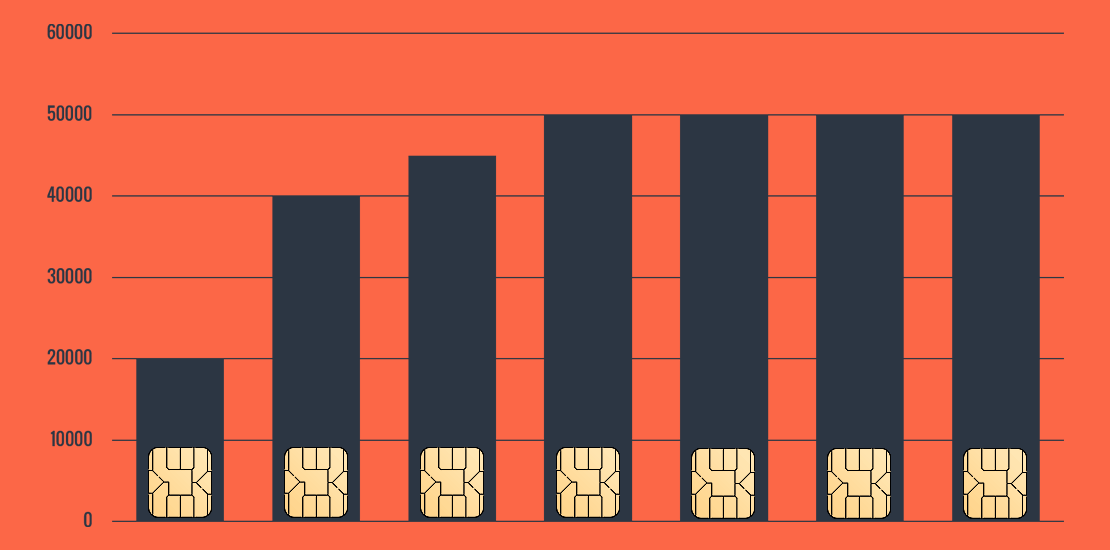
Scaling an MVNO is often described as a single climb toward profitability, but that is a dangerous oversimplification. In reality, you are navigating two distinct thresholds: the operational floor required to keep the lights on, and the strategic ceiling required to build actual shareholder value.
The chart below visualizes these two targets:
- The First Bar represents your Fixed Cost expectation, the floor you must clear just to operate.
- The Second Bar marks the 20,000 subscriber milestone, which acts as your Survival line.
- The Third Bar demonstrates the impact of reaching 50,000 subscribers, creating a clear visual gap between merely “breaking even” and truly “thriving”.
By distinguishing between these milestones, you can move from chasing arbitrary numbers to targeting the specific growth required for strategic success.
What Each MVNO Subscriber Actually Contributes
The economics of an MVNO are determined by the relationship between revenue, direct costs and acquisition costs.
A subscriber paying more per month is not necessarily more valuable than one paying less.
The higher-paying customer may require expensive sales channels, heavy support, large commissions or aggressive retention incentives.
The lower-paying customer may come through an existing community relationship, remain for many years and require minimal support.
The industry focuses heavily on average revenue per user (ARPU) because it is a familiar telecom metric. ARPU matters, but on its own it does not tell the whole story.
The important metric is contribution after all relevant costs are considered. The example below illustrates how two very different businesses can sit behind similar subscriber numbers:
Table: MVNO A vs MVNO B – why ARPU alone does not determine subscriber value
| Metric | MVNO A (Low Churn/High Eff.) | MVNO B (High Churn/High Cost) |
|---|---|---|
| Monthly ARPU | €25 | €12 |
| Wholesale and usage costs | €10 | €5 |
| Support and operational costs | €3 | €1.50 |
| Monthly contribution | €12 | €5.50 |
| Customer acquisition cost (CAC) | €30 | €80 |
| Average customer lifetime | 36 months | 18 months |
| Total Lifetime Contribution | €432 | €99 |
| Net Value (Total – CAC) | €402 | €19 |
At first glance, MVNO A appears stronger simply due to its higher ARPU. But the true disparity emerges only when we account for the cost of acquisition and churn.
While MVNO B generates revenue, its un-sustainable Customer acquisition cost (CAC) and short customer lifecycle result in a net value per subscriber that is over 20 times lower than MVNO A.
This illustrates why revenue volume is a poor proxy for business quality – in the MVNO sector, the economics of retention and acquisition define the outcome far more than the headline price plan.
Why Customer Acquisition Costs Often Determine the Real Number
Many MVNO business plans become unrealistic because they model MVNO subscriber growth as if every customer contributes immediately to profitability. In reality, every new MVNO subscriber comes with an acquisition cost that must be recovered before the customer generates meaningful value.
If an MVNO spends €100 to acquire a customer and that customer generates €5 per month in contribution, the business needs 20 months simply to recover acquisition costs. If the average customer stays for 12 months, the business loses money on every customer – even while MVNO subscriber numbers are growing.
Many MVNO plans fail because they treat every new subscriber as an immediate profit contributor. In reality, every customer begins as a liability – you must first recover your acquisition cost before they begin to generate value. The chart below shows the “Payback Period” for our two MVNO examples:
The Dark Line (MVNO A) shows a healthy trajectory, where the customer becomes profitable within a few months,
The Light Line (MVNO B) illustrates the “Growth Trap”, where high acquisition costs and churn mean the customer may never pay back their cost of entry.
If your average customer leaves before the line crosses the zero-axis, you are not scaling, you are simply subsidizing customer churn.
This is one of the reasons why some MVNOs appear successful from the outside while internally struggling. Subscriber numbers increase, revenue increases, the brand gains visibility – but the business is effectively buying growth. Growth purchased at a loss is not the same as sustainable growth.
Another reason subscriber targets are often misunderstood is that market opportunity is frequently overestimated. Founders look at a large customer segment and assume that capturing a small percentage creates a significant business.
The missing factor is switching behavior. A large potential market does not mean customers will move.
How Distribution and Existing Relationships Change the Equation
The majority of mobile users are not actively searching for alternatives. They have an existing provider, an existing number, established habits and a level of convenience.
Even dissatisfied customers often remain because switching requires effort. An MVNO therefore does not only compete against other operators – it competes against customer inertia.
This is why distribution and existing relationships are so important. An MVNO that starts with access to customers is in a fundamentally different position from one that must create awareness from zero.
A bank launching a mobile service to existing customers, a retailer launching through existing stores, or a community organization offering connectivity to members may require a much smaller subscriber base – because acquisition economics are fundamentally different.
The operator is not paying the full cost of creating the customer relationship. A purely digital consumer MVNO, by contrast, may need a much larger subscriber base because every customer must be reached through competitive marketing channels.
Churn Changes the Equation
Growth is not only about adding customers – it is about keeping them.
An operator adding 10,000 customers per month sounds impressive. However, if it loses 9,000 customers per month, the actual growth rate is limited. More importantly, the business may be continuously replacing customers instead of building a valuable subscriber base.
High churn creates multiple problems. It increases acquisition costs because the operator must constantly replace lost customers. It reduces lifetime value because customers leave before the business recovers its acquisition investment. It creates operational instability because forecasts become unreliable. It can also indicate deeper issues with product-market fit.
Successful MVNOs pay close attention not only to how many customers they acquire, but to why customers stay. Retention is often where the strongest MVNOs separate themselves from weaker ones – they create reasons for customers to remain connected to the brand, whether through community, service quality, integration with other products or a unique proposition that customers cannot easily replace.
Working Backwards From the Economics
A practical way to think about MVNO subscriber requirements is to work backwards from the economics rather than forward from a subscriber milestone.
Start with the fixed costs required to operate the business – people, technology, compliance, support, marketing infrastructure and management overhead. Then calculate the contribution generated by each customer after direct costs. The difference between these numbers determines the approximate MVNO subscriber requirement.
For example: an MVNO with 200,000 in monthly fixed costs and 10 in monthly contribution per subscriber requires approximately 20,000 active subscribers to cover those costs. An operator with only 5 contribution per subscriber requires approximately 40,000.
However, this calculation still requires caution because real businesses are dynamic. Costs change as the company grows. Support requirements increase. Technology needs evolve. Marketing efficiency may improve or decline. Wholesale agreements change.
This is why experienced operators avoid treating MVNO subscriber targets as fixed destinations – they treat them as outputs of a business model. If the model improves, fewer MVNO subscribers may be required. If the model deteriorates, more may be required.
The most successful MVNOs are usually not those that obsess over reaching the largest possible MVNO subscriber number. They are those that understand exactly what type of subscriber they want, why that subscriber joins, why that subscriber stays and how much value that relationship creates.
Subscriber growth is necessary – but it is not the objective by itself. The objective is building a business where every additional MVNO subscriber strengthens the economics of the company.
Summary
The right subscriber number for any MVNO is an output of its specific business model, not a benchmark borrowed from another operator. For one business it might be 20,000. For another it might be 200,000. For a specialized B2B operator it might be a few thousand.
What determines that number is not the size of the target market – it is the contribution generated by each MVNO subscriber, the cost of acquiring them, the average length of the relationship, and the fixed cost base that all of those subscribers must collectively support.
Operators that understand those variables before scaling tend to make better decisions. Those that chase subscriber milestones without understanding the underlying economics can find that growth makes an existing problem larger rather than smaller.
Explore how MVNO operating model choices affect cost structure and control in MVNO Types and Operational Models, or see how acquisition economics connect to broader strategy in MVNO Strategy: Market Differentiation and Segmentation.



LET’S TALK MVNO
If you have any questions, please fill out the form and a member of our team will get in touch with you. We are always open for talks on how we can add value to your MVNO.