
MVNA MVNE MVNO – Explained
Quick Summary
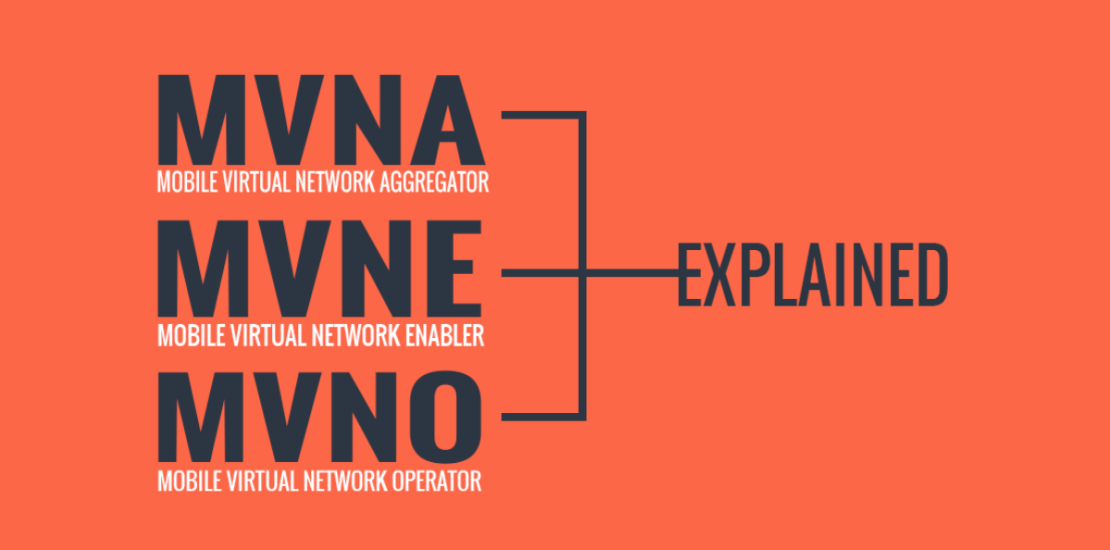
The world of mobile telecommunications is complex, with multiple players working together to deliver the services we use daily. While we’re all familiar with major mobile operators, there’s an entire “virtual” ecosystem operating behind the scenes consisting of the Mobile Virtual Network Operator (MVNO), the Mobile Virtual Network Aggregator (MVNA), and the Mobile Virtual Network Enabler (MVNE).
- MVNO (Mobile Virtual Network Operator): A company that provides mobile services to customers but doesn’t own the radio spectrum, cell towers, or core network infrastructure. It leases network access at wholesale rates and resells services under its own brand, pricing, and customer service.
- MVNA (Mobile Virtual Network Aggregator): A middleman between a major MNO and multiple smaller MVNOs. It buys massive amounts of voice, data, and SMS capacity in bulk to provide MVNOs with better wholesale rates and simplified access without the hassle of complex negotiations.
- MVNE (Mobile Virtual Network Enabler): The partner that provides the technical platform and operational support—such as billing, CRM, and SIM management—that allows an MVNO to function without building its own costly IT infrastructure from scratch.
The Shopping Mall Analogy: Think of the MNO as the Landlord who owns the building, the MVNA as the Property Management Company that handles the bulk leasing, the MVNE as the Infrastructure Provider that builds the power and security systems, and the MVNO as the Store Tenant that rents the space to run its own brand and business.
For the full breakdown of how these players interact to create a competitive mobile market, read on below.
The world of mobile telecommunications is complex, with multiple players working together to deliver the services we use daily. While we’re all familiar with major mobile operators, there’s an entire “virtual” ecosystem operating behind the scenes.
- Mobile Virtual Network Operator (MVNO),
- Mobile Virtual Network Aggregator (MVNA),
- Mobile Virtual Network Enabler (MVNE).
What is a Mobile Virtual Network Operator (MVNO)
Let’s start with the basics. The term Mobile Virtual Network Operator (MVNO) is best understood by looking at each word at a time providing a better understanding of the MVNO concept.
An MVNO is a company that provides mobile services to customers but doesn’t own the radio spectrum, cell towers, or core network infrastructure. Instead, an MVNO leases network access at wholesale rates from a Mobile Network Operator (MNO), or through a Mobile Virtual Network Aggregator (MVNA).
The MVNO then resells these services to its own customers under its own brand, with its own pricing, marketing, and customer service.
This model allows for greater innovation and a focus on specific market niches. For example, some MVNOs target students with special data plans, while others cater to international travelers with affordable roaming.
What is a Mobile Virtual Network Aggregator (MVNA)
The word “aggregate” comes from the Latin aggregāre, which means “to add to” or “to collect into a mass.” This perfectly describes the role of a Mobile Virtual Network Aggregator (MVNA).
An MVNA acts as a middleman between a major MNO and multiple smaller MVNOs. Rather than each MVNO having to negotiate its own wholesale agreement with an MNO, the MVNA takes advantage of “economy of scale” by buying a massive amount of voice, data, and SMS capacity in bulk from one or more MNOs.
It then resells this capacity to several MVNOs. This model benefits everyone involved: the MNO gets a large, reliable partner to offload network capacity to, and the MVNOs get better wholesale rates and simplified access to the network without the hassle of direct, complex negotiations with a large MNO.
What is a Mobile Virtual Network Enabler (MVNE)
An “enabler” is someone or something that makes it possible for another to achieve an outcome. A Mobile Virtual Network Enabler (MVNE) provides the technical platform and operational support that allows an MVNO to function.
While an MVNO needs network access, it also requires a host of other systems to run its business. The MVNE provides these “back-end” services, which can include:
Billing and charging systems: Processing payments and managing customer accounts.
Customer Relationship Management (CRM): Handling customer data, support, and sales.
Subscriber and SIM management: Activating and provisioning SIM cards.
Value-added services: Providing additional features like voicemail, international roaming, or data analytics.
By using an MVNE, a company can launch an MVNO without building its own costly and complex IT infrastructure from scratch, which significantly lowers the barriers to market entry.
🟌🟌🟌
Shopping Mall Analogy: MVNO, MVNA, & MVNE Compared
To fully grasp the relationship between these entities, think of the entire mobile telecommunications industry as a giant shopping ecosystem.
In this analogy:
The Mobile Network Operator (Landlord) owns the entire network, similar to a mall owner who owns the physical building and grounds.
The MVNA (Property Management Company) signs a large, single lease with the landlord and then subleases individual spaces to different stores. This simplifies the process for the stores and allows the MVNA to get a better price due to the volume of its lease.

The MVNE (Mall’s Infrastructure) builds the mall…

…and provides all the necessary tools and systems to make the stores operational. Without this, the MVNOs would have to build their own billing systems, customer databases, etc., which would be expensive and time-consuming.

This enables multiple tenants (MVNOs) to open and operate their business in the shopping mall, paying rent and utility bills to the (MVNA and MVNE).

This interconnected ecosystem allows for a diverse and competitive mobile market, giving consumers a wide range of choices beyond what traditional MNOs can offer.
From the video MVNA MVNA MVNO – Explained available on YouTube




LET’S TALK MVNO
If you have any questions, please fill out the form and a member of our team will get in touch with you. We are always open for talks on how we can add value to your MVNO.