
Full MVNO
Quick Summary
A Full MVNO assumes responsibility for its entire operation, customer base, and data, granting it full control over the services and products offered in the market. While the host mobile network operator (MNO) supplies the necessary network access, the Full MVNO manages its own switching and transmission infrastructure. This technical setup allows the operator to function similarly to a traditional MNO, minus the ownership of spectrum and radio access networks (RAN).
This model is built on high levels of technical integration and ownership, enabling the operator to manage everything from SIM and device management to roaming and interconnection agreements. Because of this, it offers significant flexibility for designing innovative services, particularly for end-users or M2M/IoT applications, while delivering long-term value to the host network operator.
Key attributes and operational details:
- Full Infrastructure Ownership: Controls critical components including the HLR, GGSN, SMSC, MMSC, and GMSC, as well as own numbering ranges and SIM cards.
- Commercial Independence: Empowers the operator to set tariff bundles independently, establish direct roaming/interconnect agreements, and maintain complete ownership of the customer relationship.
- Strategic Advantages: Provides deep access to usage data, enabling precise segmentation and the ability to bundle mobile services with other core business offerings for increased customer stickiness.
- Operational Commitment: While offering the highest level of control and differentiation, this model entails higher CAPEX and OPEX requirements for IT platforms and demands a specialized level of internal telecommunications expertise.
- Business Model Realities: Revenue is driven by customer traffic and incoming off-net traffic, offset by wholesale rates, marketing, and the significant costs of maintaining core IT infrastructure.
For the full breakdown — detailed technical architecture, regulatory considerations, and how to evaluate the cost-benefit balance of the Full MVNO model for your specific business goals — read on below.
MVNO Type: Full MVNO
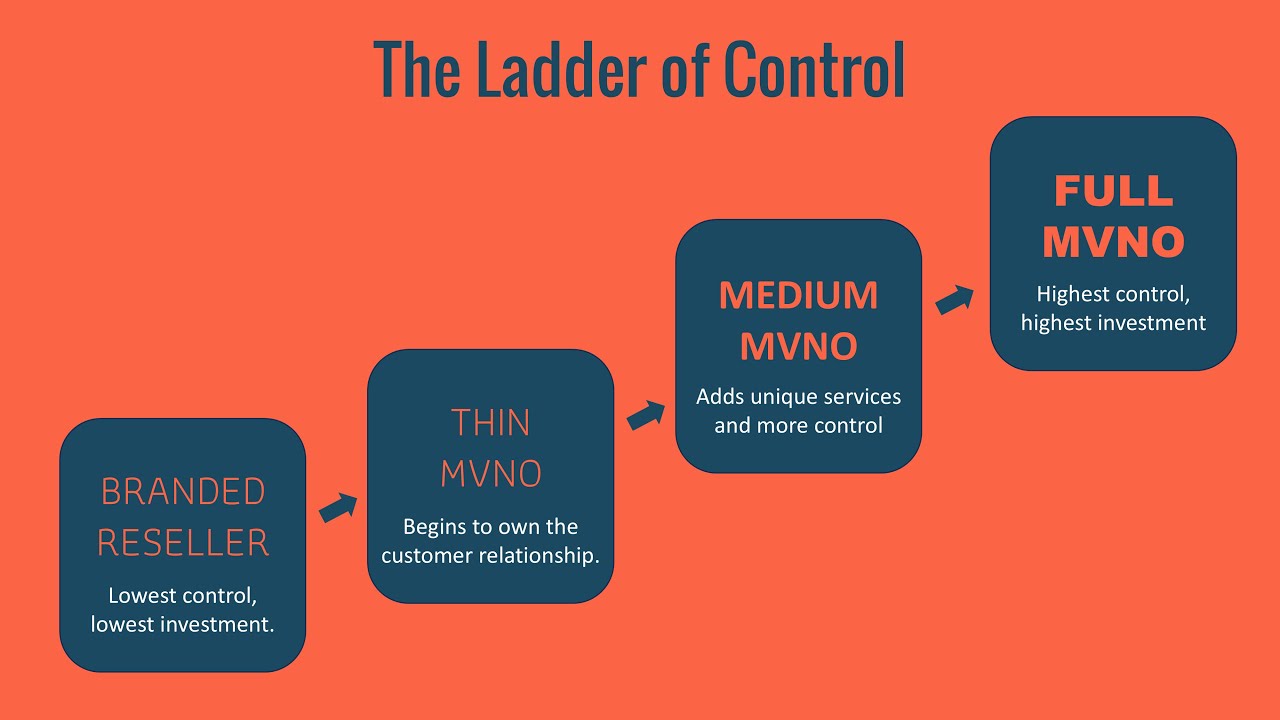
Highest investment, Highest control. A Full MVNO is the most sophisticated and independent type of MVNO. It operates with a high degree of control over its services and subscriber base.
What they do: A Full MVNO maintains its own core network and infrastructure, including essential elements like the Home Location Register (HLR), Packet Data Network Gateway (PWG), and Subscriber Data Management (SDM). They only lease radio access from a host MNO (or a via an MVNA).
Key characteristic: Full control over SIM cards (or eSIMs) and all network flows (voice, SMS, and data). This allows them to build custom services and have complete control over their customer experience.
Example: PosteMobile (Italy).
The full MVNO is responsible for the whole operation, customers, and data, giving it full control over all the services and products it offers in the market, as well as flexibility in designing and deploying new services, either to end-users or for Internet of Things (IoT) / Machine-to-Machine (M2M).
The Full MVNO utilizes its own switching and transmission infrastructure, along with a comprehensive OSS/BSS environment, to manage traffic and operations. This integrated OSS/BSS framework enables the operator to administer numbering resources, customer service, VAS, roaming, SIM and device management, and all other functions required for the provision of mobile services. By leveraging this sophisticated level of integration, the Full MVNO gains significant flexibility when utilizing the capacity and services provided by mobile network operators.
The Full MVNO operates (technically, not business-wise) in a similar way to a mobile network operator, but without a spectrum and radio access network (RAN), which it still wholesale from its host network operator.
The amount of control and ownership over its business, its positioning, branding, marketing, and the partnership an MVNO establishes, and builds with its host operator are key factors for MVNO success.
A Full MVNO delivers longer-term value to the host network operator.
Full MVNO Model - Advantages
- Its own SIM cards
- Own numbering ranges
- Home Location Register (HLR)
- Gateway GPRS Support Node (GGSN)
- Short Message Service Centre (SMSC)
- Multimedia Messaging Service (MMSC)
- Gateway Mobile Switching Centre (GMSC)
- Own roaming and interconnect agreements
- Owning the network-switching infrastructure
- Set tariff bundles and packages independently
- Complete customer ownership and relationship
- Focus on addressing a particular niche or segment
- Upsell own or partner services as value-added services (VAS)
- Access to big data (user usage data) to better address the needs and wants
- Use the MVNO to capture a share in the mobile market and generate telecoms revenues
- Uplift to an existing core business (bundles) and obtain more control and independency from telcos.
Full MVNO Model - Disadvantage
- Heavy cost on OPEX and CAPEX associated with the needed IT platforms.
- Needs a certain level of telecom know-how and understanding.
Full MVNO Model - Operational Model / MVNO Architecture
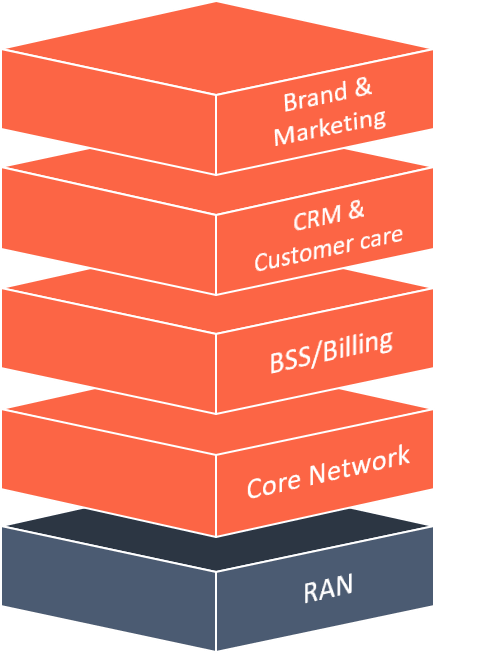
- Responsible for all the whole infrastructure and value chain – except network radio and spectrum
Table: Example of Elements, Functions and their advantage to the Full MVNO
In a Full MVNO stack integration example, the Full MVNO will install Business and Operations Support Systems (BSS/OSS) and Core Elements such as:
- IN (SCP)
- STP/DSC
- HLR/HSS
- SBC
- SMSC/SMS-G
- IVR/VMS
- OSS/BSS
- OCS
- GGSN/PGW
- USSDGW
The host network operator (HNO) is responsible for providing the following network elements:
- Radio Access Network
- MME / SGW / SGSN / GGSN / PGW / PCRF
- MSC / VLR / STP / EIR
- EIR (MNO / MVNO)
- SBC / GMSC
- DRA (DSC)
- Internet (ISP)
- DNS
- Public IPs and NAT
Full MVNO Model - Business Model
- Revenues: from traffic of its own customers and revenues from incoming traffic (Off Net)
- Costs: Wholesale rates, marketing, sales, distribution, OPEX and CAPEX associated to the IT platforms.
- Wholesale rates may vary with the type of Voice/Data/SMS/MMS, e.g., On-Net or Off-Net, National or International (origin/destination).
The Full MVNO can:
- Have their own roaming and interconnect agreements with other mobile network operators.
- Gain deep insights into customer or machine (M2M/IoT) profile.
- Create “stickiness” with customers, where the customer will be under greater control of the MVNO.
- Offer a convergence proposition, where the technical integration is important.
Operating as a Full MVNO provides the MVNO the opportunity to increase its focus on differentiation, segmentation, and customer loyalty.
Full MVNO Model - Regulation
Examples of regulatory decisions regarding “FULL MVNO”
The regulatory approach towards MVNOs differs across markets depending on how open it is to network access. The level of intervention varies from heavy-handed market interference to purely commercial negotiation and creating a more favorable entry setting.
Full MVNO access is mandated by some of the National Regulatory Authorities in EU/EEA member states, with a strong focus placed on the ability for Full MVNOs to be able to:
- Switch between Host MNO networks,
- Rely on multiple host MNOs in parallel,
- Have full commercial autonomy on all retail markets and distribution networks, and;
- Own their customer base, and not be subject to restrictions on changes in their shareholding structure, or selling the wholesale access rights they contractually acquired. In addition, the MNO license conditions provide for;
- Technical non-discrimination in favor of MVNOs on quality of service (QoS), compared to the Host MNO’s own services,
- An explicit right for the Full MVNO to own and operate its own core network and its own interconnections with third party operators, and,
- Reasonable economic conditions, compatible with effective and loyal competition on wholesale and retail markets.
See how the Full MVNO model compares to the Reseller MVNO, Thin MVNO or Medium MVNO model in your MVNO Types & Operational Models.
Additional MVNO Type & Operational Models Information
For a visual deep-dive, watch our video on Thin • Medium • Full – MVNO Types and Operational Models.




LET’S TALK MVNO
If you have any questions, please fill out the form and a member of our team will get in touch with you. We are always open for talks on how we can add value to your MVNO.