
NBTC Public Hearing – A New Low for Regulatory Transparency
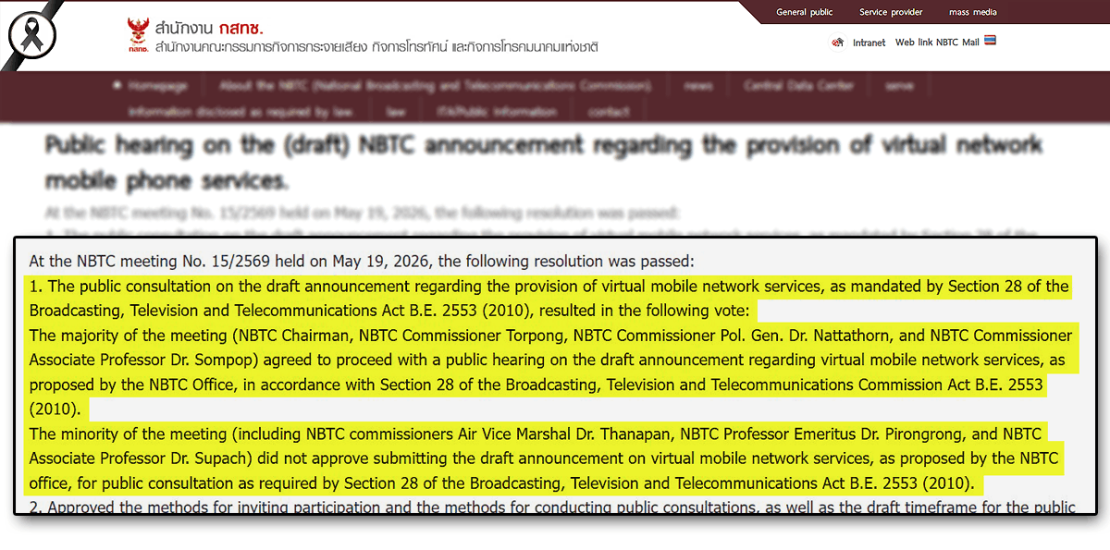
Official NBTC announcement reveals the board’s internal dissent, marking an unprecedented departure from standard procedural transparency.
The announcement from Thailand’s National Broadcasting and Telecommunications Commission (NBTC) regarding the upcoming public hearing on mobile virtual network operator (MVNO) and aggregator (MVNA) services has ignited significant concern, not yet for its regulatory content, but for its unprecedented procedural approach.
The commission has effectively transformed a standard administrative document into a public record of internal institutional conflict by formally documenting the names of dissenting commissioners in an official public notice.
NBTC Public MVNO Hearing - A Staged Departure from Neutrality
This departure from standard practice is stark. Typically, notices for public hearings serve as neutral, procedural tools intended to guide stakeholders through the consultation process.
However, by including a breakdown of the majority and minority votes, the commission has signalled that the draft announcement is not a product of internal consensus but a result of a sharp, unresolved disagreement among its leadership.
This public airing of internal discord is highly irregular for a regulator, as it undermines the image of a unified body and raises questions about the stability of the proposed policies. This is particularly concerning given that the agenda has been postponed or deferred more than 55 times at board meetings over the last several years.
Outdated MVNO Framework
While presented as a fresh push for market reform, the foundational data, technical parameters, and structural rules inside this draft are actually years old. The NBTC is effectively putting forward an old text that has sat frozen during the board’s gridlock, rather than a modernized framework built for today’s market realities.
Furthermore, the NBTC Office (the administrative part of NBTC) has been accused of procedural misconduct in its handling of network access disputes, specifically regarding the classification of cases to avoid mandatory mediation.
Critics, including industry participants and government officials, have pointed to these delays as evidence of a systemic failure to foster competition, suggesting that the “majority” bloc’s actions often prioritize the status quo over enabling new market players.
For industry participants and the public, the lack of transparency regarding the reasons for the minority’s opposition – and the delay in releasing the full meeting minutes – presents a significant challenge.
Without understanding the specific objections raised by the dissenting commissioners, stakeholders and the public are unable to engage fully with the complexities of the draft or the limitations that continue to hinder MVNO and MVNA operations.
This creates an atmosphere of uncertainty, where the regulatory future of mobile virtual services remains caught between competing visions within the commission, rather than being guided by a cohesive policy strategy.
How Internal Splits Undermine Thai Telecom Competition
It is well-known in the public domain that the commission board is deeply split into two distinct camps. This pattern has been evident in several high-profile cases involving market competition versus the two major operators in the country, AIS and True.
Most notably during the voting for or against the merger of True and Dtac, where the commission failed to reach a unified conclusion, ultimately leading to a controversial outcome that effectively reduced the market to a duopoly.
This pattern continued during the latest spectrum auctions where conflicting agendas resulted in delayed bidding procedures and controversial conditions that critics argued favored the two dominant market incumbents over new entrants.
Ultimately, the inclusion of the voting record in the public hearing announcement is viewed by many as a strategic maneuver. By highlighting this divide, the majority bloc, which has been criticized for historic delays in market competition, is effectively controlling the narrative before the official meeting minutes are even published.
This forces stakeholders to navigate not just policy ambiguity, but a regulatory body that has transformed its mandate into a stage for internal power struggles. Ultimately, the NBTC is not regulating the market – it is merely managing its own dysfunction at the expense of competition.