
Regulatory Theatre – Who is Watching the Watchdog?
The faded signage of the NBTC, a reflection of a regulator that has presided over a decade of market decay and the collapse of MVNOs
The recent 2025/2026 performance evaluation of Thailand’s National Broadcasting and Telecommunications Commission (NBTC), should have been a wakeup call for the failing regulator and the Thai digital economy.
But instead, the final report released by the Performance Monitoring and Evaluation Committee (PMEC), is yet another polished brochure.
By ignoring clear evidence of market failure, the PMEC and its consulting partner, Insight Consulting Research, have instead raised a serious question:
Is anyone actually watching the watchdog?
The Auditee is Paying the Auditor
To understand why this oversight failed, we have to look at who the Performance Monitoring and Evaluation Committee (PMEC) in Thailand, or กตป. คณะกรรมการติดตามและประเมินผลการปฏิบัติงาน กสทช, actually is.
While it is marketed as an “Independent Super Board” appointed by the Senate, the reality is very different.
The PMEC is structurally and financially tied to the NBTC, the very agency it is supposed to monitor and evaluate. It does not have its own direct independent budget or staff. Instead, it relies on the NBTC for its funding, its office space, and its administrative support.
In simple terms, the people who are supposed to be monitoring and evaluating the regulator are using the regulator’s budget and desks to do it. This creates a system where this watchdog is just another department within the house.
A Consultant in the NBTC’s Pocket
Because the PMEC should not monitor itself (NBTC) alone, it hires outside help. This is where the firm Insight Consulting Research Co., Ltd. enters the picture.
However, this firm already has a deep business relationship with the NBTC, frequently winning contracts for research and consulting. According to the firm’s own portfolio, they could risk losing a major client.
This creates a conflict of interest and a self-monitoring loop. If Insight Consulting Research produces a report that is negative about the NBTC’s failures, they could risk losing NBTC as their client.
The result is a chain of dependency: The consultant is paid by the PMEC, the PMEC is funded by the NBTC, and the consultant also takes direct payments from the NBTC. In such a system, true independence is impossible.
I Handed Them the Evidence - They Handed Back a Brochure
For years, I have documented the systematic collapse of mobile virtual network operators (MVNO) in the Thai telecommunications sector.
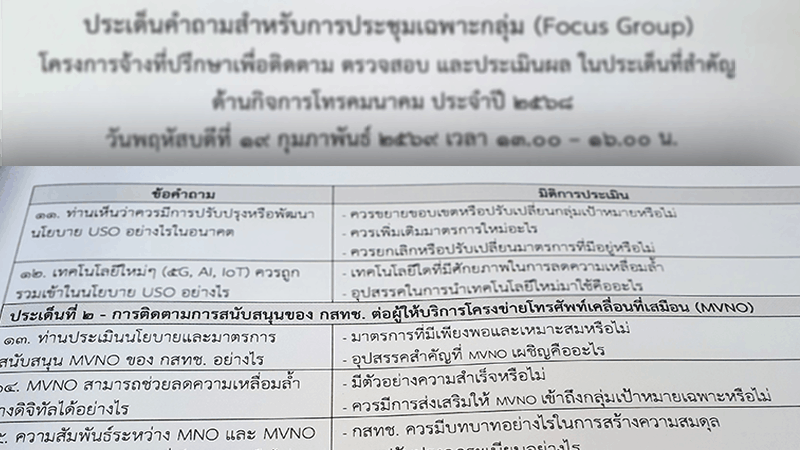
In February 2026, I believed there was finally a chance for accountability. I attended as a MVNA, MVNE, MVNO expert the “Focus Group Seminar for the Telecommunications Sector (2025/2026 Audit Cycle).”

This Focus Group meeting was organized by the PMEC, specifically to gather the data and industry testimony needed for their NBTC performance report.
The primary agenda I addressed was “The Evaluation of NBTC Measures Related to MVNO Services and Market Promotion.” During that session, I spoke directly to the committee members providing them with a range of examples of NBTC’s regulatory failures.
On March 5, 2026, I followed up as promised by delivering a 33-page formal report along with 35 exhibits, to the official email provided for such, at the Focus Group meeting.
On March 9, 2026, I sent the same report and exhibits directly to the PMEC Commissioner for Telecommunications, who was the Chair of the Focus Group meeting.
Yet, in the evaluation released by the PMEC in May 2026, the facts from my report as well as the input from others to the PMEC have been completely ignored.
The Merger Conditions Failure: After the True-DTAC merger, the NBTC was legally required to ensure its own merger conditions of 20% network capacity was reserved for MVNOs. I presented proof that after 1,000 days, there has been 0% actual allocation, and despite MVNO raising dispute cases on such, the regulator has taken no action.
Technical Gaslighting: I exposed how the NBTC Office provided the NBTC Board with factually incorrect definitions, claiming that “Full MVNOs” must own physical antennas and spectrum.
The Black Hole for MVNO Reform: I documented that a critical MVNO reform agenda item has been deferred by the NBTC Board more than 50 times (2 years+).
Market Foreclosure: Showing that the NBTC Board, by authorizing the spectrum auction of NT’s spectrum, effectively killed every remaining MVNO, causing Penguin SIM, Feels Telecom, iKool, Infinity SIM, and Redone, to cease operations by August 2025, and 60+ other MVNO licenses to become worthless.

How to Ignore the Truth with Metrics
Despite receiving this in person at their own focus group and in writing, the final PMEC report contains no mention of these outcomes but only a few weak sentences about MVNOs and mergers. Instead, the committee and its consultant used Regulatory Theatre to hide the truth through three specific tactics.
The report praises the NBTC for having an electronic licensing system, giving them a high score simply because a website exists. This is like a teacher giving an “A” to a student just for bringing a pencil to class, even if they refuse to write.
PMEC praise the existence of a system while totally ignoring the lack of enforcement that keeps the door locked for anyone trying to use it.
Hiding Market Collapse Behind International Labels
The PMEC states that its evaluation used a framework “linked to OECD, ERGA, and ITU standards.” This claim deserves scrutiny because it namedrops prestigious international names and use the word “standards” to hide domestic failures.
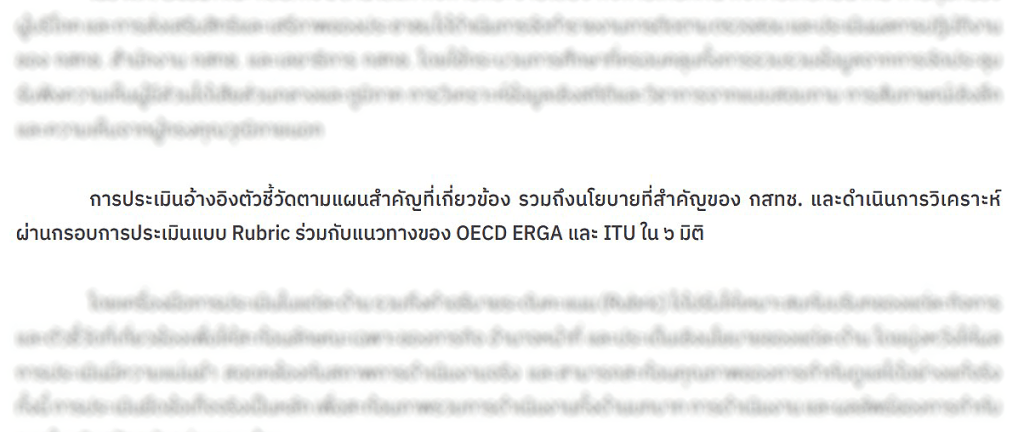
By invoking these names, the committee invites scrutiny under such standards, and that scrutiny is damning.
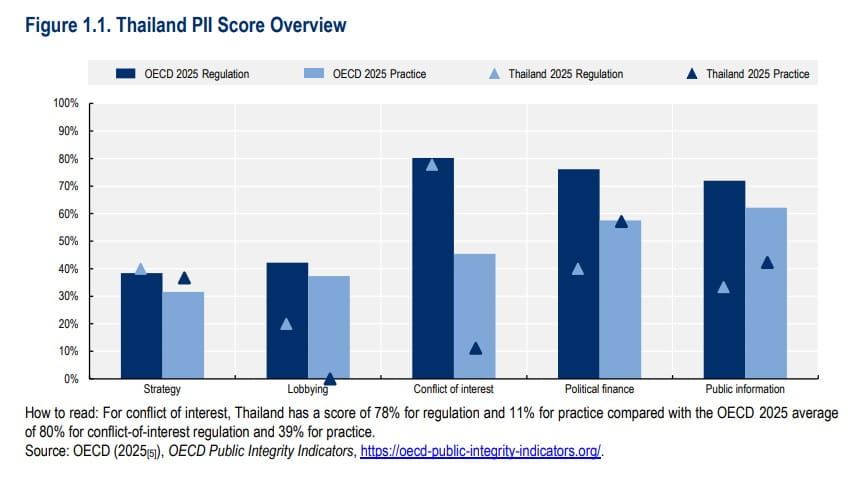
The OECD’s own 2026 report, Advancing Public Integrity in Thailand, reveals a shocking truth about how Thailand handles corruption and Policy Capture.
When looking at the laws for Conflict of Interest, the OECD gave Thailand a high score of 78% for its written rules. This means the laws on paper look excellent. However, when they looked at actual practice – how those laws are used in real life – the score dropped to only 11%.
This means that while the rules exist, they are almost never enforced.
The OECD specifically defines Policy Capture, as a process where public decisions are repeatedly directed away from the public interest toward the interests of a specific group.
Even worse is the score for Lobbying and Undue Influence (when powerful groups secretly influence government decisions). In this category, the OECD found that actual enforcement is 0%
They called this a “critical enforcement vacuum.” This vacuum is like a hole in the law where powerful interests can operate freely without any fear of being stopped. For the PMEC and NBTC, this explains why they can have a relationship while still claiming to follow international standards.
The structure used here, where the auditee (NBTC) effectively funds the auditor (PMEC), and the consultant firm maintains a recurring business relationship with the body being evaluated (NBTC), is a textbook example of this capture.
It is exactly what the OECD is warning Thailand about.
The report also links to European Regulators Group for Audiovisual Media Services (ERGA) standards. ERGA was created to help implement the Audiovisual Media Services Directive (AVMSD), which mandates in Article 30 that regulatory bodies must be “functionally independent” from any other public or private body.
Maintaining a recurring vendor relationship (PMEC) with the subject of the audit (NBTC) is a total departure from this principle of independence.
Finally, while the ITU promotes evidence-based regulation under its G5 framework, the PMEC ignores the outcome focused and market oriented dimensions of that framework.
They use the ITU name to validate administrative processes while ignoring the fact that the MVNO market is currently being closed down.
By using the OECD, ERGA, and ITU to hide domestic failures, the PMEC has created a transparency mirage. They use these international labels not to meet high standards, but to provide cover for a system where the auditee (NBTC) funds the auditor (PMEC), and the enforcement vacuum remains wide open.
The Rubric Trap - Scoring on Efforts, Not Results
The PMEC and its consultant use a scoring system called “Rubrics.” While this sounds technical and objective, the core problem is that this system is self-referential.
A rubric is just a list of criteria, like a checklist, but the PMEC and its consultant designed the Rubric, applied the Rubric, and scored the Rubric themselves.
There is no external validation of whether the scoring criteria are appropriate, whether the weightings are correct, or whether the scores were applied consistently. In a genuine international evaluation, the methodology itself would be subject to peer review or independent validation. Here it was not.
The rubric used in the report is just a checklist designed to give points for effort instead of results.
For example, the NBTC gets a high score for: Holding a meeting on time (Process), Publishing a PDF on a website (Output), Having a dispute system, even if that system never actually helped a single MVNO.
More specifically, the Rubric rewards the existence of regulatory architecture over the performance of that architecture.
A regulator that has a dispute resolution mechanism scores points for having it, regardless of whether it has ever produced a binding decision in favour of a complainant.
A regulator that holds stakeholder consultations scores points for holding them, regardless of whether the input was ever acted upon, which in the case of MVNOs it demonstrably was not.
This is what is called “Regulatory Theatre.” By using a rubric that only counts these small steps, the PMEC can give the NBTC a high grade even when the actual goal, like saving the MVNO market, is a total failure.
The OECD’s 2026 findings warn against exactly this. They found that Thailand is great at “checking boxes” (scoring 78%) but fails at actually changing things (scoring only 11%).
For a regulator chaired by a heart doctor, the irony is thick. The PMEC has effectively graded the surgeon on how neatly they filled out the patient’s chart and checked their pulse-monitoring equipment, while completely ignoring the fact that the patient died on the operating table.
Ten Years of Warning, Zero Years of Action
The MVNO failure is not a new development. In fact, the PMEC has been documenting the NBTC’s failure to address the MVNO sector for a decade with no result.
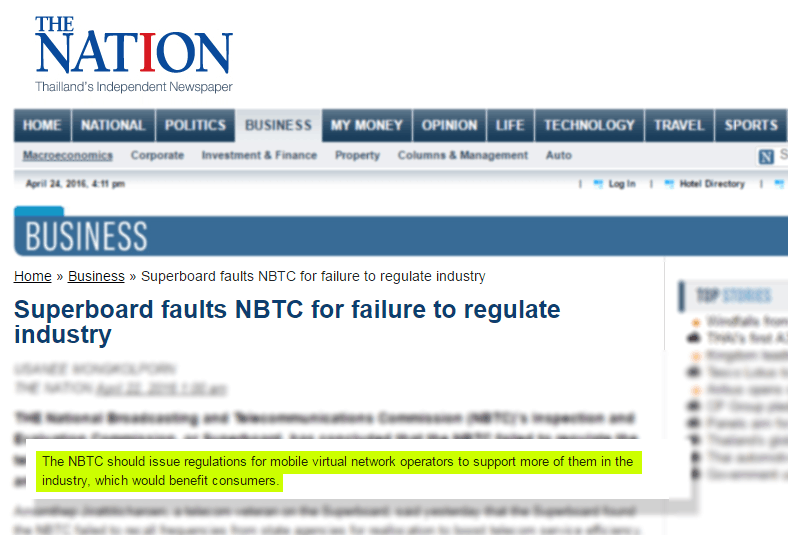
The Key Findings of the 2016 PMEC (“Superboard”) Evaluation stated:
- Failure to Promote Competition: The Superboard concluded that the NBTC failed to foster competition by not supporting new entrants, such as Mobile Virtual Network Operators (MVNOs), in the mobile industry.
- Stagnant MVNO Market: Despite the issuance of 43 MVNO licenses by early 2016, the market was stagnant, with zero new MVNOs launching on the major networks (AIS, DTAC, True).
- Lack of Regulatory Action: The Superboard highlighted a lack of updates and supporting regulations from the NBTC to promote these smaller operators, despite licensing them.
Despite these warnings starting ten years ago, and every year since then, nothing has been done, instead the have just watched on the sideline softly whispering “fire”
A Paper Trail That Leads Nowhere
The most damning part of the PMEC report is that it acknowledges the crisis without naming the cause.
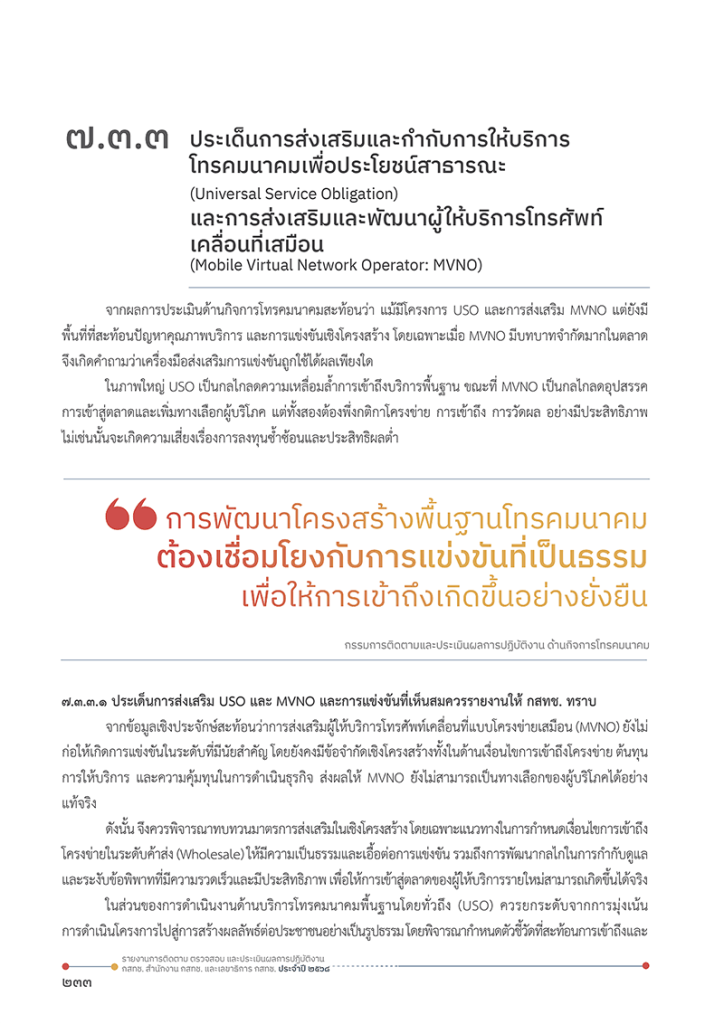
On page 243, the report does mention a few MVNO issues, yet the committee chose to sanitize the actual findings.
The report admits to problems, including a confidence crisis following major mergers and concerns over a duopoly.
It even acknowledges that 57% of the population believes telephone charges have increased.
While these admissions may seem like a benefit, they are intentionally weak.
The report treats these issues as “new concerns to be studied” rather than a multi-year failure to enforce the law.
For example, the PMEC reports on feelings of a crisis while ignoring the mathematical proof, that the mandatory network capacity reservation for MVNOs has resulted in exactly 0% actual allocation, 4,955 days (13 years) since it was introduced, and 1,000+ days since the True-Dtac merger conditions with 20% capacity to MVNOs should have taken effect.
Lawsuits, Scandals, and the NBTC Clown Bus
While the PMEC report focuses on administrative processes, it conveniently glazes over the fact that the NBTC has become a clown bus of institutional scandals.
For years, the agency has operated without a permanent Secretary-General, relying on an acting official while the Chairman reportedly attempted to sign a letter extending that acting role indefinitely. The same Secretary-General who said the True-Dtac merger had delivered on the merger conditions but failed to show the evidence.
The board members are famously locked in legal warfare, suing each other left and right, while the Chairman’s own qualifications have been repeatedly questioned. This is the same board that oversaw the loss of 600 million baht in public funds during the World Cup football broadcasting debacle.
Beyond the internal warfare, a more dangerous form of regulatory sabotage is taking place. Significant power has shifted from the elected Board to the permanent NBTC Office staff. As have been seen in cases, where the Office is now making critical decisions and setting definitions that is the responsibility of the Board.
This bureaucratic takeover ensures that even if the Board wanted to act, they are fed sanitized information, effectively sabotaging the market from within the engine room of the agency. When the leadership is distracted by lawsuits and lack of knowledge and outside input, the NBTC Office is left to run the show without accountability.
Social Media is filled with complaints and the call for the closure of the NBTC. With most posters asking What does the NBTC actually do?
All of this is completely ignored in the PMEC report.
Conclusion: The Audit That Refused to See
The PMEC is required by law to provide a true picture of the NBTC’s performance. By choosing to ignore both testimonies and officially delivered evidence from several sources, they have failed their duty.
They did not monitor or evaluate whether the NBTC enforced its obligations and the outcome. They simply copied and pasted what the NBTC said it would do – but completely ignored that they did not.
Instead they evaluated whether boxes were checked, meetings were held, and PDFs were produced. Process became more important than results. In the end, the PMEC was busy inspecting if an alarm system had been considered while the market itself was on fire.
This ensures that the systemic regulatory failure of the market remains undisturbed while the public and the Senate are kept in the dark.


Latest MVNO News


LET’S TALK MVNO
If you have any questions, please fill out the form and a member of our team will get in touch with you. We are always open for talks on how we can add value to your MVNO.