
MVNO Types & Operational Models

Quick Summary
An MVNO operational model is defined by the ladder of control, a spectrum ranging from a simple Reseller over Thin MVNO, and Medium MVNO to a Full MVNO.
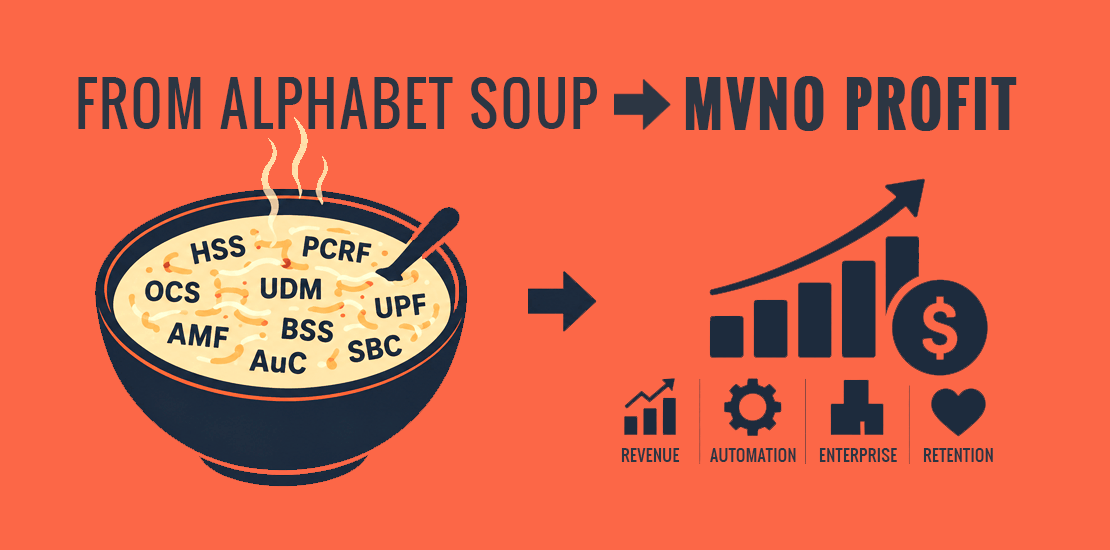
While industry jargon often creates an “alphabet soup” of terms, the market is primarily defined by four distinct operational tiers, each offering different levels of independence, technical responsibility, and revenue opportunity.
The four primary MVNO tiers:
- Branded Reseller: (Reseller MVNO): The most basic model. Focuses exclusively on sales and marketing with no technical control, relying entirely on the host for backend operations.
- Thin MVNO (Service Provider): Manages customer-facing operations and CRM, but delegates core network, radio access, and billing functions to the host.
- Medium MVNO (Enhanced Service Provider): Takes control of BSS/OSS, including billing and rating. This model balances flexibility with infrastructure costs, allowing for independent tariff and bundle design.
- Full MVNO: The most sophisticated tier. Manages its own core network and subscriber data, offering the highest level of control over services, SIMs, and 5G innovation.
Strategic implications:
- Regulatory Impact: As control increases, so do licensing requirements, legal obligations for data retention, and the need for specialized telecom expertise.
- Profitability & Leverage: Operational control correlates directly with revenue.
For the full breakdown—including detailed comparison tables of network functions, revenue market share analysis by model, and the strategic importance of choosing the right tier—read on below.
What are the types of MVNO models - and why is it important?
MVNO types are defined by which of the operational components (Network Functions) the MVNO manages and which one the host network operator manages – indicating the depth of the individual MVNO’s market participation.
Mobile Virtual Network Operators (MVNO), are companies that provide mobile phone services but do not own the wireless network infrastructure over which they operate. Instead, they lease network capacity at wholesale rates from a Mobile Network Operator (MNO) and sell it to their customers.
While all MVNOs follow this core business model, they aren’t all the same. The various types of MVNOs are defined by a crucial factor: the degree of control they have over their operational components. This ranges from simply reselling airtime to managing their own core network.
The Ladder of Investment & Control - Types of MVNOs
If you ever tried to figure this out, you may have come across this wall of jargon: Airtime Reseller, Basic MVNO, Branded Reseller, Digital virtual network operators (DVNOs), Enhanced Service Provider (ESP), Extended MVNO, IMSI MVNO, Full MVNO, Hybrid MVNO, IN MVNO, Medium MVNO, On-brand MVNO, Reseller MVNO, Service Provider MVNO, Thick MVNO, Thin MVNO, etc. – it is an absolute alphabet soup.
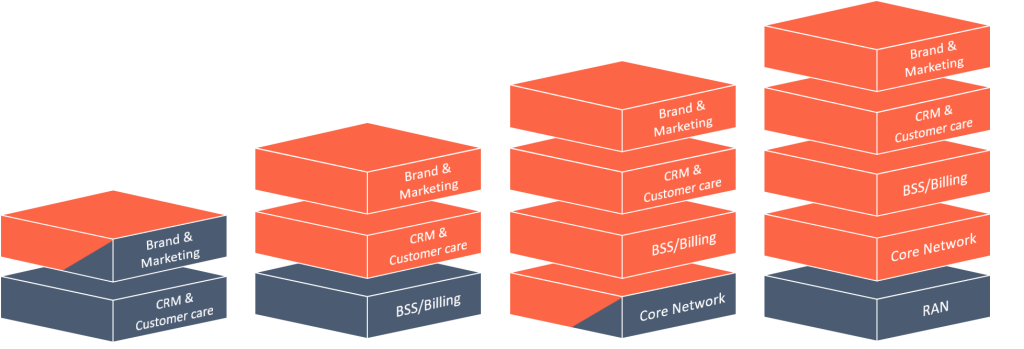
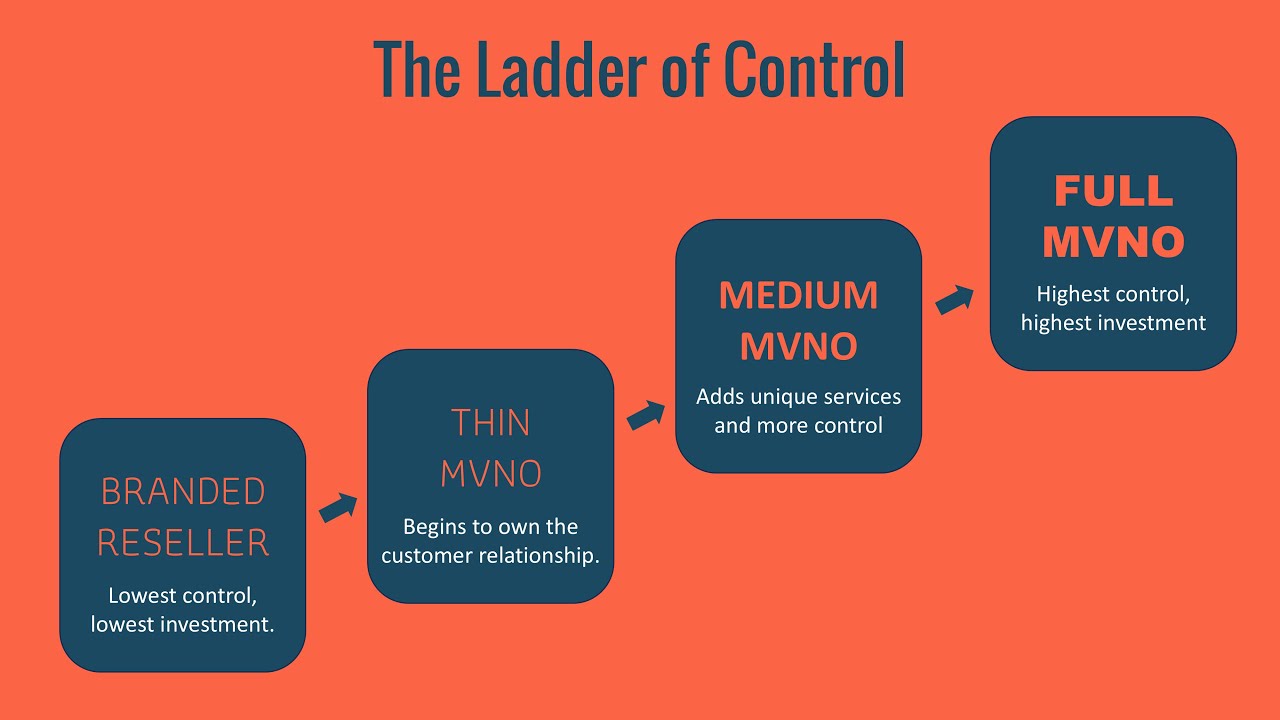
However, we can boil all that complexity down to just four simple steps up a ladder, and use the most common terms for the type of MVNO:
RESELLER MVNO
Lowest investment
Lowest control
THIN MVNO
Begins to own the
customer relationship
MEDIUM MVNO
Adds unique services
and more control
FULL MVNO
Highest investment
Highest control
Why the "Ladder" Metaphor?
European regulators changed how the mobile market works by changing the ladder of investment.
Previously, to enter the market, a company had to buy expensive radio spectrum and build its own cell towers. Regulators realized these requirements were too difficult for new companies to meet, so they removed these steps from the ladder. As shown in image, this created two different paths.
Traditional Mobile Network Operators (MNOs) continue to own and manage the physical network and spectrum.
In contrast, Mobile Virtual Network Operators (MVNOs) are now allowed to enter the market by paying a wholesale fee instead of building their own infrastructure.
This allows new companies to compete by focusing only on the bottom two blocks: IT and customer services, and marketing and customer acquisition. By removing the need to own towers and spectrum, the European Union made it easier for new businesses to enter the market and compete.
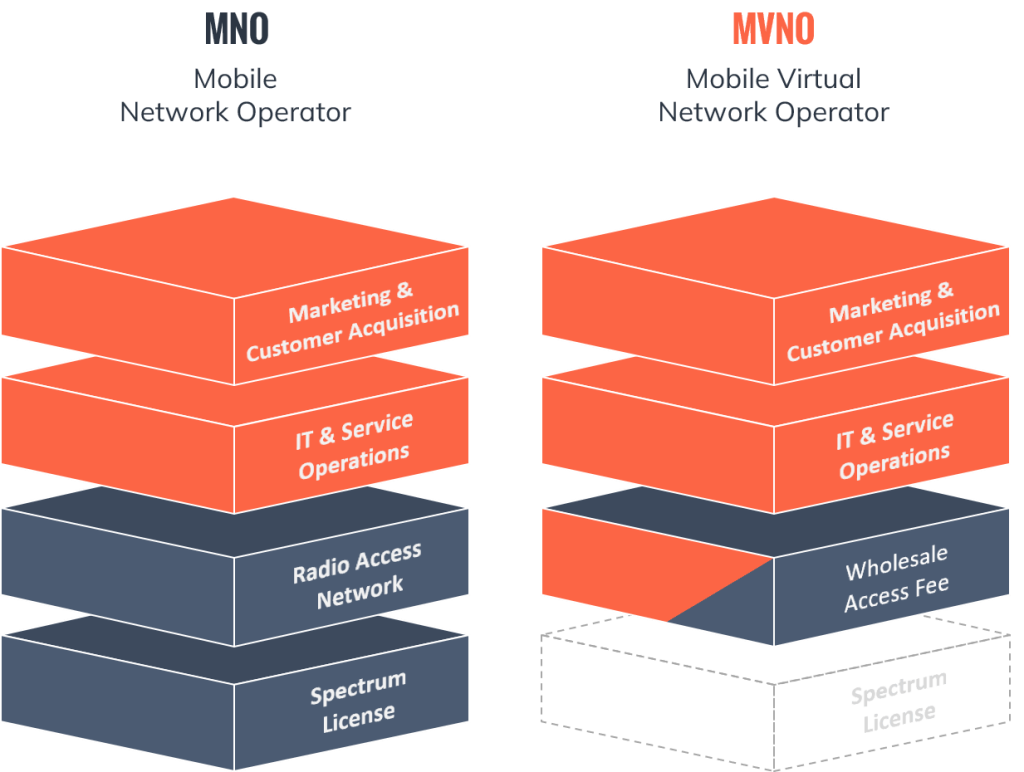
As illustrated, the ladder metaphor helps explain that an MVNO does not need to own the entire stack to be a successful competitor. By taking away the obligation to build the physical network, the EU forced the industry to compete on the “softer” blocks: providing better customer service, more creative pricing, and more flexible IT systems.
Understanding the MVNO Types and Operational Models
What is a Reseller MVNO Model?
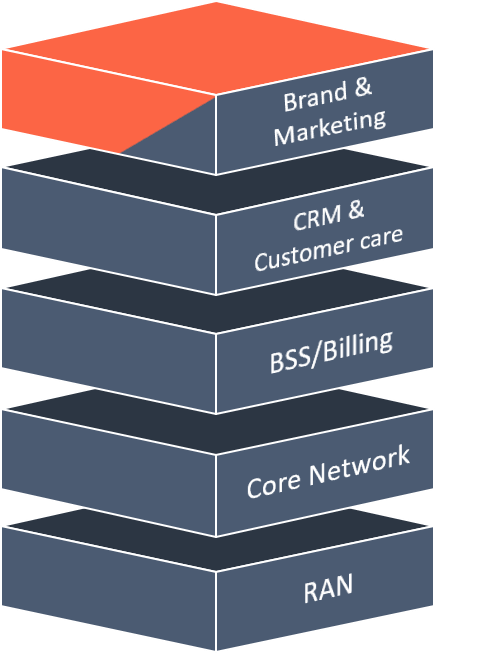
Lowest investment, Lowest control. A Reseller MVNO or Branded Reseller is the most basic and least complex type of MVNO. They focus on sales, marketing, and customer relationships, often leveraging a well-known brand to sell the mobile services. This model requires a low initial investment and has a short time-to-market.
What they do: They acquire pre-defined services and bundles from a host MNO or another provider and resell them under their own brand.
Key characteristic: They have no technical control over the network. They rely entirely on the host provider for billing, customer support, and all network services.
Example: Walmart Family Mobile (U.S.)
At a Glance: Reseller MVNO
What is a Thin MVNO Model?
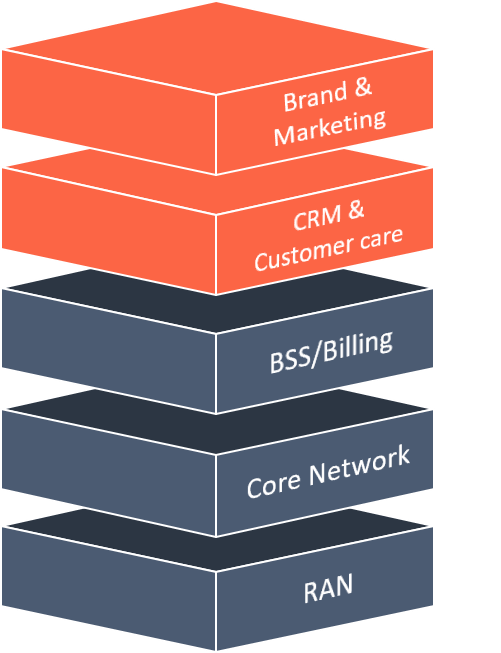
Begins to own the customer relationship. A Thin MVNO or Service Provider MVNO has slightly more control than a Branded Reseller, typically managing its own customer-facing operations. This model allows for more flexibility in defining services and customer plans.
What they do: They manage their own customer service and marketing, but still rely on the host MNO for the core network, radio access, billing, and rating.
Key characteristic: They own the Customer Relationship Management (CRM) but delegate most of the other technical and backend network functions to the MNO or a Mobile Virtual Network Enabler (MVNE).
Example: Google Fi (U.S.)
At a Glance: Thin MVNO
What is a Medium MVNO Model?
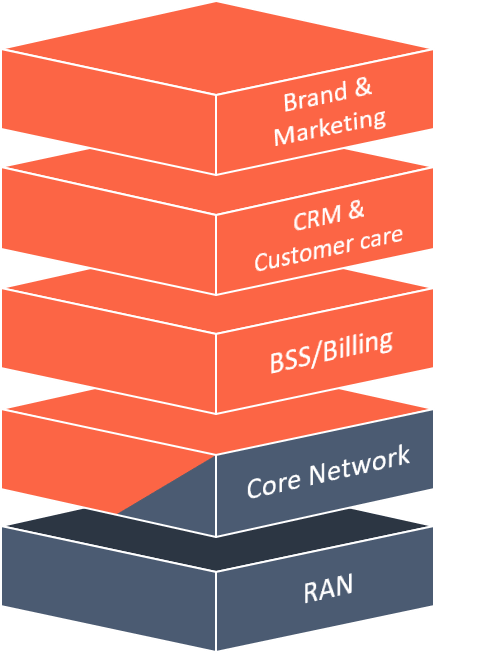
Adds unique services and more control. The Medium MVNO model – or Enhanced Service Provider MVNO – strikes a balance between flexibility and cost. While they still do not own all the core network elements, they take control of their business operations. This allows them to create more customized offerings than a Thin MVNO.
What they do: They own their Business Support Systems (BSS) and Operational Support Systems (OSS), including billing, rating, and customer care. They still purchase core network and radio access from the host network, or via a Mobile Virtual Network Aggregator (MVNA).
Key characteristic: They have full control over their business operations, allowing them to define their own pricing, bundles, and services.
Example: FNB Connect (South Africa).
At a Glance: Medium MVNO
What is a Full MVNO Model?
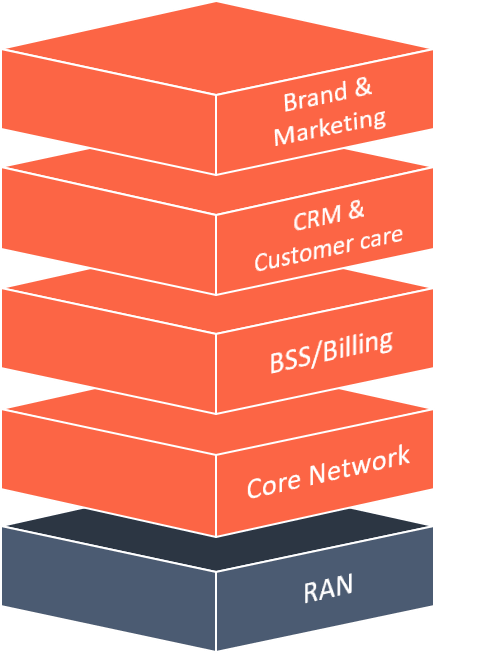
Highest investment, Highest control. A Full MVNO is the most sophisticated and independent type of MVNO. It operates with a high degree of control over its services and subscriber base.
What they do: A Full MVNO maintains its own core network and infrastructure, including essential elements like the Home Location Register (HLR), Packet Data Network Gateway (PWG), and Subscriber Data Management (SDM). They only lease radio access from a host MNO (or a via an MVNA).
Key characteristic: Full control over SIM cards (or eSIMs) and all network flows (voice, SMS, and data). This allows them to build custom services and have complete control over their customer experience.
Example: PosteMobile (Italy).
At a Glance: Full MVNO
What Defines the MVNO Operational Models?
As mentioned, the MVNO type (Reseller, Thin, Medium or Full MVNO), is defined by which of the operational components, network elements, or facilities the MVNO manages, and which one the mobile network operator (or MVNE) manages.
This table summarizes the key operational differences between the four MVNO types and the host MNO.
| Capability / Function | MNO | Reseller | Thin MVNO | Medium MVNO | Full MVNO |
|---|---|---|---|---|---|
| Primary Role | Network Owner | Service Reseller | Service-Based MVNO | Enhanced MVNO | Infrastructure MVNO |
| Investment Level (1 low - 5 High) |
N/A | 1 | 2 | 4 | 5 |
| Operational Complexity (1 low - 5 High) |
N/A | 1 | 2 | 4 | 5 |
| Network Infrastructure | |||||
| Spectrum | Owns & Manages | No | No | No | No |
| Radio Access Network (RAN) | Owns & Manages | Uses MNO | Uses MNO | Uses MNO | Uses MNO |
| Core Network Functions (HLR/HSS, EPC, 5G Core, etc.) |
Owns & Manages | Uses MNO | Uses MNO or MVNE | Partial Ownership | Owns Significant Core Functions |
| Switching Functions | Yes | No | No | Limited | Yes |
| Interconnection | Yes | No | No | Market Dependent | Typically Yes |
| Subscriber Management | |||||
| SIM / eSIM Issuance | Yes | No | Sometimes | Usually Yes | Yes |
| Subscriber Database (HLR/HSS/AuC) |
Yes | No | No | Usually Yes | Yes |
| Numbering Resources | Yes | No | Usually No | Market Dependent | Market Dependent |
| Business Operations | |||||
| Billing & Charging | Owns & Manages | Host Managed | Owns & Manages | Owns & Manages | Owns & Manages |
| CRM & Customer Care | Owns & Manages | Limited | Owns & Manages | Owns & Manages | Owns & Manages |
| Value Added Services (VAS) | Full Control | Limited | Moderate | High | Full Control |
| Sales & Marketing | Owns & Manages | Owns & Manages | Owns & Manages | Owns & Manages | Owns & Manages |
| Typical Wholesale Model | N/A | Retail Minus | Retail Minus / Cost Plus | Cost Plus / Capacity | Capacity / Interconnect |
Note: The exact capabilities associated with Reseller, Thin, Medium, and Full MVNO models vary between jurisdictions. In some markets, these categories are defined by regulation, while in others they are determined through commercial agreements between the MVNO, host MNO, and any MVNA or MVNE involved in service delivery. The table above reflects common industry practice rather than any specific regulatory framework.
Why are the Types of MVNO and MVNO Operational Models Important?
The choice of MVNO operational model is a strategic decision that has two major implications for a the MVNO business: Licensing Requirements and Profitability.
1. Regulatory and Licensing Importance
In some countries, the national regulatory authority grant licenses to operate telecommunication services. The type of license an MVNO needs, and the application process for it, is often determined by the MVNO’s operational model.
- Higher control, more regulation: As an MVNO takes on more responsibility for core network functions (moving from a Reseller to a Full MVNO), the regulatory oversight increases. A Full MVNO, for example, must often apply for a specific telecom license that gives it its own numbering range and allows it to manage subscriber data.
- Lower barriers for entry: A Branded Reseller, on the other hand, often requires no special telecom license because all core services are managed by the host operator. This makes it the easiest and fastest model for a company to enter the mobile market, as it relies on the host’s existing regulatory compliance.
- Legal Compliance: The level of control also determines an MVNO’s legal obligations for things like lawful interception and data retention, which are crucial for security and law enforcement. A Full MVNO must have its own systems in place to handle these legal requirements, while a Reseller defers to the host MNO.
2. Margin and Business Control
The MVNO model directly impacts the profit margin on each subscriber. The more control and components an MVNO owns and manages, the better its bargaining power and potential for higher margins.
- Reseller (Branded Reseller): This model operates on the lowest profit margin because the MVNO has little to no control over the wholesale price. The host operator provides a near-complete service, leaving only a small slice of profit for the reseller’s branding and marketing efforts.
- Full MVNO: In contrast, a Full MVNO has the highest potential for profit. By owning core network elements like its billing and subscriber management systems, the MVNO effectively pays a lower, bulk rate for network access and can manage its own costs. This gives the MVNO the flexibility to create custom, value-added services and pricing plans that increase revenue per user. The host MNO’s costs are also lower since it is providing a less-managed service, which can lead to more favorable wholesale agreements.
- Negotiating Power: The components an MVNO brings to the partnership act as leverage during wholesale agreement negotiations with MNOs. A company that can show it will handle all the billing, customer support, and value-added services is a more attractive partner for an MNO and can secure a better per-unit rate for network access, directly improving its bottom line.
Example: Nigeria's Tier-Based MVNO Framework
As we have established, the national regulators and the industry generally classifies operators according to the degree of operational control they exercise over customer management, service platforms, network functions, and subscriber management.
Internationally, this is most commonly described as a progression from Reseller MVNO, Thin MVNO, Medium MVNO, and Full MVNO.
Nigeria who recently (2024) introduced MVNOs, adopted a different approach by introducing a five-tier MVNO framework (Tier 1–Tier 5).
While several of these tiers broadly correspond to established MVNO operational models, the Nigerian framework places greater emphasis on regulatory permissions, network ownership rights, numbering resources, hosting arrangements, and infrastructure responsibilities.
It is important to note that one element of the Nigerian classification differ from standard practice. Nigeria has licensed Mobile Virtual Network Enablers (MVNE), which is in-correct. MVNEs are regarded as upstream providers that enables MVNOs rather than being in the MVNO categories themselves.
Despite this, the Nigerian model serves as an interesting example of how regulators can adapt MVNO classifications reflecting the industry’s underlying progression from low-control service providers to operators with greater technical and commercial independence, and doing so, actually provide the details of what each Tier can do, and what each Tier cannot do.
The table below summarizes the key differences and details in Nigeria’s five tier framework.
| Capability / Function | Tier 1 S-VNO |
Tier 2 SF-VNO |
Tier 3 CF-VNO |
Tier 4 MVNA/MVNE |
Tier 5 UVNO |
|---|---|---|---|---|---|
| Primary Role | Service-based MVNO | Simple-facilities MVNO | Core-facilities MVNO | Aggregator / Enabler | Unified MVNO |
| Retail Mobile Services | Yes (via Host) | Yes (via Host) | Yes | Limited | Yes |
| Own Brand & Marketing | Yes | Yes | Yes | Yes | Yes |
| Customer Relationship Management (CRM) | Yes | Yes | Yes | Yes | Yes |
| Issue SIM Cards | No | Yes | Yes | Yes | Yes |
| Own HLR / HSS / AuC / EIR | No | Yes | Yes | Yes | Yes |
| Own Billing Platform | No | Yes | Yes | Yes | Yes |
| Own Service Layer Elements | No | Yes | Yes | Yes | Yes |
| Own Switching Infrastructure | No | No | Yes | Yes | Yes |
| Own Interconnection Facilities | No | No | Yes | Yes | Yes |
| Own Numbering Resources | No | No | Possible with Approval | Possible with Approval | Possible with Approval |
| Host Lower-Tier MVNOs | No | No | No | Yes | Yes |
| Operate as MVNA / MVNE | No | No | No | Yes | Yes |
| Direct Interconnection Rights | No | No | Yes | Yes | Yes |
| Own Spectrum | No | No | No | No | No |
| Own Radio Access Network (RAN) | No | No | No | No | No |
| Typical International Equivalent | Reseller / Thin MVNO | Medium MVNO | Full MVNO | MVNE / MVNA | No Direct Equivalent |
Key Observations from the Nigerian Five Tiered MVNO Framework
Tier 1: Closer to a Service Provider than a Traditional MVNO
Tier 1 operators function primarily as service-based MVNOs. They can manage branding, customer relationships, content, and certain value-added services, but remain entirely dependent on a Host Network Operator for numbering, switching, interconnection, and core service delivery. Unlike many Medium or Full MVNO models, Tier 1 operators cannot issue SIMs or operate service-layer network elements.
Tier 2: Introduction of Service Layer Ownership
The most significant step from Tier 1 to Tier 2 is the ability to own service-layer elements such as HLR, HSS, AuC, EIR, billing systems, and SIM management platforms. However, Tier 2 operators still depend on a host for switching, transmission, interconnection, and numbering resources.
Tier 3: The First Tier with Switching and Interconnection Rights
Tier 3 represents the largest increase in operational independence. It is the first tier permitted to own and operate switching and interconnection infrastructure and is therefore the closest equivalent to a traditional Full MVNO. Despite this increased autonomy, Tier 3 operators remain prohibited from owning spectrum or radio access infrastructure.
Tier 4: MVNA and MVNE Functions as a Licensed Tier
One of the more unusual aspects of the Nigerian framework is the creation of a dedicated tier for MVNA and MVNE activities. Rather than treating enablement and aggregation as wholesale support services, the framework incorporates them directly into the MVNO licensing structure. Tier 4 operators may host lower-tier MVNOs and provide shared OSS/BSS platforms, provisioning systems, and other enabling functions.
Tier 5 : A Unified MVNO Concept
Tier 5 has no direct equivalent in most international MVNO markets. It combines capabilities from multiple lower tiers and may operate across retail, hosting, and enablement functions, subject to license conditions and regulatory approval. In practice, it represents the broadest operational scope available under the Nigerian framework.
Why the Nigerian MVNO Framework Matters
While the Nigerian tier structure differs from the traditional Reseller, Thin, Medium, and Full MVNO terminology used elsewhere, the framework is noteworthy because it explicitly defines the network elements, operational responsibilities, and regulatory rights associated with each level of market participation.
Few regulators provide this degree of detail, making the Nigerian model a useful reference for understanding how operational control increases as an MVNO moves up the ladder of investment.
How Does The Type of MVNO Define The Wholesale Revenue Sharing?
In most MVNO markets, the wholesale agreement reflects (or should reflect) which network functions and operational components are provided by the Mobile Network Operator (MNO) and which are provided by the MVNO.
As an MVNO moves up the ladder of investment and assumes more responsibility for additional network elements, billing systems, subscriber management platforms, switching functions, or interconnection facilities, its dependence on the host network decreases. This in return have to result in lower wholesale costs and improved commercial margins.
What makes the Nigerian framework unusual is that the regulator has chosen to explicitly define a wholesale revenue-sharing methodology linked to the MVNO tier structure. Rather than leaving the commercial model entirely to negotiations between the MNO and MVNO, the framework provides guidance on how revenues should be allocated based on the operational responsibilities assumed by each party.
For a detailed explanation of MVNO wholesale pricing models, including revenue share, retail-minus, cost-plus, capacity-based, and the Nigerian model, see our guide to MVNO Wholesale Pricing.
Table: Nigeria’s Tiered MVNO Wholesale Pricing Framework
| MVNO Tier | Network Elements | MVNO Revenue % | MNO Revenue % |
|---|---|---|---|
| Tier 1 | VAS Platform, SMS-C | 25 | 75 |
| Tier 2 | VAS, SMS-C, Billing & Provisioning, IN & HLR | 30 | 70 |
| Tier 3 | VAS, SMS-C, Billing & Provisioning, IN, HLR & Core | 40 | 60 |
| Tier 4 | VAS, SMS-C, Billing & Provisioning, IN, HLR, Core, Transmission Network & Radio Access | 50 | 50 |
| Tier 5 | VAS, SMS-C, Billing & Provisioning, IN, HLR, Core, Transmission Network & Radio Access | 50* | 50* |
Example: When MVNO Operational Models Become Too Broad
Thailand’s MVNO framework illustrates the opposite regulatory approach to the more prescriptive model adopted by regulators such as Nigeria.
The framework from the regulator NBTC classifies operators into categories such as Thin MVNO, Medium MVNO, Full MVNO, and MVNA.
However, the accompanying guidance does not explicitly define the network elements, operational functions, numbering rights, interconnection rights, hosting rights, or wholesale responsibilities associated with each category. Instead, the framework primarily identifies broad classes of network elements without providing detailed regulatory definitions regarding how those elements may be deployed or operated in practice.
As a result, operators are left without a clear understanding of which platforms, systems, and network functions may be implemented under a particular license category. Questions relating to subscriber management platforms, switching functions, service-layer ownership, enablement platforms, numbering resources, and wholesale operations are therefore ultimately to be determined through regulatory interpretation rather than through clearly published rules.
This creates a regulatory elasticity whereby the practical meaning of a license category can evolve through individual regulatory decisions rather than through formal regulatory guidance. In practice, MVNOs and MVNAs may believe that a particular network element or operational model is permitted, only to later discover that the regulator interprets the framework differently.
The issue is further compounded by the fact that the framework continues to rely on a classification model developed during an earlier generation of mobile network architecture. While mobile networks have evolved significantly since the framework was introduced, including the transition to LTE and 5G core architectures, the underlying categorization remains largely unchanged. As a result, many modern network functions and deployment models are not explicitly addressed within the published framework.
Historically, applicants seeking MVNO licenses were required to acknowledge and operate in accordance with this classification framework. However, because the framework does not provide detailed definitions for many operational scenarios, disputes regarding permitted network elements and operational responsibilities have continued to arise.
The practical consequence is that market participants lack regulatory certainty regarding what is permitted under their license until a specific issue is reviewed by the regulator. This creates huge challenges for MVNOs and MVNAs seeking to develop new capabilities, negotiate access arrangements, or invest in infrastructure where the regulatory position is not explicitly documented.
As of June 2026, Thailand continues to license Thin MVNOs, Medium MVNOs, and MVNAs. Although the framework references a Full MVNO category, Full MVNO licenses have not been implemented. The lack of details and a correct framework is one of the main reasons why no MVNAs or MVNOs in Thailand have been able to launch. The host operators ASI and True) are using this elastic to turn down request for access, and the regulator follows.
The difference is therefore not simply the number of MVNO categories you add (Thin, Medium, Full MVNO, MVNA). The more important distinction is whether the regulator clearly defines what those categories mean in operational, technical, and commercial terms. Where those definitions are absent, regulatory certainty may be replaced by regulatory interpretation.
Table: Thailand’s (NBTC) MVNO Framework: Network Element Classification Without Detailed Operational Definitions
| Capability / Network Element | MNO | Full MVNO (N/A) | Medium MVNO | Thin MVNO | MVNA |
|---|---|---|---|---|---|
| License Type | Type 3 | – | Type 1 | Type 1 | Type 1 |
| Spectrum | ✓ | ||||
| 3.1 Switching and Data Network | |||||
| BTS / Node B | ✓ | ||||
| BSC / RNC | ✓ | ||||
| MSC / GMSC | ✓ | ✓ | ✓ | ||
| SGSN | ✓ | ✓ | |||
| GGSN | ✓ | ✓ | ✓ | ||
| 3.2 Subscriber Registered, VAS, Internet Application Platform | |||||
| HLR / AuC / EIR | ✓ | ✓ | ✓ | ||
| Voice Mail | ✓ | ✓ | ✓ | ✓ | |
| SMS | ✓ | ✓ | ✓ | ✓ | |
| VAS | ✓ | ✓ | ✓ | ✓ | |
| IN | ✓ | ✓ | ✓ | ✓ | |
| IP Router | ✓ | ✓ | ✓ | ✓ | |
| SIM Branding | ✓ | ✓ | ✓ | ✓ | |
| 5. Retail Elements | |||||
| Billing | ✓ | ✓ | ✓ | ✓ | ✓ |
| Customer Care | ✓ | ✓ | ✓ | ✓ | ✓ |
| Customer Ownership | ✓ | ✓ | ✓ | ✓ | ✓ |
| Tariff + Product Development | ✓ | ✓ | ✓ | ✓ | ✓ |
| Brand Visibility to End User | ✓ | ✓ | ✓ | ✓ | |
| 6. Business Model | |||||
| Wholesale | ✓ | ✓ | ✓ | ✓ | ✓ |
| Retail | ✓ | ✓ | ✓ | ✓ | |
Although Thin and Reseller MVNOs make up the majority of MVNOs globally, Full MVNOs generate the largest share of total industry revenue.
This reflects a broader industry trend: the greater the operational control an MVNO has, the greater its revenue potential.
Chart: Global MVNO Revenue Share Based on Operational Model (2024)
Full MVNO Revenue
Full MVNOs account for the largest share of global MVNO revenue, despite representing a smaller number of operators overall.
By controlling their own core network systems, subscriber management, pricing, billing, and service delivery, Full MVNOs can create differentiated products and target higher-value customer segments. This level of control typically results in higher average revenue per user (ARPU) and stronger long-term profitability.
Medium MVNO Revenue
Medium MVNOs represent a significant portion of the global market by balancing operational flexibility with lower infrastructure costs.
These operators typically manage their own customer experience, billing, and service platforms while relying on the host MNO for radio access and some core network functions. This allows them to offer more customized services and pricing than Thin MVNOs without the complexity of a Full MVNO.
Thin / Reseller MVNO Revenue
Thin and Reseller MVNOs are the most common MVNO models worldwide due to their low barriers to entry and minimal infrastructure requirements.
However, because they rely heavily on the host Mobile Network Operator (MNO) for technical operations and service delivery, their ability to differentiate services and increase margins is more limited. As a result, they contribute a smaller share of total global MVNO revenue.
Key Market Insights
- Full MVNOs consistently generate the highest share of industry revenue globally.
- Thin and Reseller MVNOs make up the majority of active MVNOs worldwide.
- Medium MVNOs continue to grow in importance, particularly in Asia-Pacific markets.
- Revenue potential generally increases alongside operational control and infrastructure ownership.
What About Sub-brand MVNOs?
Sub-brand MVNOs (also: secondary brands or flanker brands) are secondary brands, owned and controlled by the network operators.
They are economically dependent on the network operators and try to differentiate offers and target groups.
However, in a competitive context, “sub-brand MVNOs” are not be viewed as relevant players because they have no independence from the network operators, and are not in any price or innovation competition with the network operators.
MVNO Types & Models - Frequently Asked Questions
What capabilities does a Medium MVNO gain over a Thin MVNO?
A Medium MVNO (Enhanced Service Provider MVNO) builds upon the capabilities of a Thin MVNO by gaining a few key advantages:
Own Numbering Range/Mobile Network Code: A Medium MVNO can obtain its own numbering range, giving it greater brand presence and potentially more direct control over how its services are identified.
Value-Added Services (VAS) Platform: This type of MVNO can add its own value-added services platform. This allows for greater differentiation from competitors by offering unique applications, data, and content services, which can be used to upsell or enhance the customer experience.
While a Medium MVNO still relies on the MNO for interconnect and IMSI and cannot negotiate its own wholesale interconnection agreements, these added capabilities provide it with more tools for market differentiation and revenue generation compared to a Thin MVNO.
What defines a Full MVNO, and what are its most significant advantages and disadvantages?
A Full MVNO represents the highest level of independence and control for a virtual operator. It is responsible for the entire operation, including customers and data, giving it complete authority over the services and products it offers. While it still leases access to the radio access network (RAN) and spectrum from a host MNO, it owns and operates its own core network infrastructure.
Significant Advantages:
Complete Control: Full MVNOs have full control over their own SIM cards, numbering ranges, Home Location Register (HLR), Gateway GPRS Support Node (GGSN), Short Message Service Centre (SMSC), Multimedia Messaging Service Centre (MMSC), and Gateway Mobile Switching Centre (GMSC).
Independent Roaming and Interconnect: They can negotiate their own roaming and interconnect agreements with other mobile network operators.
Customer Ownership and Customization: Full MVNOs have complete customer ownership and relationship management, allowing them to set their own tariff bundles and packages independently and gain deep insights into customer data for tailored services.
Differentiation and Flexibility: This level of integration provides greater flexibility in designing and deploying new services, offering significant opportunities for differentiation, segmentation, and fostering customer loyalty.
Significant Disadvantages:
High Costs: There are heavy OPEX and CAPEX costs associated with the extensive IT platforms and core network elements required.
Telecom Expertise: Operating as a Full MVNO demands a significant level of telecommunications know-how and understanding.
What core network elements can a Full MVNO own and operate, and why is this advantageous?
A Full MVNO can own and operate a wide range of core network elements, which provides significant advantages in terms of control, flexibility, and service differentiation. These elements include:
Mobile Switching Center (MSC): Controls call routing and generates usage information, allowing for independent wholesale relationships for voice/SMS routing.
Serving GPRS Support Node (SGSN): Handles packet-switched data, mobility management, authentication, and charging functions.
Gateway GPRS Support Node (GGSN): Manages subscriber access to the internet network, enables mapping and internet gateways, and allows for monitoring/controlling data usage.
Home Location Register (HLR): Registers SIM cards, stores subscriber information and privileges, maps internet access points, and enables management of dedicated IMSI series, special number allocation, and activation/deactivation of various services.
5G Core / User Plane Function (5GC/UPF): Separates user data from control data, handles high-bandwidth traffic, enables network slicing, and supports use cases like IoT and VR/AR.
Policy and Charging Rules Function (PCRF): Enforces policies related to data usage and quality of service (QoS), manages service access and billing, and enables granular control over data plans and flexible billing models.
User Data Management (UDM): Stores and manages subscriber data, provides a single source of truth, simplifies subscriber management, and enhances security and privacy.
Operations & Business Support Systems (OSS/BSS): Manages the business side of the network (billing, CRM, service fulfillment), automates operational processes, improves customer service, and provides a unified view of the customer.
Short/Multimedia Message Service Center (SMSC/MMSC): Manages the store-and-forwarding of text and multimedia messages, ensuring reliable delivery and allowing independent control and customization of messaging services and pricing.
Owning these elements grants the Full MVNO the ability to customize services, gain deep customer insights, establish its own roaming and interconnect agreements, and truly differentiate its offerings in the market, providing a level of independence similar to an MNO, albeit without owning the radio access network.
What are the key advantages and disadvantages of a Reseller MVNO model?
Advantages:
Low Startup Costs: Reseller MVNOs require minimal initial investment and have a quick time to market because they don’t need to invest in network infrastructure. The MNO handles most technical aspects.
Core Business Uplift: The MVNO can be leveraged to boost the reseller’s primary business by offering bundled services.
Disadvantages:
Lack of Control: The MNO retains ownership of customers, user data, post-sale interaction, SIMs, and infrastructure. The MNO also sets tariffs and receives revenues from incoming traffic.
Brand Translation Challenges: An existing brand might not translate effectively into the mobile sector.
Limited Industry Expertise: Branded resellers often lack the necessary telecom experience, making it difficult to gain market share without a deep understanding of the mobile industry.
How does a Thin MVNO differ from a Reseller MVNO in terms of ownership and control?
A Thin MVNO (Service Provider MVNO) offers significantly more ownership and control compared to a Reseller MVNO (Branded Reseller).
Customer and SIM Ownership: A Thin MVNO can own its own SIMs and customer relationships, which is not the case for a Reseller MVNO where the MNO retains customer ownership.
Tariff Setting: Thin MVNOs have some ability to set their own tariff bundles and packages, independent of the host network operator’s retail prices. Reseller MVNOs, on the other hand, have tariffs primarily set by the MNO.
Operational Responsibility: Thin MVNOs are responsible for customer care processes, including CRM, support, billing, tariffs, and associated IT platforms (BSS/OSS), incurring their own OPEX and CAPEX. Reseller MVNOs have fewer operational responsibilities, with the MNO handling most core processes.
Despite these differences, a Thin MVNO still does not own the International Mobile Subscriber Identity (IMSI) and has limited control over network routing capabilities, distinguishing it from Medium and Full MVNOs.
Can an MVNO (Thin, Medium, or Full) operate without investing in and owning its own equipment?
Yes, an MVNO, regardless of whether it is a Thin, Medium, or Full MVNO, does not necessarily need to invest in and own all of its own equipment or network elements.
It can partner with an MVNE (Mobile Virtual Network Enabler) to utilize the MVNE’s infrastructure and services. This partnership model allows MVNOs to reduce their capital expenditure (CAPEX) and operational complexity, as the MVNE provides the necessary technical platforms and support systems.
This flexibility is particularly beneficial for MVNOs looking to enter the market with lower upfront investment or those that prefer to focus their resources on marketing, customer acquisition, and service innovation rather than network management.
What is a sub-brand in telecommunications, and how does it differ from other MVNO types?
Sub-brands, also known as secondary or flanker brands, are telecommunications brands that are entirely owned and controlled by network operators. They are economically dependent on these operators and aim to differentiate offers and target specific customer groups.
However, from a competitive standpoint, sub-brand MVNOs are not considered significant players because they lack independence from their network operators and do not engage in price or innovation competition with them.
In contrast, other MVNO types (Reseller, Thin, Medium, and Full) generally operate with a greater degree of independence, even if they still rely on a host network operator for core network access.
While sub-brands are extensions of the network operator’s own offerings, other MVNOs strive to establish their own brand identity, customer base, and service differentiation, sometimes even owning significant portions of their operational infrastructure.
Additional Information on Types of MVNO and Operational Models
For a visual deep-dive, watch our video on Thin • Medium • Full – MVNO Types and Operational Models.
You Can Read the Full Video Transcript Here
Hi, and welcome to Yozzo’s podcast dedicated to empowering mobile virtual network operators with the insights they need to succeed.
This is the place where we break down the complexities of the MVNO ecosystem.
Let’s get started.
So, if you’ve ever used one of those smaller, maybe more niche mobile carriers, you’ve actually been a customer of an MVNO.
That’s a mobile virtual network operator. Now, these are the companies that sell you mobile service, but here’s the kicker. They don’t own a single cell tower. So, how on earth do they do that?
Well, that’s what we’re going to break down.
And you know, if you’ve ever tried to figure this stuff out on your own, you get hit with this just this wall of jargon, right?
Airtime reseller, thick MVNO, thin MVNO, enhanced service provider. It’s an absolute alphabet soup. And honestly, it makes it feel impossible to figure out who’s who and what’s what.
But what if you could boil all that complexity down? What if it was really just four simple steps up a ladder?
That’s exactly what we’re going to do. We’re going to cut through all that noise and give you one simple framework to see how a company goes from just being a brand to a real honest to goodness mobile operator.
And here it is. We’re calling it the ladder of control. It’s pretty straightforward. We’re going to start at the bottom on the first rung with the basic reseller and we’re going to climb all the way to the top to the full MVNO.
And as you’ll see, every step up that ladder means more money. Yeah. But it also means way more control. All right, so let’s get started.
We’re on the very first rung of the ladder, the reseller MVNO. Think of this as the easiest, most common way for a new brand to dip its toes in the mobile world.
A reseller, well, it’s pretty much exactly what it sounds like. Their whole job is to focus on the flashy stuff, the branding, the marketing, the sales. They bring the customers in the door, but everything else, all the technical stuff, the heavy lifting, that’s all handled by the big guy, the host network, what we call the MNO or mobile network operator. So, you can see the appeal, right?
The huge advantage here is that it’s super cheap and incredibly fast to get started. You can launch a mobile brand almost overnight. But, and this is a big butt, the downside is massive. You have basically zero control. The host network owns your customer. They own the SIM card. They own all the user data, and they set the prices. You’re really just a sales front.
I mean, just look at how this breaks down. The reseller, their only job is marketing and sales. That’s it. Everything else you’d associate with a mobile company, billing, customer service, the actual SIM cards, the network itself, that’s all on the host MNO.
It’s a partnership for sure, but it’s a very, very one-sided one.
Okay, time to climb a little higher. We’re moving up to the middle rungs of the ladder. Now, this is where things get interesting. Companies start taking on more responsibility, a little more risk, but in return, they get a whole lot more say in their own future.
We’re talking about thin and medium MVNOs now. And this is where a brand starts to get really serious. You’re not just a sales agent anymore. Now you actually start to own the relationship with your customer.
You manage your own billing and you can even start creating your own unique services that make you stand out from the crowd. And the key word here is control. The MVNO now runs its own CRM. That’s the customer relationship management system. They have their own BSS or billing support system. Having that control is a gamechanger. It means they can set their own prices, create their own data bundles, and maybe most importantly issue their own branded SIM cards.
That’s a huge leap from being a simple reseller. But you know how it goes. With more control comes more responsibility and more cost. The upside is fantastic. You finally own your own customers.
You can build a real brand for a specific community. The downside though, your IT cost just shot way up, both for day-to-day operations and initial investment. And at the end of the day, you’re still relying on the big M for the actual network connection. All right, we’ve climbed all the way to the top. This is the final rung on the ladder.
We’re talking about the full MVNO, the most powerful, most independent a virtual operator can possibly be. Here’s the easiest way to picture this. A full MVNO is basically a traditional mobile network in every single way except one. They don’t own the radio towers. That’s it. They lease access to the towers, but pretty much everything else they own and operate it themselves.
And the perks of being at the top, they are huge. We’re talking complete ownership of the customer, your own blocks of phone numbers, and your own network switching gear. That last one is key.
It means you can negotiate your own roaming deals with other carriers. You get total flexibility and direct access to all that rich, valuable user data. I mean, the technical complexity here is just on another level.
A full MVNO might own and operate more than 15 separate pieces of the core network. all those complicated bits and pieces that make a mobile service actually work.
So, let’s just zoom in on two of the most important ones to really get what that control means. First up, you have the HLR, the home location register. Think of this as the master brain, the central database that keeps track of every single one of your subscribers.
When you own the HLR, you control your own SIM cards and you get to decide exactly what services each customer can access. Another critical piece of the puzzle is the GGSN. Okay, that’s a mouthful, but it’s basically the gateway to the internet for your customers.
It’s the on-ramp. And if you own that gateway, you can see, manage, and control all the data your customers are using. And in today’s world, that is an absolutely critical power to have.
Okay, so we’ve climbed the whole ladder from bottom to top. But you might be wondering, why does this whole system even exist? Why does any of this matter? Well, it turns out this isn’t just a business model.
This ladder is actually a core part of telecom policy around the globe. Yeah, this isn’t just about business plans. Governments are involved. Regulators all over from Europe to Singapore look at MVNOs and see a way to crank up the competition in the mobile market. They actually make rules to encourage new players.
Some places like Canada even give companies a push up the ladder, saying you have to own your own core network to even be considered an MVNO. So, it’s pretty obvious that getting to the top of this ladder gives you a ton of power.
But let’s be real, it’s also insanely expensive and technically complicated. That’s a huge barrier for most companies. But what if there was a kind of cheat code, a shortcut? Well, it turns out there is.
And it’s all thanks to another player in this ecosystem called an MVNE. That stands for Mobile Virtual Network Enabler. And these companies offer a partnership that, to put it simply, completely changes the game. It’s a B2B company and their whole business is basically selling a full MVNO in a box.
They build out all that complex expensive network stuff and then they rent it out to new companies. It lets an MVNO launch with all the power of being at the top of the ladder, but without having to build it all from scratch.
You could say they’re the ones who build the ladder for everyone else.
So, when you put it all together, what you have is this really clear path for new ideas in the mobile world. You’ve got this ladder of control where a company can pick exactly how much they want to invest and how much risk they want to take. And now with these enablers making that climb easier than it’s ever been, it really makes you wonder who’s going to be the next one to use this system to completely shake things up.
And that wraps up another episode of Yozzo’s podcast. If you want to dive deeper into today’s topic, you can find much more resources at yozzo.com. We’ll be back next time with more insights. Until then, keep innovating.

LET’S TALK MVNO
If you have any questions, please fill out the form and a member of our team will get in touch with you. We are always open for talks on how we can add value to your MVNO.
The Three MVNO Models
Building a successful MVNO requires a clear plan in three different areas: MVNO Operational Models, MVNO Business Models, and MVNO Wholesale Models. Industry guides often mix these topics together, which can cause confusion. To succeed, you must treat them as separate parts of your business. This helps you align your technical tools, regulatory requirements, and commercial goals.
MVNO Operational Models
Focus: Technical control and infrastructure ownership
Examples: Reseller, Thin, Medium, Full MVNO
Strategic Goal: Defining operational independence and capability
MVNO Business Models
Focus: Market segment, audience, and value proposition
Examples: Fintech, Lifestyle, Ethnic, M2M/IoT, Retail/Brand
Strategic Goal: Capturing specific customer niches
MVNO Wholesale Models
Focus: Financial structure and cost calculation
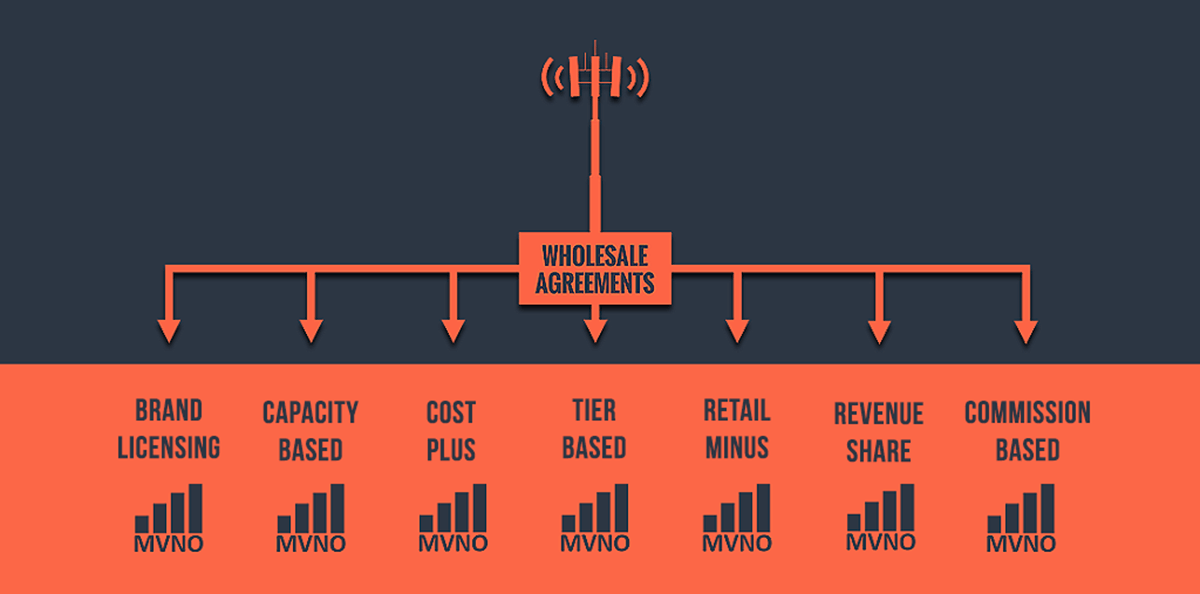
Examples: Retail Minus, Cost Plus, Capacity-Based, Revenue Share
Strategic Goal: Managing margins and wholesale risk
