
Turning MVNO Network Functions Into Profit: A MVNO Business Strategy Guide
Quick Summary
Your MVNO network functions are not just a alphabet soup – they are business assets that directly determine your ability to generate revenue, deliver great customer experiences, reduce operational costs, and win enterprise contracts.
This guide cuts through the acronyms – HSS, OCS, PCF, UPF, UDM and more – and explains what each network function means for your MVNO’s commercial performance, not your engineering team.
Key facts at a glance:
- Every network function impacts one of four outcomes: revenue, customer experience, operational efficiency, or security
- Not every MVNO owns every function – your type of MVNO determines your capabilities
- The more control you have over key functions, the greater your ability to differentiate and grow
- Functions are grouped into four tiers: Revenue Growth, Customer Experience, Enterprise & B2B, and Cost Reduction
- Operators that treat their network as a growth platform outperform those that treat it as a cost center
For the full breakdown — function by function, with real business examples – read on below.
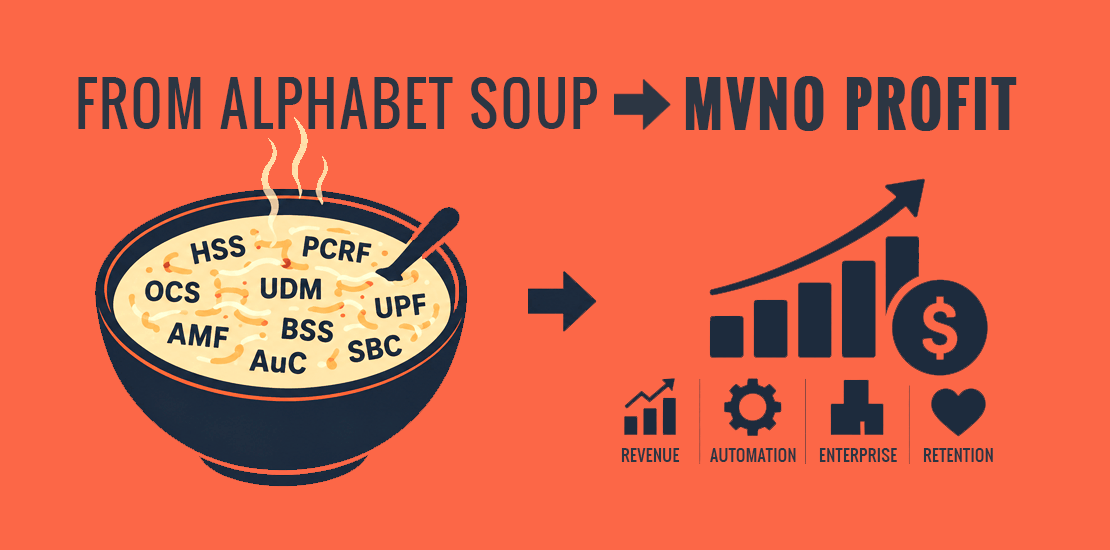
From Alphabet Soup to MVNO Profit
If you’re running or planning to launch an MVNO, you’re probably surrounded by an endless stream of acronyms. Your vendors, network partners, and technical teams talk about HSS, PCRF, AMF, UDM, and dozens of other network functions that can quickly feel like an alphabet soup of complex technology.
Let’s change that perspective. Because your network functions are business assets – not just alphabet soup.
This is not a deep-dive engineering manual explaining how packets move across a network or how signaling protocols work. Instead, this is a business-focused guide designed to help MVNO founders, executives, product managers, and commercial teams understand what these functions actually mean for growth.
Every network function ultimately impacts one or more of four business outcomes:
- Revenue generation
- Customer experience
- Operational efficiency
- Security and risk management
The operators that understand these capabilities often uncover new revenue streams, launch differentiated products faster, reduce operational costs, and win enterprise customers that competitors cannot.
The technology already exists. The question is how you use it.
Not Every MVNO Owns Every Network Function
Depending on your type of MVNO model, you may not directly own or operate all of the MVNO network functions described in this guide.
A Light MVNO may rely heavily on its host MNO or MVNE for core network capabilities, while a Full MVNO typically operates many of these functions directly. In some cases, a full-core MVNE may provide these capabilities as a managed service.
Ownership matters.
The more control you have over key network functions, the greater your ability to differentiate products, automate operations, launch new services, support enterprise customers, and improve margins. Even if a particular function is operated by a partner today, understanding its business impact helps you negotiate stronger agreements and identify opportunities for future growth.
Whether a function sits within your own infrastructure or a partner’s platform, every component below represents a potential lever for growth.
Revenue Growth Functions
These functions directly influence your MVNO’s ability to create new products, monetize usage, and increase average revenue per user (ARPU).
Online Charging System (OCS)
The real-time prepaid charging engine.
Business Benefit
Creates immediate upsell opportunities and real-time monetization.
Example
When a customer reaches 90% of their data allowance, the OCS can trigger an instant offer for a $5 data boost. Instead of creating customer frustration, the event becomes a revenue opportunity.
Short Message Service Center (SMSC)
The messaging delivery platform.
Business Benefit
Generates high-margin A2P messaging revenue.
Example
Banks, fintech companies, healthcare providers, ecommerce platforms, and government agencies all need reliable OTP and notification delivery. Every message becomes billable revenue.
Policy & Charging Rules Function (PCRF)
The 4G policy engine.
Business Benefit
Enables differentiated plans and sponsored-data offerings.
Example
Offer unlimited social media usage while maintaining metered charging for other traffic, creating premium plans that attract specific customer segments.
Policy Control Function (PCF)
The 5G evolution of PCRF.
Business Benefit
Supports dynamic service creation and premium enterprise offerings.
Example
Launch sponsored-data programs where a business pays for customer connectivity within its application.
Session Border Controller (SBC)
Protects and manages voice communications.
Business Benefit
Creates opportunities for hosted voice and business communications services.
Example
Bundle secure VoIP and business telephony services for SMEs looking to replace traditional PBX systems.
User Plane Function (UPF)
The 5G data-forwarding engine.
Business Benefit
Enables private networking, edge services, and premium enterprise connectivity.
Example
Provide private 5G connectivity for logistics providers, factories, healthcare organizations, or smart-city deployments.
Customer Experience Functions
These functions determine how smoothly customers connect, stay connected, and interact with your services.
Home Location Register (HLR)
The legacy subscriber database.
Business Benefit
Supports customer intelligence and service personalization.
Example
Automatically identify roaming users and offer relevant travel bundles upon arrival in a new country.
Home Subscriber Server (HSS)
The 4G subscriber profile manager.
Business Benefit
Automates service activation and provisioning.
Example
A customer purchases a roaming package through self-service and receives immediate access without manual intervention.
Unified Data Management (UDM)
The 5G subscriber intelligence platform.
Business Benefit
Creates a unified customer view.
Example
Support teams gain immediate access to customer history, device information, and service status, improving support quality and upsell opportunities.
Mobility Management Entity (MME)
The 4G mobility controller.
Business Benefit
Reduces service interruptions and customer complaints.
Example
Customers remain connected while travelling at high speed, improving overall network perception.
Access & Mobility Management Function (AMF)
The 5G mobility controller.
Business Benefit
Supports large-scale IoT and high-density device environments.
Example
Manage hundreds of thousands of connected sensors under a long-term enterprise contract.
Gateway Mobile Switching Center (GMSC)
The voice traffic gateway.
Business Benefit
Improves call completion and customer satisfaction.
Example
Reliable call routing ensures business customers never miss important inbound calls.
Enterprise and B2B Growth Functions
These functions often determine whether you can compete for higher-value business customers.
Packet Data Network Gateway (PGW)
The 4G data gateway.
Business Benefit
Enables private corporate connectivity.
Example
Provide secure APN services for law firms, healthcare organizations, logistics operators, or government agencies.
Authentication Server Function (AUSF)
The 5G authentication platform.
Business Benefit
Strengthens enterprise security positioning.
Example
Win contracts requiring advanced security controls and modern authentication frameworks.
User Plane Function (UPF)
The data-forwarding engine of the 5G network.
Business Benefit
Enables edge-computing and supports low-latency enterprise applications.
Example
Enable industrial automation, healthcare monitoring, and mission-critical communications.
Policy Control Function (PCF)
The 5G rule-setter.
Business Benefit
Enables network slicing to sell guaranteed, high-performance bandwidth.
Example
Sell a dedicated, high-speed “network slice” to a sports stadium for their augmented reality app, ensuring it works perfectly even when the stadium is packed, while standard consumer traffic remains on a different slice.
Session Border Controller (SBC)
The voice and video traffic controller.
Business Benefit
Supports professional-grade enterprise communications services.
Example
Provide secure SIP trunking and hosted VoIP to business customers, allowing them to replace their on-premise office phone hardware with a modern, reliable, and mobile-integrated cloud service.
Traffic Detection Function (TDF)
The “content-aware” inspection engine.
Business Benefit
Provides deep analytics for usage-based billing and tiered enterprise service plans.
Example
Offer a Business-Only plan that prioritizes traffic for authorized apps like Microsoft 365, allowing you to charge lower rates for business data while charging standard rates for recreational traffic (Social Media).
Cost Reduction and Automation Functions
These functions help operators scale efficiently without constantly increasing headcount.
Business Support System (BSS)
The commercial operations platform.
Business Benefit
Automates the customer lifecycle.
Example
Launch fully digital eSIM onboarding in under a minute.
Operational Support System (OSS)
The operational management platform.
Business Benefit
Reduces support costs through proactive issue detection.
Example
Automatically identify service issues before customers submit complaints.
Diameter Routing Agent (DRA)
The 4G signaling controller.
Business Benefit
Improves infrastructure efficiency.
Example
Delay expensive network expansion by optimizing signaling traffic.
Service Communication Proxy (SCP)
The 5G service routing layer.
Business Benefit
Improves resilience and uptime.
Example
Automatically reroute traffic when network functions experience failures.
Network Repository Function (NRF)
The 5G service registry.
Business Benefit
Accelerates service deployment.
Example
Reduce integration time when introducing new fraud detection or analytics services.
Offline Charging System (OFCS)
The postpaid charging platform.
Business Benefit
Automates billing and dispute resolution.
Example
Provide accurate usage records that reduce billing disputes and support costs.
Security and Revenue Protection Functions
Revenue lost to fraud is revenue you never recover.
Authentication Center (AuC)
The subscriber authentication platform.
Business Benefit
Protects against SIM fraud and unauthorized access.
Example
Prevent cloned SIMs from generating fraudulent roaming charges.
Equipment Identity Register (EIR)
The device verification database.
Business Benefit
Protects networks and supports device-driven marketing.
Example
Block stolen devices while identifying upgrade opportunities among legacy device users.
Signaling Transfer Point (STP)
Legacy signaling traffic controller.
Business Benefit
Protects service reliability.
Example
Maintain stable network operations during traffic spikes and abnormal signaling events.
Authentication Server Function (AUSF)
The 5G security gatekeeper that validates subscriber identity.
Business Benefit
Provides robust identity verification while maintaining strict access control across all 5G network slices.
Example
Prevent unauthorized network access and SIM-swapping attacks by implementing advanced 5G authentication protocols that meet rigorous industry compliance standards.
Security Edge Protection Proxy (SEPP)
The 5G perimeter security guard for roaming and inter-carrier signaling.
Business Benefit
Prevents external threats from entering the network during inter-carrier roaming exchanges.
Example
Shield your core network from malicious signaling attacks when subscribers travel internationally, ensuring that your network’s traffic remains encrypted and authenticated even when crossing carrier boundaries.
Network Exposure Function (NEF)
The secure API mediation gateway for third-party access.
Business Benefit
Enables safe integration with external applications while maintaining a hardened barrier around sensitive core functions.
Example
Allow enterprise developers to securely access network capabilities such as real-time device location or QoS triggers without giving them direct access to your internal network core, effectively isolating your infrastructure.
Which Functions Matter Most for My MVNO?
Not every network function delivers the same business impact. Prioritize these based on your current growth phase.
Tier 1: Immediate Commercial Impact
- BSS, OCS, SMSC, OSS
- These are the engines of your business. They handle onboarding, real-time monetization, messaging revenue, and operational efficiency. Without these, you cannot acquire or retain customers at scale.
Tier 2: Growth and Differentiation
- PCRF, PCF, SBC, HSS, UDM, TDF
- These functions allow you to move beyond basic connectivity. Use them to create custom data plans, implement usage-based billing, and deliver premium voice and video services that your competitors cannot easily replicate.
Tier 3: Enterprise and Advanced 5G Monetization
- UPF, AMF, NRF, NEF
- These are your “scaling” functions. As you transition into private networking, IoT, and high-value enterprise contracts, these allow for specialized service deployment and secure, low-latency performance.
Tier 4: Security and Infrastructure Integrity
- AUSF, SEPP, EIR, STP
- These are your defensive layers. In an increasingly hostile digital environment, these functions protect your reputation, prevent revenue-draining fraud, and satisfy the rigorous compliance requirements demanded by high-value enterprise and government clients.
Your Network Is Your Roadmap
If there is one takeaway from this guide, it is this:
Your network infrastructure is not simply a collection of technical components keeping the lights on. It is a collection of business assets that determine how quickly you can innovate, how efficiently you can operate, and how effectively you can compete.
The next time a vendor, engineer, or partner discusses HSS, OCS, PCF, UPF, or UDM, don’t ask whether the technology is working. Ask what business outcome it enables.
The operators that view their network as a growth platform rather than a cost center are the ones that create new revenue streams, win enterprise contracts, and build customer experiences that are difficult to leave.
The technology is already there. Now it’s time to put it to work.
Evaluating Your MVNO Technology Strategy?
The difference between a basic MVNO and a highly profitable MVNO often comes down to control. Understanding which network functions you need today – and which capabilities you may want to own tomorrow – can significantly impact your ability to launch new products, automate operations, support enterprise customers, and increase margins.
Whether you’re evaluating an MVNO in a Box, a dedicated MVNE integration, or a Full MVNO architecture, having the right technology roadmap is essential for long-term growth.
If you are currently assessing your MVNO strategy, explore our MVNO Consulting Services or learn more about our MVNO Feasibility & Business Planning service.
